
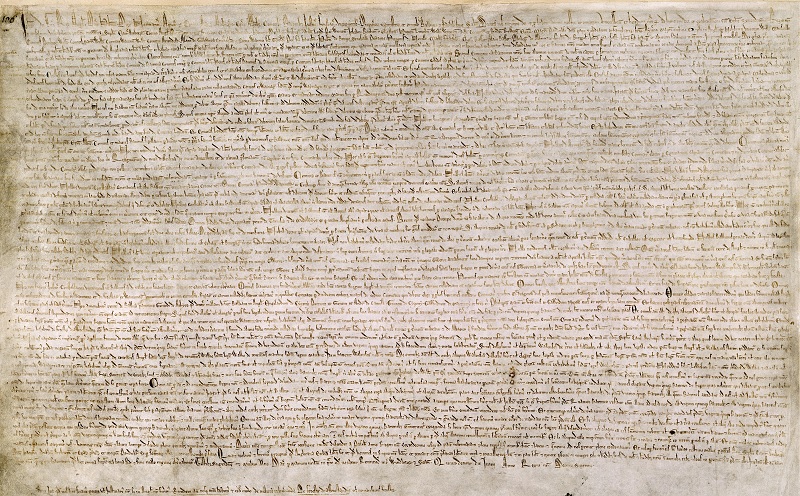
Clause 50
“We will remove entirely the kinsmen of Gerard d’Athée from their bailiwicks, so that in future they may hold no bailiwick in England. We will remove from the kingdom all foreign knights who have come to the detriment of the kingdom.”
Magna Carta, 1215
English rights for English barons:
That was the cry at liberty’s birth –
And though they’d gag at the thought, would the barons,
Their rights would trickle down to the serfs.
Slowly, slowly, and bloody hard-won,
Till the days of the tyrant-kings were done.
But nothing but exile for Gerard d’Athée,
Farewell to Engelard, can’t let you stay,
Goodbye to Guy, and to Guy, too-da-loo,
Au revoir, Peter, and Andrew, adieu,
And Geoffrey and Geoffrey, your fate is the same:
Deported by charter in liberty’s name.
And Philip (and brothers), return to your sires,
Ex-Sheriff of Derby- and Nottingham- shires.
So there it was: the English disease:
Scraping-up some scapegoats for their sleeping in our bed.
But never for a moment did we get up off our knees
To kick out at the barons – so we kicked the French instead.
This lack of disquiet from locals is telling:
Just tugging at forelocks instead of rebelling.
But surely things have improved ?
It isn’t as though the world hasn’t moved:
It started a wave that has kept rolling on,
So we’ve far more rights now than had even King John.
But all the un-English may find us less caring,
For English-born freedoms were not made for sharing.
So tell, Magna Carta: just what are you for ?,
But a thing to suspend when we’re neck-deep in war.
The quote above is actually elided from half of clauses 50 (which does indeed go on to name nine individuals as well as two additional sets of ‘brothers’), and also part of clause 51 which continues the thought – although in the original, the clauses were not infact numbered. The first to do so was George Ferrers’ English translation of 1534, while the modern numbering dates from William Blackstone in 1759.

 Rhyming Couplets