Hippocalypse

horses
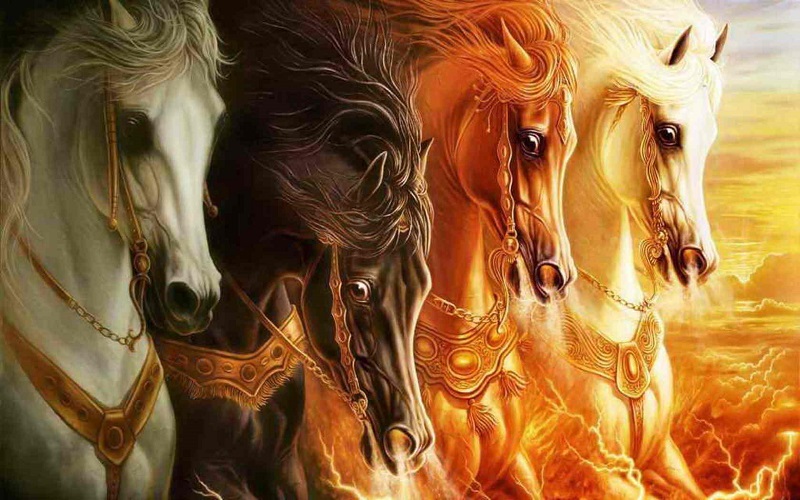
The Horses of the Apocalypse by Sharlene Lindskog-Osorio

Hippocalypse

Now that the herd is in the barn,
And now that the flock is in the fold,
Then huddle close and I’ll spin you a yarn,
The one my father told.
And he was taught by his in turn,
And he by his, the self-same airs
That someday your own kids will learn
When you tell them, and they tell theirs.

Sometimes, late at night,
Out on the plains, or on the road,
When the bats are in full flight
To the singing of the toad,
There can be heard the gallop
Of a lonely charger wild,
Through the ups of York and Salop
And the downs of Kent and Fylde

There’s those who claim they’ve seen him,
And they claim he rides a grey,
A snow-white grey so gleaming
That the very stars give way.
A king, they say, with bow and crown,
And horseshoes of cold steel –
And ev’rywhere those hooves stomp down,
The people come to heel.

Though some say he’s not invading
Through our castles, towns and huts,
But rather the land he’s raiding
Is our throats, and veins, and guts –
Riding, riding, ever onwards,
There is no defence –
Though some may call him Conquest,
And others Pestilence.

But many will say No!, he rides a chestnut
When he roams abroad,
And he wears a shining breastplate,
And he holds a tempered sword –
And he is War, yet not invasion,
But one folk upon another,
Year-on-year, at any provocation,
Brother killing brother.

But fighting is fighting, and always near
To the likes of us who are called-on to bleed,
And arrow or sword, it’s the same old fear
When facing-down the next stampede.
Or maybe a few who see this horseman
Get to then escape to tell –
Yet whether Mongol, Moor, or Norseman,
All those roads lead straight to Hell.

Still, I have also heard it told by folks
That the horse is jettest black,
And gaunt enough that each rib pokes,
With scarcely strength for saddle or pack –
But its passenger can’t weigh much, at least,
He’s spindly as his balancing scales –
Clearly the lord of the Famine, not feast
As he measures-out losses from frosts and gales.

Then others say his is the best-fed mount
In any town it passes,
Glossy as the fur-coat of a count,
‘Gainst their threadbare nags and asses.
And the dirt where its hoofprints have trodden is barren now,
The only thing growing is the drought –
The fields are always so shy of the plough
When Famine goes riding out.

Yet the final vision of our phantom knight
Is the strangest of all they claim have seen,
When robed in black, or robed in white,
On a pale steed – dun, or maybe green.
Some say a skeleton, lacking flesh,
And what does he carry ?  An hourglass of time ?
A downturned torch, or a flail to thresh ?
Or a sickle to scythe the stalks in their prime ?

And they give him a name, they call him Death.
But surely all these versions are that –
So death by what ?  From a poisoned breath ?,
Or the slurry from the mines, or rancid fat ?
Maybe our souls aren’t chaff to the miller,
But the smoke in the lung and the acid on the stone –
Pollution, that’s the next big killer –
And surely worth a horse of its own.

So light all the candles and ring all the bells,
To ward off the Silent Divider,
And warn them in Wigan and Walsall and Wells
Of the grizzled new face of the Rider.
From Wetherby weavers to Tintagel tin,
From the tar-pits of Derby to Sunderland soot,
So each time we breathe we invite the rogue in
And his fingers leave shadows wherever they’re put.

Then listen, my children, listen for his hoofbeat,
Listen as he slowly yet surely destroys
By dogging the trudging of your own two feet
In the choke and the grime and the constant noise.
His other visions are horrors of our past,
But it’s in our future that we all must die –
And the fourth of the horsemen will take us at the last,
As he kicks up the dust as he’s riding-by.

I suppose Pollution should cover the mass-deaths by human-caused tragedies, while Pestilence cover those from other living things while Famine has the natural disasters gig.  This would mean that a plague of locusts is definitely one for Pestilence, while Famine would deal with meteor impacts.  But don’t even get me started on green horses...
Damnatio ad Bestias

is that aslan about to polish them off
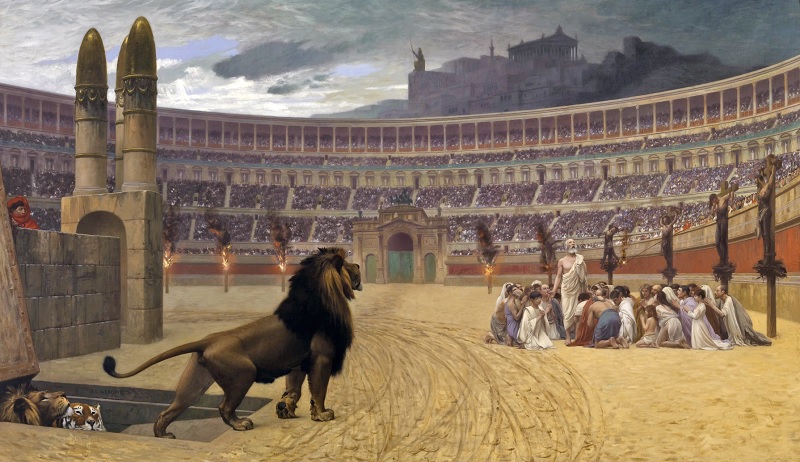
The Christian Martyrs’ Last Prayer by Jean-Léon Gérôme

Damnatio ad Bestias

The lions weren’t alone in the Colosseum
To kill the priests –
Not that there were none,
But the Romans also had their fun
With boars, and bulls, and dogs, especially dogs,
To be the beasts.
Their moment was the lunchtime lull
When public executions filled the interval –
And some, I guess, were Christians,
Making up the Lions’ feasts.

Of course, a Colosseum death
Was for the criminals –
And Christians weren’t that often used
To feed the animals.
Persecution was rarer than lions –
It happened, but only in spurts.
But how to vilify Roman indiff’rence
And un-martyred lack-of-hurts ?
We needed far more dramatic saints,
So unleash the lions and uncork the paints !

Barrow Bird

what a star
European Starling (Sturnus vulgaris) by hape662

Barrow Bird

I saw a bird in town today,
Pecking round the outdoor cafe tables –
Plucking up the crumbs astray,
Then flitting off to perch atop the gables.
I only saw a smidgeon,
Of a flash of green upon the fowl –
So not the usual pigeon,
Nor a bully blackbird on the prowl.
I thought I saw some speckles,
But it surely couldn’t be a thrush ?
I’d wager seven shekels
That they’d never brave this market crush.

So, it’s not a mavis, then –
Too small and bright for crow or rook, I’d say,
Too big for sparrow or a wren,
And far too dark for chaffinch or a jay.
A parakeet ?  Baloney !
And even I know magpies from a robin !
That leaves the starling only –
But then, just where were all the others mobbing ?
I sacrificed a sandwich prawn
To tempt it down, my enigmatic bird –
And yes, it took my proffered pawn
And yes !, a starling straggled from the herd.

Don’t you have meadows to pirouette over ?
Don’t you have siblings all missing their rover ?
Are you an orphan, or outcast, or rebel
They taught to caw bass, but who wants to sing treble ?
Or are you a mute who can
not hold a ditty,
Now seeking your fortune within the big city ?
I’m much the same, really, I came for the glory –
So here, have a peanut, and tell me your story.

The Green & The Red

shepherds' warning
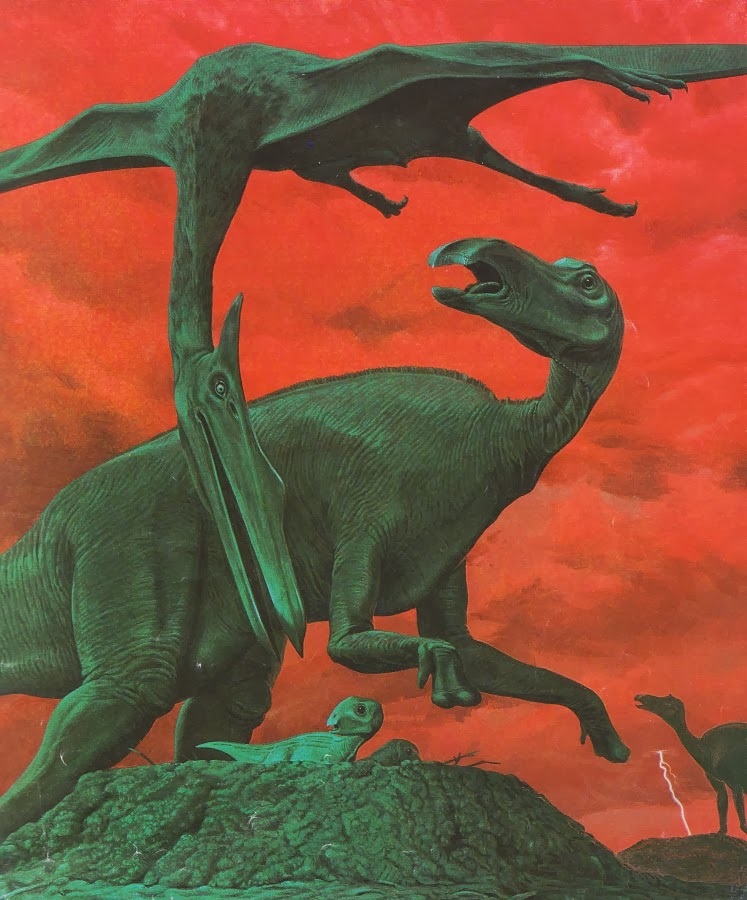
Maiasaura & Azhdarchid by Wayne Barlowe

The Green & The Red

To comment that Nature is always in balance
Is viewing it just in the shortest of terms –
Infact, as the countless extinctions all show
How the strong will go on, and the weak will just go.
For Nature exploits with its various talents,
From predator apex to parasite worms,
With no thought for planning or smoothing-out quirks –
And the law of the jungle is ‘whatever works’.

Like the tusks of a babirusa
Or a peacock’s sexy tail,
Nature will often fail through greed –
And as for the losers, let them all bleed !


From ancient bacteria breathing out oxygen,
Right upto elephants knocking down trees,
They do it regardless, they live for today –
And the balance keep shifting, and life finds a way.
So don’t think of Nature as perfection’s proxy
When plague-rats are swarming with some new disease –
For humans could not be more nat’ral, in truth,
When Nature is selfish and red in the tooth.

Like the cheetah and gazelle,
It’s an arms race to the bottom
The tree of life is rotten through
With its endless fascination for the new.


But warnings are warnings – why must we resist them ?
We still haven’t learned not to piss in the wadis –
We poison ourselves when we poison our neighbours –
The stables need cleaning, but nobody labours.
And sure, we are smart, but we’re part of the system –
For just as our thoughts are a part of our bodies,
So bodies are Nature, and Nature is us –
As perfectly nat’ral as cancer and pus.

Like the lemmings booming and busting,
There’s too many of us, however clever
But Nature’s balance is never still –
And if we can’t fix it, other life will.

Cocky & Fishy

candirus

Cocky & Fishy

Candirus – do they ?
No.  They don’t.
Firstly they can’t,
And second, they won’t.
They parasite gills –
Not penises, ever.
They’d suffocate up there –
That wouldn’t be clever.

They don’t swim up pee-streams
(Even if laminar),
Cos fluid dynamics
Need far too much stamina.
They haven’t a tool
To wedge your tool wide,
Nor have they the strength
To push-up inside.

So next time you’re spreading
A rumour or two
That deep down you desp’rately
Want to be true,
When pissing on truth
Cos it pleases your gut –
Recall the candirus
And keep your hole shut.

Longhold Tenancy

6 cats

Longhold Tenancy

A neighbour, it was, who alerted us,
Alerted himself by the muffles within –
Apologising for making a fuss,
“I’m no busybody, and she’s hardly kin,
That’s why it took me this long to call –
If only I knew my neighbours at all.”

I worked for the landlord’s agent, so
I grabbed my coat and signed-out keys
And hopped on a passing 220
To Fulham, above the Cantonese,
Lift not working, second floor,
With a gentle tap upon the door –

No reply, except some mewing –
So I rapped again, then risked the lock,
Announcing myself and what I was doing –
A sudden guest can be quite a shock.
Nobody home (though the stench was strong) –
It turned out I was very wrong.

She sat upon her sofa, asleep,
With two cats guarding her, agitated,
The kitchen another three cats deep,
And a sixth who snuck in while I waited,
Calico, Siamese, blacks and tawny,
Most of them hissing, all of them scrawny.

I knelt down beside the tenant then,
Gently touched the back of her hand –
The coldness a jolt, but I touched her agen,
And all I could think of was all I’d got planned
For that afternoon – all now postponed,
While windows were opened and constables phoned.

The cats were making ev’rything harder,
They’d made a mess, and were clearly starving –
I found some tins of food in the larder,
The way they fell upon it was jarring.
Flies aplenty upon the ceilings,
I fought down all my nauseous feelings.

The undertakers had taken her
By six, so careful and so unblinking.
I stayed away in the kitchen, shaken,
Stroking the cats to stop from thinking.
The PCs left the place to me,
The neighbour popped-in with a cup of tea.

“I don’t think she had family, really,
Kept herself alone, poor mite,
Except her cats, she loved them dearly –
What’ll become of them, tonight ?”
I scooped one up to work her charms,
Into his unexpecting arms.

Another neighbour took another,
I badgered the landlord to take a brace,
And one to my less-than-happy mother,
And as for the last, she’s at my place –
This job, right down to its chromosomes,
Is all about providing homes.

Swimming Head

sunfish
A Mola mola Relaxes… by Paul Nicklen

Swimming Head

The Ocean Sunfish, Mola mola –
Why the adjective at all ?
Why the need for double mola ?
Is it cos they’re so un-small ?
Just a puffed-up pufferfish,
And over-named to double-check –
It moons around encumbered
By this millstone round its neck.
And yet, it turns out, other sunfish
Share the genus and the name –
And even unrelated fish
Are rashly called the same.
So fair enough, the ocean kind
Is thusly dubbed to be precise.
And as for mola-of-the-Mola –
It’s so good, they named it twice.

Exit the Dragon

St George 2
Saint George & The Dragon by Paolo Uccelo

Exit the Dragon

Once were dragons, so they say,
In ancient times on ancient hills,
In red and gold and green and grey,
And some with teeth, and some with bills.
They say they slept in riverbeds,
Or lived in caves beneath the bats,
And some were spawned with seven heads,
And some would flock as thick as gnats.

Here be dragons, once-a-time,
Their shrieks were oft upon the breeze,
They flew where only geese could climb,
And nested in the tallest trees.
Their breath was hot, their blood was cold,
Their snorts would burst in fiery jets.
They snatched the sheep from out the fold,
And plucked the fish from out the nets.

Here were dragons, hereabouts,
With glossy coats of chequered scales,
And some with whiskers on their snouts,
And some with manes and feathered tails.
Dragons !  Dragons, ev’rywhere !
A horde of wyverns, so it’s said.
But none was safe within its lair
From he who bore the Cross of Red.

Good old George – he fills the aisles
As England’s saviour, brave and true.
We love to hear his quests and trials,
The wily beasts he stalked and slew.
He chased the wyrm from out these Isles –
But how I wish he’d spared a few !
If folks can live with crocodiles,
They could have lived with dragons, too.

Asterisks

six !
Six Legged Knobbly Starfish by StormFall

Asterisks

To my mind, at least,
For all their charms,
A starfish only has five arms –
Or fewer, I guess – the occasional fours –
Those species (or mutants ?) from stranger shores.
And then there are those that have been in the wars,
And still clearly lack what they’ve yet to grow back.
But more than five, at least to me,
Must clearly be a sea-star, see ?
Now, I have no idea how far or near they are,
The -fish and -star –
If species with x-number limbs displayed
Are brothers-in-arms within a clade ?-
Or whether an extra arm or three
Is all within the family ?
But since the urchins are based on fives,
And brittles and dollars and cucumbers too,
It does seem like the higher numbers are the lives with something new.

But when you tell me not to call them
(Any of them) as starfish,
I’m sorry, I cannot grant your wish.
You claim that they ain’t fish in fact,
They broke off from the stem before
The backbone got I on the act.
But what the hell ?  There’s plenty more,
Like jelly-, silver- and shell-fish by the score,
Which are even further from the core !
The word is Anglo-Saxon
And it simply meant a creature from the sea,
But now you claim the taxon
Is whatever you decide that it must be.
And then you say that we are fish as well,
It’s in our genes, you tell –
Well yes, but then the fishy way you preach
Is stinking up your speech.
I know that I’m a vertebrate –
That I am closer to a lungfish
Than a lungfish is to any trout.
But that’s not what I’m on about –
It’s not the science that I hate,
But how you cannot separate
The mathematic from the ev’ryday.
So would you really try to ban the lot ?
The sea-horse is no horse, you say.
(The hippopotamus is not
A real river-horse, of course –
But that’s in Greek, so seemingly okay.)

You want me to favour the sea-star for starfish,
So even the fives will henceforth be
Now sea-stars in perpetuity.
But that still makes no sense to me –
They may not be strictly fishes like we are,
But stranger by far to name them after a star !

Bottom of the Barrel

organ grinder
The Organ Grinder by Vasily Perov

Bottom of the Barrel

I saw an organ grinder and his capuchin the other day –
He made an awful racket, and the monkey didn’t want to play,
And no surprise !, the poor bedraggled creature looked a broken thing,
Half-starved and half-exhausted, on a short and fraying string.
The organist was little better – no musician with a skill –
He simply turned the handle to produce the loud and flat and shrill.

I ought to add, this wasn’t in a smart and swanky part of town,
Because the rich have constables to move them on and shut them down.
Instead, they haunt the humble in the poorest, foulest thoroughfare,
In begging half a penny from the folks who haven’t one to spare.
But still I stopped, and watched that doleful monkey, as his master hawked,
And wondered what he might have dreamt of, if he only could have talked…

“I’d rather be a monkey than an organ grinder, any day –
We monkeys gets to leap and dance, and gen’rally to have our way,
And sport a hand-made uniform, and all the grapes that we can eat,
And always play to cheering crowds from Berkeley Square to Gower Street.
And yet the world is quick to view me as a lackey or buffoon –
But grinders only get to grind, and grind, and grind all afternoon.”


I saw an organ grinder and his capuchin the other day –
And shared a knowing look, we three, of how they’d soon be swept away.