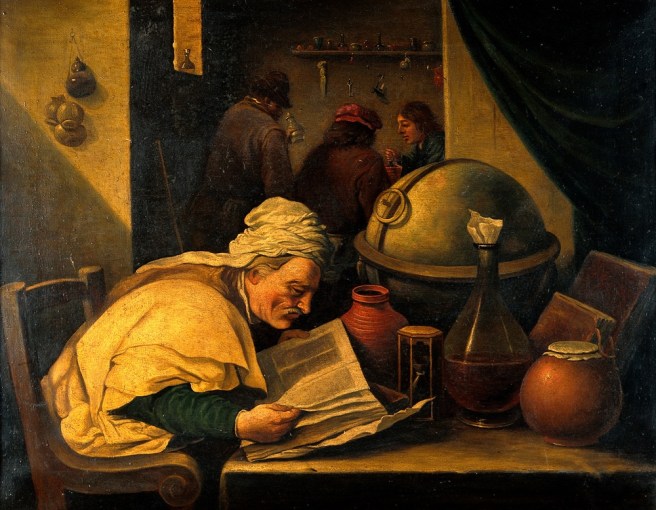
An Alchemist in His Laboratory after David Teniers the Younger
Chymistry
The alchemists assigned the ancient metals To a planet each: The Sun is gold, and brightsilver the Moon, Or so the heavens teach. While quicksilver is Mercury, And Venus has a copper heart. And Mars is cast in iron, clearly, In their philosophic art. Old Jupiter is made of tin, And Saturn is a lump of lead – (Or bendledd, as I like to think They should have called the stuff instead.) And that was the edge of their knowledge, And Uranus came too late – But what might they have named his element, To match his fate ? I think redledd – bismuth, Though they did get them confused – And Neptune can be brimstone, Since that still has not been used. But what of the others ? Like the Earth ? I guess that must be carbon coal. And plainsight-hidden Ceres is our makebrass zinc – That fits her role. And banestone Pluto gets to stand For ars’nic, dark and glimmer-free, Till dim and distant Eris is our stibblack, For antimony. Of course, we really did get chemicals That have all grown with them – That’s how we got uranium, Neptunium, plutonium, (And much-forgotten cerium) And all the secrets each unlocks. One wonders what the alchemists Would make of such explosive rocks…?
Note that antimony has its stress on the second syllable (as it should be…)
And of course, these days we’ve actually found the philosopher’s stone that can turn other metals into gold – only these days we call it a supernova instead.
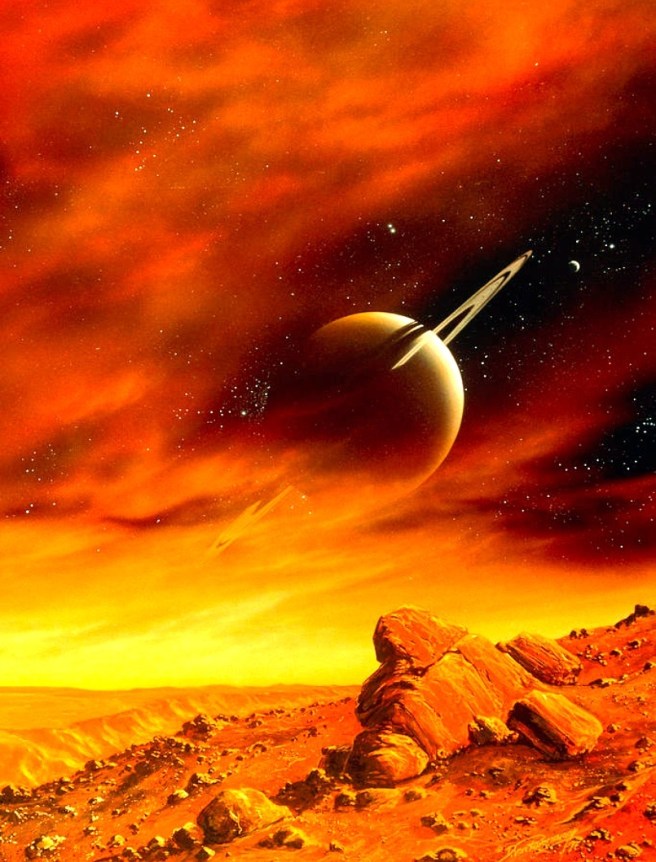
Saturn over Titan by Detlev van Ravenswaay – though we now know that Titan’s atmosphere is too thick to see out of.
Lightweight Light
In a galaxy of smaller stars, With few that ever get to boom – They only get to fuse to silicon, By steady burn. Besides the odd Type 1, Then none will face a sudden doom – And just ten elements (bar traces) In the churn. Though ‘smaller’ stars are relative – We still get whites and blues – But nothing that can cross The cataclysmic iron line. In truth, the silicon is rare, Without a few Type 2s, But the largest lose their mass to stop Their super-shine. So there’s enough to build some silicates That build a rocky world, Though lacking radioactivity To heat its core. But it has a liquid ocean, In which chemicals are swirled, As the ultraviolet starlight warms Its barren shore. It may miss plate tectonics, But it holds an atmosphere, And it has no need to hurry When its stars are here to stay. Organic molecules will still Eventu’ly appear – However long it takes for life To find a way.
The 10 elements mentioned are Hydrogen, Helium, Carbon, Nitrogen, Oxygen, Neon, Sodium, Magnesium, Aluminium, & Silicon. And although needing fewer protons, the missing ones (Lithium, Beryllium, Boron, & Fluorine) are very hard to acquire without the by-products of a supernova.
In truth, the oxygen-burning needed to produce silicon (and small amounts of phosphorus & sulphur) usually only happens in the final months before a Type 2 supernova, which in turn will produce iron from burning that silicon unless the candidate star is only just over the 8-solar-mass threshold – though it is possible to get some ‘localised’ oxygen-burning in stars just below the limit when they’re on the asymptotic-giant branch of their evolution.
In terms of life, it is fascinating to think if it would be possible for life to arise – but it would be greatly increased if our rocky planet of silicates could avoid having its early atmosphere stripped away. Now, a lack of a magnetic core prevents an Earth-like magnetosphere, but an equally powerful dynamo can be generated from metallic hydrogen inside a gas giant of Jupiter-or-greater mass.
And having our terestrial world be a large moon of such a planet will also give it plenty of tidal heating to compensate for its lack of radioactive decay to provide internal heating. It may even be able to have some form of plate tectonics and volcanism to prevent the carbon dioxide from getting locked away in the crust and losing all of our liquid water to ice.
Of course, there’s absolutely no reason to think that gravity could only form stars upto a maximum of 8-solar-masses but no greater. This is simply a thought-experiment into how to generate life using the least-possible number of elements.
And as an aside, I have always found it hard to hear talk of ‘carbon burning’ and mean ‘carbon-fusing’ instead of ‘carbon-oxidising’. Of course, ‘oxygen-burning’ means the same either way…
A sunfish may look like a sun, And a starfish like a star – But both are fake, for the only one that’s real – The starriest fish by far – Is not some Milky Way-long eel, But Cetus – the stellar monster gar – He’s bigger than Cancer, older than Pisces, Swimming the span of the sky high seas.
We’ll still grow trees on Mars, Under the domes, And rooted in thin soil – We’ll take nuts to the stars And distant homes, To shade our fervent toil. Beside potato fields, And stands of wheat, They’ll ease the barren crag – Not for their timber yields Or fruits to eat, But just to plant our flag.
It only takes an acorn, That’s not too much weight To build a tree. And ev’ry sapling born Shall grow up great In lower gravity. Yet forests don’t get lush Till many years Of Martian peace have been – I guess we’re in no rush To clothe our spheres, And turn the red to green.
Which trees, though, all depends – Can pine withstand ? Or desert raise a beech ? We nurture ev’ry friend In ev’ry land Our giant leaps shall reach. And thus, we’ll leave a trace From overseas That shows we once came by. We’ll still grow trees in space, Because the trees Have reached-up to the sky.
Round and round we orbit As the days grow short and chill. But we’ve turned the Winter’s corner, And we’ve started up the hill. We’re close to perihelion, The Cold Moon lights the frost, And the dawn is a chameleon Once Solstice has been crossed.
One Is the circle and Two Is the line and Three Is the trilith and Four Is the sign. The planets and skies Are alive with their play, As the new Sun shall rise On the shortest-long day.
So gather round the sarsens, As we welcome back the Sun, While the druids and the parsons Offer tales on why we’ve spun. We’re close to Heaven’s hinter, As the Dog Star watches over, So let’s raise a toast to Winter And the sleeping of the clover.
One Is the Sun and Two Is the Moon and Three Is the midnight and Four Is the noon. The planets and wives Are all dancing away, Yet the dawn still arrives On the shortest-long day.
I’ve always been disappointed with Stonehenge, in the same way that I’m disappointed with a ruined castle – forever second-rate compared with the grandeur it once possessed. With Stonehenge, we really need to build a new one nearby to show it at its best.
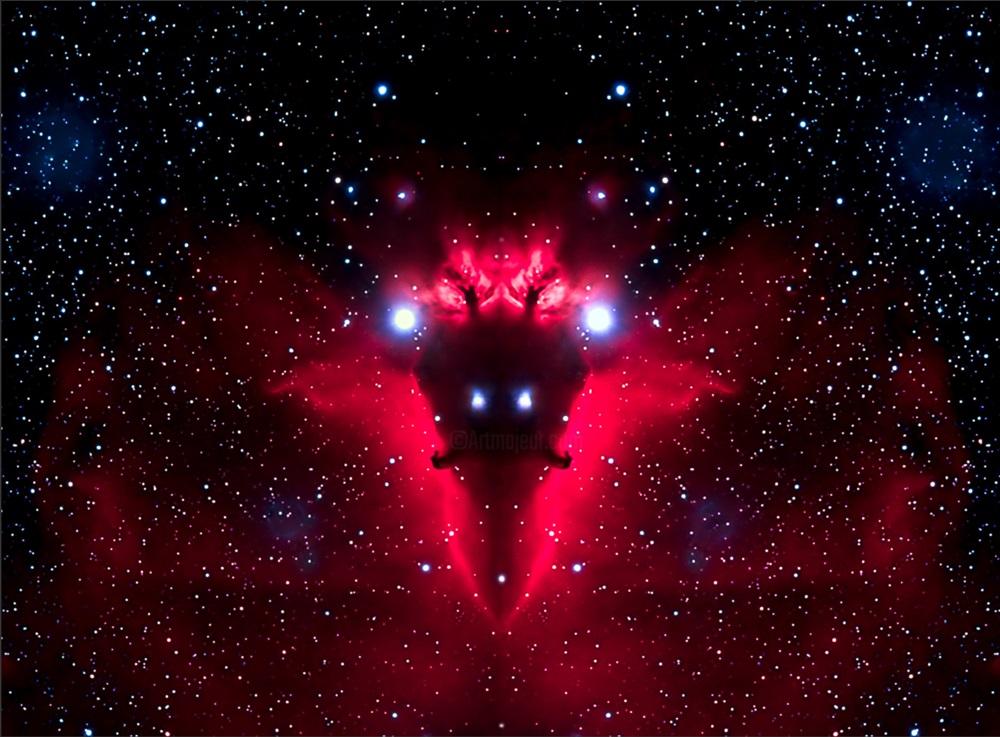
The Horsehead Nebula, as photographed by William Mccarthy
The Morningstar
It’s a little known fact, but so they tell, That the Devil loves astronomy. And when he steps away from Hell, Away from the caves of his citadel, With their ceilings of monotony – Then the one thing that he wants to see Are stars in infinity. Is it a part some evil scheme ?, Or simply that the Devil, as well, can dream ?
I wonder if he can visit them ? Or can he only gaze from Earth ? I’m sure he understands each gem, As much as the Star of Bethlehem, And over aeons watched their birth To their glorious end, and brought him mirth When friendships were in dearth. Has he lusted for their gleam ?, Or has he simply been condemned to dream ?
The Bible doesn’t mention much, Except as signs, or points of light. Or else, Creation Week and such, But science there is out of touch – Like Joshua, needing time to smite, Commands the Sun to halt its flight – He knows that that ain’t right ! So is it to score one for his team ?, Or simply cast away that crutch, and dream ?
There is surprisingly little astronomy in the Bible – there is the basic flat-Earth cosmology which both their smarter neighbours the Persians and the Greeks had already debunked, but not much stargazing it seems. There are numerous references to the Moon, but always in passing – none of them suggest anyone is actually looking at it. Job has mention of Arcturus (or Leo, or Ursa Major), Orion, the Pleiades, and the Chambers of the South (possibly the zodiac, or Centaurus and Crux), but oddly no mention of the very prominent Sirius or Cassiopeia. For a desert culture, you would think that those big skies would feature far more…
The Sun is a restless god, Driving his chariot ever on. The dawn won’t last for long, Before it’s gone, to welcome the morning Where the queen of night once trod. Before we know, it’s midday, And his heat is full upon us – Then into his afternoon we rush, And all too soon, the growing dusk, As once again he slips away.
A 19th century shell cameo brooch, as sold by Roseberys
I want to hear less of Uranus, That big gassy body found in the Bath. You see, you’re sniggering already ! It’s a noble planet, it’s not a cheap laugh ! Why use the Roman name of the Greek ? ‘Ouranos’ sounds not so silly. Or better yet, let’s see more of ‘Caelus’ For the methane found by the Willy. That’s Wilhelm Herschel, the man who slapped it Into the solar system. And named it after King George the Third – When he saw royal buttocks, he kissed ’em ! From its nether regions, this constant hot air Gets so petty, and I want it to stop – I want to see less of this childish smut, Or the pressure will make it go pop.
Urban Planning for Urbane Planets
You can’t build Uranus Circus in Bath – At least, not by that name. A quirk of language is having a laugh, And we all have a smirk in the game.
Uranus was discovered in 1781 (11781 HE), though it had been unknowingly sighted several times, possibly as early as Hipparchus in 9873 HE. This was the first time that the concept of there being a new planet had ever occurred to anyone, and there was no reliable naming convention to guide them. Yes, the ‘prehistoric’ planets all bore the names of Roman gods, but was this new object really another one just like them, or should it be demarked as something different ?
Indeed, although Uranus was proposed as a name within a year (and the equally-newly-discovered element Uranium so named in its honour), consensus around it wasn’t achieved until some seventy years later, and meanwhile other proposals included Hershel, Cybele, and even Neptune. But at least the eventual winner was considerably better than that proposed by its discoverer – Georgium Sidus (or King George’s Star). I mean, it’s not a star, is it ? Next you’ll be naming a chunk of rock an asteroid…
Blue, is hard for nature to be it – We’re told “no pigments” is the why. Forget-me-nots, though, give the lie, And kingfishers darting by, And rocks of lapis lazuli, And the irises of Lady Di – And Planet Earth, I hear you cry, Together with the frigging sky ! So yes, the ancient Greeks could see it, Just as well as you or I.
This is a particularly pernicious urban myth that will take years to debunk, and shame to say it’s often lefties who love these QI-style gotchas (two moons, anyone ?). I recomend watching Metetron’s takedown of this bullshit.






 Rhyming Couplets