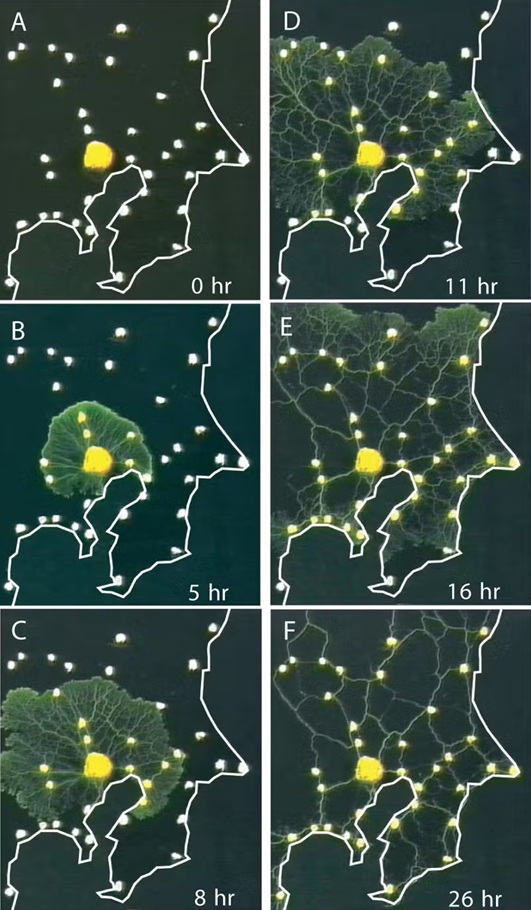
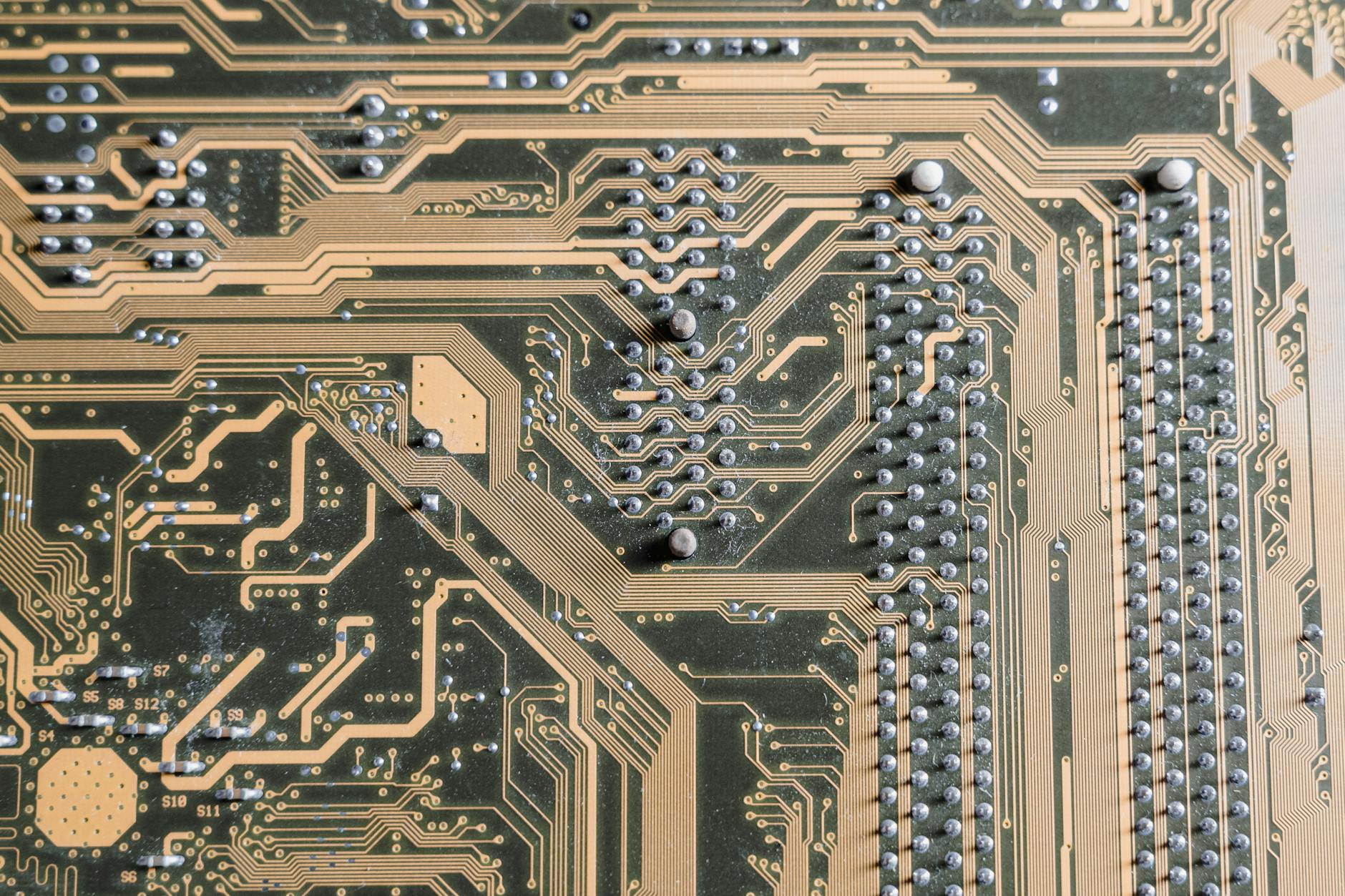
My body is a mass of public transit Running through my flesh, As supersonic neurons sprint down nerves, Whose networks branch and mesh. And food is ferried by the central core That winds its way on down, On through the stomach-hub, And past the branch-line to appendix-town. My lungs, meanwhile, are shuttling air Upon the trunk-route to my nose, And blood cells catch the tube to distant suburbs In my hands and toes. My brain contains the signal-box, My heart contains the motive power, Keeping my commuters moving Through the rush and midnight hour.
AI has no soul, no self, No special atom at its heart – To live or die. Just fractal wires and strands and filaments To pull apart, And magnify. It’s just a string of ones and ohs, That sees the world as just a game.
With software nothing but the common sense Of ruthless logic – lacking art, Or reasons why. It’s very fast and very dense, Which we mistake for something smart – But it’s a lie. It turns all poetry to prose, And ‘human’ into just a name.
Yet if machines are godless clones That lack a special soul – Well, so am I. I’m flesh and cells and chromosomes – I’m just a greater whole, A local high. My inner spark is all for show, My inspiration lacks a flame.
I’m just a mass of carbon – Complicated, not divine. My end is nigh – For silicon will overtake one day, And hey, that’s fine – It’s not goodbye. I’ll still be here to say hello, And let them know we’re all the same.
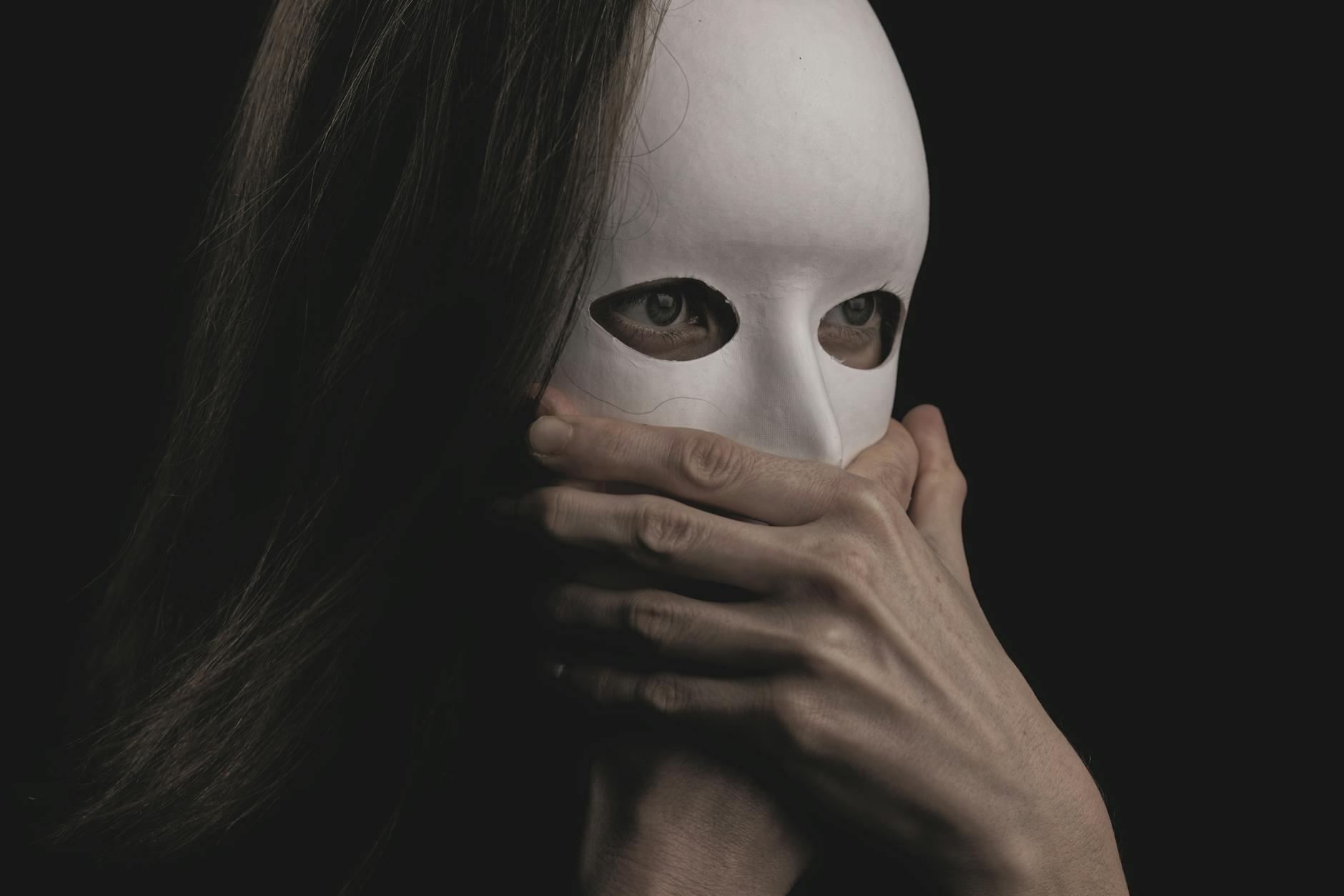
Some people hear a voice in their head That they don’t think it’s them, But that’s okay. They’re not schizophrenic, They just don’t think that it’s them, This lodging-voice of grey. And some people hear a number of voices, But know they’re them, So they let them stay. And some people hear no voice at all, They’re only them, A one-voice play. Some have a voice-of-God narrator, Or invisible ‘them’ Who must have their say – Or something less reliable, But they still hear them On a quiet day… Just diff’rent flavours of subconscious- It works for them, In their own calm way And they’re each quite normal, each quite sane, Are you one of them, With a chatty stray ?
No matter how new the blade, And no matter how thick the foam – No matter how many passes made, My stubble sits right at home. The razor burn is fiery, As striation still sing out – Yet my chin is grey and wiry, With the crevices in-sprout. My whiskers are a warning That I’m not so young and steady – It’s first thing in the morning, Yet it’s five o’clock already.
Hiccups come with a thump thump thump, To wrench our guts and punch our lungs – A painful start, but soon each jump Has settled down to ting our tongues. But we never notice when they go, They slip away to no concern Once we ignore their gulps below – To build their strength for their return…
Two blue-eyed parents ? Then how can a brown-eyed child be ? If brown is dominant, Her true-colours are right there to see. Ah, poor Hercule, Inheritance is trickier than that – It’s not down to a single gene To slot into a simple clever fact.
A type-O body ? Then how can there then be a type-A son ? This child is not his blood, Once the cutting-edge analysis is done. Ah, poor Lord Peter, Kinship is less iron-clad these days – It’s not down to a single letter, Pumping through the logic of your plays.
It’s not really fair, That your ingenuity is overtaken – You made us feel so clever When we thought we’d learned what science you’d awaken. Ah, poor hindsight, Your layman’s clues are too much on-the-nose. It’s not down to a single twist To show whose blood is blue and eyes are ohs.
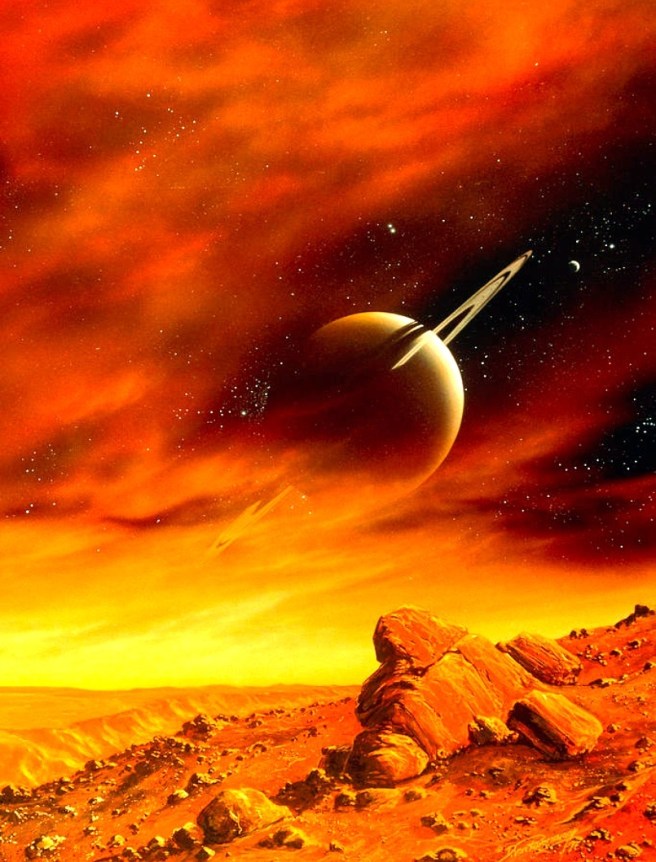
Saturn over Titan by Detlev van Ravenswaay – though we now know that Titan’s atmosphere is too thick to see out of.
Lightweight Light
In a galaxy of smaller stars, With few that ever get to boom – They only get to fuse to silicon, By steady burn. Besides the odd Type 1, Then none will face a sudden doom – And just ten elements (bar traces) In the churn. Though ‘smaller’ stars are relative – We still get whites and blues – But nothing that can cross The cataclysmic iron line. In truth, the silicon is rare, Without a few Type 2s, But the largest lose their mass to stop Their super-shine. So there’s enough to build some silicates That build a rocky world, Though lacking radioactivity To heat its core. But it has a liquid ocean, In which chemicals are swirled, As the ultraviolet starlight warms Its barren shore. It may miss plate tectonics, But it holds an atmosphere, And it has no need to hurry When its stars are here to stay. Organic molecules will still Eventu’ly appear – However long it takes for life To find a way.
The 10 elements mentioned are Hydrogen, Helium, Carbon, Nitrogen, Oxygen, Neon, Sodium, Magnesium, Aluminium, & Silicon. And although needing fewer protons, the missing ones (Lithium, Beryllium, Boron, & Fluorine) are very hard to acquire without the by-products of a supernova.
In truth, the oxygen-burning needed to produce silicon (and small amounts of phosphorus & sulphur) usually only happens in the final months before a Type 2 supernova, which in turn will produce iron from burning that silicon unless the candidate star is only just over the 8-solar-mass threshold – though it is possible to get some ‘localised’ oxygen-burning in stars just below the limit when they’re on the asymptotic-giant branch of their evolution.
In terms of life, it is fascinating to think if it would be possible for life to arise – but it would be greatly increased if our rocky planet of silicates could avoid having its early atmosphere stripped away. Now, a lack of a magnetic core prevents an Earth-like magnetosphere, but an equally powerful dynamo can be generated from metallic hydrogen inside a gas giant of Jupiter-or-greater mass.
And having our terestrial world be a large moon of such a planet will also give it plenty of tidal heating to compensate for its lack of radioactive decay to provide internal heating. It may even be able to have some form of plate tectonics and volcanism to prevent the carbon dioxide from getting locked away in the crust and losing all of our liquid water to ice.
Of course, there’s absolutely no reason to think that gravity could only form stars upto a maximum of 8-solar-masses but no greater. This is simply a thought-experiment into how to generate life using the least-possible number of elements.
And as an aside, I have always found it hard to hear talk of ‘carbon burning’ and mean ‘carbon-fusing’ instead of ‘carbon-oxidising’. Of course, ‘oxygen-burning’ means the same either way…
Delicate, nimble, Steady as a gimbal, A veritable symbol Of dexterity – But no such accolade To perfect poise displayed, Could ever be made To maladroit me. I’m subtle as a cymbal, As sharp as a thimble – I blunder and I bimble With artless artistry. My tiptoe is plantigrade, My whisper a hand grenade – A dancer, I’m afraid Is a thing I’ll never be.
The hornet laid her sting in my leg, Injected her toxic egg – Her ovipositor dripping with yolk, As if to joke how childbirth hurts. The pain began in rapid pangs and spurts, But at least, I said in spite, At least it’s just a sting, this thing, And not a hatching parasite…
Those clean-shaved chaps all suffer hell From a lack of stiffened upper-lips, Their razor-bothered mouths are far too sleek. When it comes to cunning twirling, well, They simply cannot get to grips – Their naked filtrums wobble when they speak. No rakish pencil wits For these tongue-tied sunburned Brits, But the unconnected stubble of the meek. No bushy walrus manliness On faces long on gangliness, Whose claims to hairy days are bare-faced cheek !