This firefly is all a lie – He has no flame in him ! The light that’s seen Is cold and green – And most of all, so dim ! Flashing out his Morse, Of course, To bring the ladies in. At least he does emit a bit, And pimps his abdomin – Unlike the many lads in other species, Where the dads Leave all the glow-up to the dames. And some have given up entirely, Never even slightly fiery, In defiance of their names. I guess he’s earned the term, When he’s been sparking since a glowworm, Putting-on a show. But boy, he’s still a slacker, More a squib than fire-cracker – Just a pin-prick in the black, Who’s turned his wattage way down low. Or maybe it was all because his loneliness Was all a sign – A cry of fading prominence, A dwindling from the present tense, His species in decline ? They used to fly so thick, so dense – And even now, beside the fence, They sometimes congregate and look so fine ! Alone, he hardly glorifies – But when the fireflies fill the skies, That’s when they really shine !
The hornet laid her sting in my leg, Injected her toxic egg – Her ovipositor dripping with yolk, As if to joke how childbirth hurts. The pain began in rapid pangs and spurts, But at least, I said in spite, At least it’s just a sting, this thing, And not a hatching parasite…
Time is short, perhaps a month or two, Since they were just an egg – But now the gnats must boogaloo, To swarm a wing and shake a leg. They gather round a random patch of air Just as the eve’ning falls – And jink and jive until they pair, Attending countless black-fly balls. If love is on the cards for them tonight, It leaves them out of breath – Exhausted from their swaggered flight, Too soon they’ve danced themselves to death.
Spiders have eight, and box-jellies twenty-four, Scallops have hundreds, and dragonflies thousands, And digital cameras even more ! But vertebrates make do with two, Plus the odd ocelli peeping-through – But only a couple of retinas – A pair of light-bucket dishes – Well, except for a few strange fishes ! And I don’t mean the four-eyed anableps, Who see through both the water and air, And focus the light through diff’rent steps But onto the same old patch of cells, That parallels the ones we chordates share. No, I mean the brownsnout spookfish – They may not look as swish as barreleyes, Until we realise that here may be The ancestor of a whole new tree Of multi-looking vertebrates to arise – That one day may just populate The future Earth with their future eyes.
Where were the darts of Galilee ? And the damsels of the Rubicon ? Was Runnymede so needle-free, Or the Athens Woods of Oberon ? So where are all the dragonflies ? There’s not a word in tale or scroll – The Greeks and Romans closed their eyes, The monks and knights ignored them whole.
It took the new Enlightenment To even notice them at last – And then Romantics sought intent In Nature bold and wild and vast – Till Art Nouveau, which gave them wings That keeps them soaring till this day – As wardens of eternal springs, Where dreamy Summers while away.
So where were the dragonflies of Hermes ? Why no mention in the myths ? Why did Freyr not claim these flurries, Crafted by the finest smiths ? Perhaps the Bible’s just too dry For water-sprites as story-tools, But rainy Europe shouldn’t shy To catch the eye with flying jewels.
Transforming in among the reeds, A lit’ral metamorphosis – The fey-folk surely rode these steeds ?, Yet Brigid never knew such bliss. Shouldn’t the Devil have taken hold ?, Or gargoyles, say, or heraldry ? Yet where were the dragonflies of old ?, Who chirped and danced for nobody.
‘Adderbolt’ is the only earlier name for them that I couold find, and this only dates from 1483, according to the OED, and ‘Devil’s darning needle’ is only from 1809.
And finally, the image below is from a poster which looks reminiscent of others advertising the various Art Nouveau exhibitions at places like the V&A.cHowever, I cannot find out anything else about this particular image, and if it is even an original by William Morris. I hope it isn’t AI…
A butterfly house is a curious series of rooms – A bit like a tropical farm, Where exotic moths can dine on exotic blooms, With wingspans as wide as my palm. Or so I had hoped – but this was no Forest of Arden – Or jungle of scent-heavy petals – But flitting about were familiar sights from the garden, And all that was growing were nettles. It turned out they mastered in only British varieties, Tortoiseshells, coppers, and whites. Pretty, but small – the kind that give gard’ners anxieties, Or taken-for-granted delights. Oh sure, the elephant-hawks are impressive as caterpills, Stripping the fuchsia to shreds, But overall, any good hedgerow holds similar thrills, Without the need of these sheds. Although, as a lifelong dweller of chalky downs, And the home-strip lads that brings. It was good to see some strangers from limestone towns With a Northern brogue to their wings. So yeah, I guess I enjoyed them in concentration, A blaze about the flowers – And proof that beauty can still exist in our nation – Because all of these ones are ours !
I asked a few AIs for a plan to build such a self-sustaining glasshouse, with a list of the fewest number of native plants. Here is the consensus:
Firstly, a fair spread of readily-available lepids:
TYPE
NAME
BINOMIAL
FLYING SEASON
Whites
Large (Cabbage) White
Pieris brassicae
Apr-Oct
Green-Veined White
Pieris napi
Apr-Sep
Yellows
Brimstone (endangered, but worth the effort)
Gonepteryx rhamni
Mar-Oct
Orange-Tip
Anthocharis cardamines
Apr-May
Clouded Yellow (migrates in wild, so won’t survive the Winter)
Colias croceus
May-Oct
Blues
Holly Blue
Celastrina argiolus
Mar-Sep
Small Copper
Lycaena phlaeas
Apr-Oct
Common Blue
Polyommatus icarus
May-Sep
Small Blue
Cupido minimus
May-Jun / Aug if 2nd brood
Browns
Speckled Wood
Pararge aegeria
Mar-Oct
Duke of Burgundy
Hamearis lucina
Apr-Jun
Wall
Lasiommata megera
Apr-Sep
Ringlet
Aphantopus hyperantus
Jun-Aug
Meadow Brown
Maniola jurtina
Jun-Sep
Gatekeeper
Pyronia tithonus
Jul-Aug
Hairstreaks
Green Hairstreak
Callophrys rubi
Apr-Jun
Brush-Footeds
Small Tortoiseshell
Aglais urticae
Mar-Oct
Red Admiral
Vanessa atalanta
Mar-Nov
Peacock
Aglais io
Mar-Nov
Pearl‑Bordered Fritillary
Boloria euphrosyne
Apr-Jun
Comma
Polygonia c-album
Apr-Oct
Marsh Fritillary (endangered, so may not be possible)
Euphydryas aurinia
May-Jul
Marbled White
Melanargia galathea
Jun-Aug
Silver-Washed Fritillary
Argynnis paphia
Jun-Aug
White Admiral (also feeds on honeydew from aphids)
Limenitis camilla
Jun-Aug / Sep if 2nd brood
Skippers
Large Skipper
Ochlodes sylvanus
Jun-Jul
Day-Flying Moths
Emperor Moth (don’t feed as adults)
Saturnia pavonia
Mar-May
Mint Moth
Pyrausta aurata
Apr-Sep
Scarlet Tiger-Moth
Callimorpha dominula
May-Jul
White Ermine (woolly caterpillars !)
Spilosoma lubricipeda
May-Jul
Forester
Adscita statices
May-Jul
Six-Spotted Burnet
Zygaena filipendulae
Jun-Aug
Day-flying Inchworms
Latticed Heath
Chiasmia clathrata
May-Jun / Sep if 2nd brood
Blood-Vein
Timandra comae
May-Sep / Oct if 2nd brood
Yellow Shell
Camptogramma bilineata
Jun-Aug
Hawk-Moths
Narrow-Boarder Bee-Moth (a bee-mimic !)
Hemaris tityus
May-Jun
Elephant Hawk-Moth (giant caterpillars ! – nocturnal adults, but they do hibernate)
Deilephila elpenor
May-Aug / Sep if 2nd brood
Hummingbird Hawk-Moth (more giant caterpillars ! – day-flyers, though they won’t survive the Winter)
Macroglossum stellatarum
Jun-Sep
The months listed above are for typical outdoor activity, so may be extended indoors with earlier Springtime starts and possibly a second or third brood. If the glasshouse is insulated but not heated (except to keep it above 5°C through the Winter), this will mean that not all of these species can be self-sustaining, as some of them migrate (Clouded Yellow, Hummingbird Hawk-Moth), and fresh stocks will need to be brought in each Spring (this is something all butterfly houses need to do). I can see making use of an ornate pupilarium with windows to watch them ‘hatch’. We will also have some structural little brick towers around to provide dry pupation sites(and resting spots for the Walls).
I’ve included the Brimstone, as it’s the classic bright-yellow species that possibly gave all lepid’s the name of ‘butter-fly’, but it should be noted that their numbers aren’t doing great at present, which could certainly cause problems. Their caterpillars only eat buckthorns, which aren’t exactly the smallest shrubs, but perhaps we could have a few in the centre of the glasshouse and make a feature of them ? (By the way, I call it a glasshouse instead of a greenhouse to emphasise that it will be considerably larger than the things found at the bottom of the garden for growing tomatoes in.) I’ve also listed the Marsh Fritillary, which faces similar worries, but otherwise fit in nicely !
I’d also like to introduce Rose Chafer beetles (Cetonia aurata) for a bit of metallic variety. Their grubs live on rotting wood, so we’ll need a decomposing stump in a corner (maybe from when we prune the alder buckthorn ?), but if it also supports fungus and woodlice, it could be quite a feature. Their adults eat nectar, just like the butterflies, and are on the wing May-Oct.
And, since aphids and mildew are inevitable, I decided to also include the following ladybirds:
7-Spot(Coccinella septempunctata) – Mar-Oct – the familiar red-with-black spots – both grubs and adults eat aphids Kidney-Spot(Chilocorus renipustulatus) – Apr-Oct – black with two red spots – both grubs and adults eat scale insects likely found on the woody plants (alder buckthorn, honeysuckle, ivy) 22-Spot(Psyllobora vigintiduopunctata) – Apr-Aug – yellow with black spots – should make for a good mildew-munching colony in the honeysuckle and the rotting logpile
It will be interesting to see if there are sufficient levels of aphids, scale, and mildew to sustain populations. Perhaps not initially, but over time I’m sure there will be a veritable banquet ! A harder problem will be keeping out the harlequin ladybirds from crashing the party…
If we were really smart, we could include a free app that will identify each of the above species (adults and caterpillars) so that visitors can point their phones at one and get its name and details. This data can also be used to record when the adults first and final flying days are each year. But I don’t think it can help with keeping a census unless it could also identify individuals so as to not count them each multiple times.
But anyway – the plants need to be natives, and robust, and able to regrow quickly after heavy defoliation by caterpillars, while also provide nectar for the butterflies/moths for the entire time they are flying. Indeed, I wanted to make sure that there were two different nectar sources incase of any issues, though I held off doing the same for feed plants, as a lack of food will be an important population control (though many species do have multiple food options, but this was not deliberate). Here’s the answer I got:
PLANT
LARVAL HOST FOR
ADULT NECTAR FOR
FLOWERING SEASON
Sheep’s Sorrel (Rumex acetosella) – Shoots out rhizomes, so keep it in pots.
Small Copper Forester Blood-Vein Yellow Shell
None
(May-Nov)
Alder Buckthorn (Frangula alnus) – Can be pruned, but still likely to be 2-3m tall.
Brimstone Holly Blue Green Hairstreak Emperor Moth
Kidney-Spot Ladybird – scale
(May-Jun)
Cock’s-Foot Grass (Dactylis glomerata)
Speckled Wood Wall Ringlet Meadow Brown Marbled White Large Skipper Yellow Shell
None
(May-Jul)
False Brome Grass (Brachypodium sylvaticum)
Speckled Wood Wall Ringlet
None
(May-Jul)
Red Fescue Grass (Festuca rubra)
Wall Meadow Brown Gatekeeper Marbled White Yellow Shell
Brimstone Holly Blue Small Copper Speckled Wood Duke of Burgundy Small Tortoiseshell Peacock
Feb-May
Primrose (Primula vulgaris)
Duke of Burgundy
Brimstone Orange Tip Holly Blue Speckled Wood Duke of Burgundy Gatekeeper Small Tortoiseshell Red Admiral Peacock Pearl‑Bordered Fritillary Comma Latticed Heath Blood-Vein Ladybirds
Feb-May
Cowslip (Primula veris)
Duke of Burgundy
Brimstone Common Blue Small Blue Wall Green Hairstreak Latticed Heath Blood-Vein Ladybirds
Apr-May
Garlic Mustard (Alliaria petiolata) – Can be an aggressive spreader, so keep it in pots.
Large White Green-Veined White Orange-Tip – eats the seeds, so don’t dead-head them.
Large White Green-Veined White Brimstone Orange-Tip Latticed Heath Blood-Vein
Apr-May
Stinging Nettle (Urtica dioica) – Unavoidable, but we can use a dwarf variety and keep it out-of-the-way.
Small Tortoiseshell Red Admiral Peacock Comma Scarlet Tiger-Moth White Ermine
Small Copper White Ermine
Jun-Sep
Bird’s-Foot Trefoil (Lotus corniculatus)
Clouded Yellow Common Blue Green Hairstreak Six-Spot Burnet Latticed Heath
Orange Tip Clouded Yellow Common Blue Small Blue Wall Green Hairstreak Pearl‑Bordered Fritillary Marsh Fritillary Forester Six-Spot Burnet Latticed Heath Blood-Vein Narrow-Boarder Bee-Moth Rose Chafer
Small Tortoiseshell Elephant Hawk-Moth Hummingbird Hawk-Moth
Jun-Sep
Kidney Vetch (Anthyllis vulneraria)
Small Blue
Common Blue Small Blue Ringlet
Jun-Sep
Wild Marjoram (Origanum vulgare)
Mint Moth
Brimstone Holly Blue Small Copper Common Blue Small Blue Wall Ringlet Meadow Brown Gatekeeper Green Hairstreak Small Tortoiseshell Pearl‑Bordered Fritillary Marsh Fritillary Marbled White Silver-Washed Fritillary White Admiral Large Skipper Forester Six-Spot Burnet White Ermine Latticed Heath Blood-Vein Yellow Shell Elephant Hawk-Moth Rose Chafer Ladybirds
Jun-Sep
Common Honeysuckle (Lonicera periclymenum) – Let’s find a late-blooming variety.
White Admiral Scarlet Tiger-Moth
Brimstone White Admiral Blood-Vein Elephant Hawk-Moth Hummingbird Hawk-Moth Rose Chafer 22-Spot Ladybird– mildew Kidney-Spot Ladybird – scale
Jun-Sep / Oct (some varieties)
Devil’s-Bit Scabious (Succisa pratensis)
Marsh Fritillary Narrow-Boarder Bee-Moth
Brimstone Common Blue Wall Ringlet Meadow Brown Marsh Fritillary Marbled White Silver-Washed Fritillary Forester Six-Spot Burnet Blood-Vein Yellow Shell Rose Chafer Ladybirds
Jul-Oct
Common Ivy (Hedera helix)
Holly Blue
Overwinter site: Brimstone Small Tortoiseshell Red Admiral Peacock Comma
Large White Green-Veined White Holly Blue Small Copper Small Tortoiseshell Red Admiral Comma Blood-Vein Hummingbird Hawk-Moth Kidney-Spot Ladybird – scale
Oct-Nov
Wood Spurge (Euphorbia amygdaloides)
None
Duke of Burgundy Ladybirds – they need early-Spring nectar before aphid numbers rise.
Apr-Jun
Forget-Me-Not (Myosotis arvensis) – Definitely a spreader, but not a bully, and after flowering it shrinks into the background.
None
Orange Tip Holly Blue Small Copper Duke of Burgundy Wall Small Tortoiseshell Red Admiral Peacock Pearl‑Bordered Fritillary Comma Scarlet Tiger-Moth Blood-Vein Yellow Shell Narrow-Boarder Bee-Moth
Apr-Jun
Bugle (Ajuga reptans)
None
Green-Veined White Orange-Tip Holly Blue Small Blue Wall Green Hairstreak Pearl‑Bordered Fritillary Marsh Fritillary White Admiral Scarlet Tiger-Moth Latticed Heath
Large White Green-Veined White Orange-Tip Small Copper Duke of Burgundy Green Hairstreak Mint Moth White Ermine Forester Latticed Heath Rose Chafer – eats the petals! Ladybirds
May-Jul
Red Campion (Silene dioica)
None
Large White Duke of Burgundy Wall Scarlet Tiger-Moth Latticed Heath Blood-Vein Elephant Hawk-Moth Rose Chafer
May-Sep
Knapweed (Centaurea nigra)
None
Large White Green-Veined White Brimstone Wall Ringlet Marsh Fritillary Marbled White Silver-Washed Fritillary Large Skipper Six-Spot Burnet Blood-Vein Yellow Shell Elephant Hawk-Moth Rose Chafer Ladybirds
Jun-Sep
Wild Thyme (Thymus serpyllum)
None
Small Copper Common Blue Small Blue Duke of Burgundy Green Hairstreak Small Tortoiseshell Large Skipper Scarlet Tiger-Moth Latticed Heath Blood-Vein Ladybirds
Jun-Sep
Musk Mallow (Malva moschata)
None
Large White Green-Veined White Gatekeeper Small Tortoiseshell Red Admiral Rose Chafer
Jun-Sep
Of course, the lepids will have no birds or bats preying on them, so careful management is needed to preventing boom-and-bust cycles. To some extent, there will be some predation from the ladybirds, who will happily eat butterfly eggs if aphid numbers are low, and parasitic wasps have a knack for getting into everywhere, from our glasshouse to the bodies of caterpillars. I suppose we cold also net the surplus butterflies and release them outside of the glasshouse, but this would only work legally for species that aren’t endangered, aren’t migratory, and occur naturally in the local environment. We could even make a bit of an event of the release, could be good for PR – though probably best not to include cabbage whites…
But thinking about it, a few plants above are described as being in pots, but probably this should apply to most of them (except for the alder buckthorn, the ivy, and the honeysuckle, which will each be istraight into soil a metre deep) – not only will it allow for different soil-types, but if any particular plant is over-grazed, it can be whisked away and put into quarantine, to prevent a population boom. Replacement pots would be grown ‘backstage’, ready to understudy and provide fresh foliage. Obviously, these are likely to be larger than the average garden terracotta, and contain more than one nettle or tussock of grass, but still modular enough to allow for easy relocation. his also allows for the containers to be raised up closer to eye-level – handy for low-growers like forget-me-nots !
Hopefully, these plants will be self-sustaining (or at least self-seeding), though they don’t all love full Sun, and some like the primroses and violets will be best kept under the alder buckthorn for shade. We can also use an evaporative cooling system for those plants that favour wetter conditions (bugle, violet, devil-s bit scabious). Actually, the walls don’t need to be nothing-but-windows, but can include structural brickwork too, more like an orangery perhaps… Also, where possible the air circulation will be internal, rather than having too many vents, so as to prevent too many unwanted visitors (even with a fine mesh over them). As for the public, they will enter through an ‘airlock’ of sequential strips of hanging, overlapping, heavy plastic as is common in butterfly houses. They’re also good for building anticipation…
To be honest, this thought-experiment started with just a dozen species and a handful of plants, but I kept finding that I could utilise the existing flora to add more butterflies, except…well, another source of nectar wouldn’t harm, and this also allows for another species as a side benefit, except this one hangs around for longer so needs another Autumn bloom,…and you can see how things started getting a bit out-of-hand. But I think this is now a good balance of providing a decent selection of flyers in any given month.
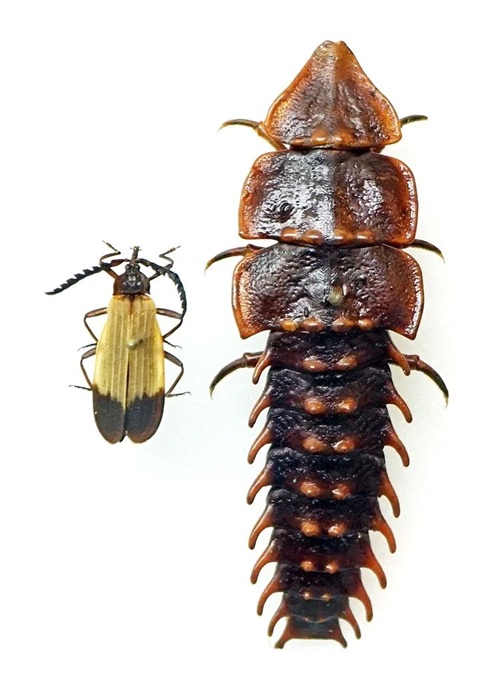
Trilobite beetles, showing the adult male (l) and adult female (r)
Larviform Females
Larviforms are ladies who remain forever young – As they climb-up through the instars but won’t reach the highest rung. So they stay as grubs or maggots or as caterpillar bags, Where these slow and wingless-women are such lazy lallygags. Most will still pupate, but then emerge as they went in – Or at least upon the outside, though their innards had a spin. So they still have genes for adult-forms they’ll never get to wear, But they do tend to be larger than the chaps, so plusses there. I guess it works for them, as long as blokes can come and find them, And they get on with the job that evolution has assigned them. So they’ll never get to fly, but still their shells are looking smart – Maybe larviforms are ladies who are just big kids at heart.
Larviforms are a kind of neoteny, which I’ve discussed before. But it’s interesting to imagine how this might have evolved. I can see the following occurring:
1) The genitals develop early, in the final instar before pupation. But this won’t help much if they can’t attract a mate… 2) The adult pheromones subsequently develop one stage early as well. These two steps could be reversed, and might actually be hormonally linked, meaning a change to one will also change the other. However, they are both needed before the final instar can lay any eggs, unless… Alternate 2) The insect is/becomes parthenogenic – popping out clone eggs of herself without need of a male. 3) The instar still undergoes pupation, because this is pre-programmed. 4) The imago emerges as a regular adult and carries on reproducing.
5) A subsequent mutation causes problems with the pupation, but since the larvas have already laid some eggs, it isn’t catastrophic (at least on a species level, though not much fun for the girls involved…) But I don’t think that there has been any extensive research into the failure rates of pupas due to developmental issues, as opposed to predation. 6) For insects like the trilobite beetle, which still undergo a pupation, but then emerge as a larger version of their old self, things are more complicated. It seems they undergo ‘pre-pupation’, where they curl up motionless for several days, still in the exoskeleton of their previous stage, and then shed that to become an adult. They have even managed to perform metamorphosis…on their mouthparts, but nowhere else (and not caused by the old ones being liquified and then rebuilt out of the soup as in the males). Well, they do now have working genitals, though I have no idea how far along their development was in the previous stage. But the crucual thing is that they never undergo a final moult, so their adult form is essentially a highly-active pupa that can feed and lay eggs and from which they never emerge. Presumably treating them with the right hormones could maybe reactivate this final moult, though I imagine it would be fatal.
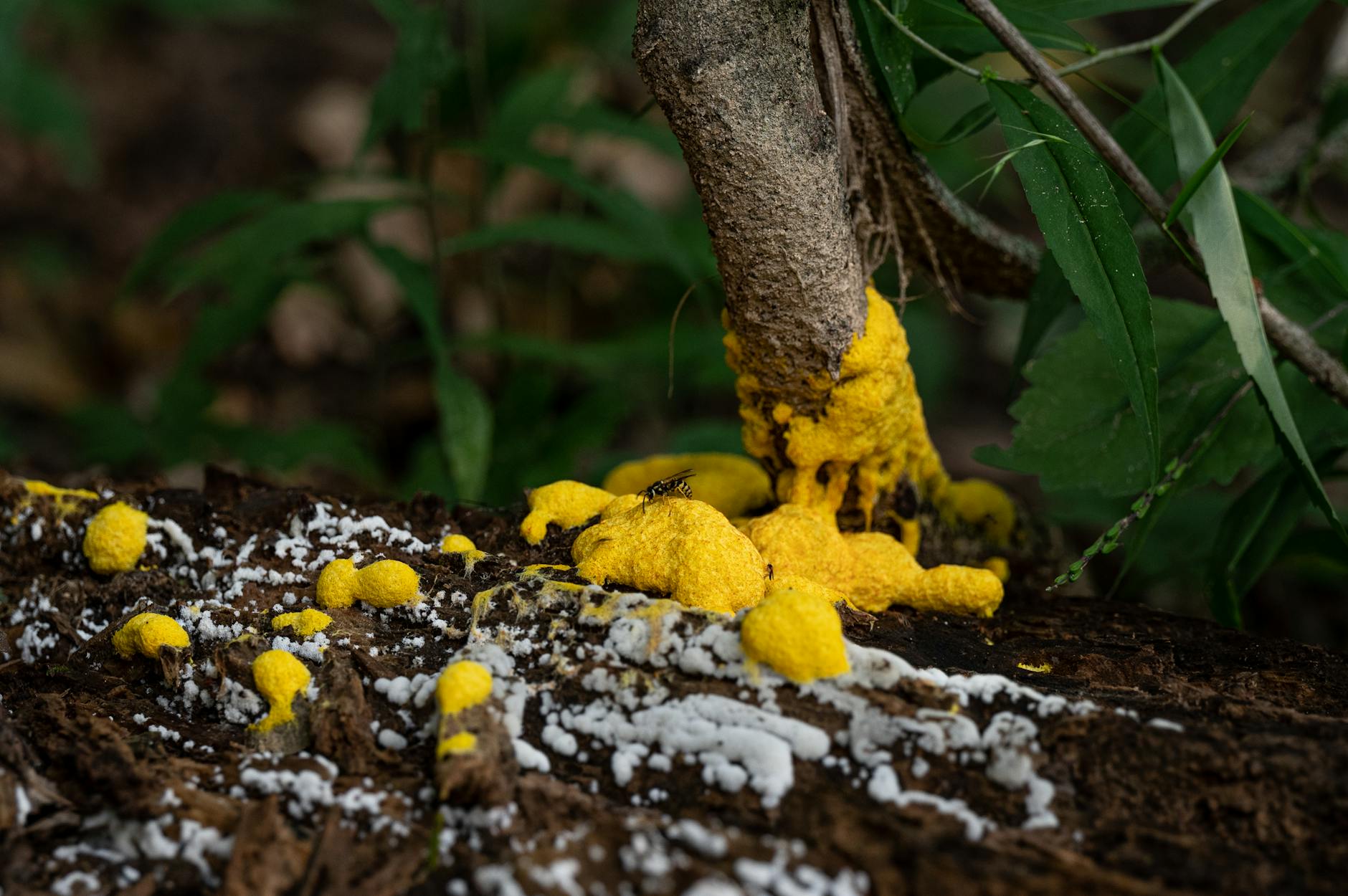
Slime moulds lack brains But still can get around – Navigating maps and mazes, Simple cells yet going places ! Building networks for our trains, With tunnels through the ground – Their tendrils stretch and seek and probe, Across the petri-dish and globe.
Out there in the wood Is the old oak tree, Just lapping-up the sunshine, All of it for free. But there in its branches, There lies the mistletoe, Just sucking-up the sap Of its clueless host below. And there on this shrub Is a little caterpillar, That’s munching on the leaves Like a cute and stealthy killer. And inside of the bug there lurks The grubling of a wasp, As it chews-through the organs, Squatting like a boss. But inside the grubling Is another, smaller maggot Of a teeny-tiny wasplet That will wear it like a jacket, And inside of the maggot Is a nematody worm, And further inside that There is a microscopic germ Of a fungus, creeping silent Through the gut-within-the-gut, Which is home to a bacterium That spawns itself in glut, And yet even that must make space To the lurking of a phage, Which is suffering from oxygen That tears apart its cage. So they each are chowing-down, And they each are getting fatter, Till they burst-out of the body, That they leave in such a tatter. But the enemies of enemies Don’t turn-out to be friends agen – Just ask the plague that bit the fleas, Then bit the rats, then bit the men…
So, I asked AI if such a Russian doll is possible, and it thought it was – though vanishly unlikley, and the length of time that all eight trophic levels could be ‘eating’ at the same time is a matter of minutes before one of the levels is killed.
Of course, inside of every cell in every multicellular-body’s body is the remains of a possible parasite, in the form of mitochondria. But over time, evolution tends to find that the healthier a parasite can leave its host, the better the tenant does as well. But bacteria can get in on the act as well, with their viruses that would co-opt their landlords into making a sex pilus to infect other neighbours, and accidentally carried across some of their host’s DNA with them and thus enabled the unintended spread of antibacterial resistance…
Sea monkeys aren’t monkeys, Never will they be – They don’t live in the trees And they don’t live in the sea. These brine shrimps are no chimps, They’re bugs with jointed limbs – Such fascinating little imps, Or tiny specks who swim. There’s plenty fun invertebrates, But these are pretty scant – If you want pets that resonate, You’re better off with ants. Funky, shrunky monkeys, Who are oh-so very wee – They’re glorious, but also junk, As dinky as a flea.