Ancient wisdom always seems To favour pure and nat’ral artefacts, The stuff of philosophic dreams Of unmined hills and untapped cataracts – Yet crying for such simple ways From modern lives of iron, wells and mills, They lounge and think away their days, While harder-working peers must hone their skills To hew and dig and chop and grind, And turn the world into a workshop floor – To build the surplus so a mind Has food enough to ponder nat’ral lore.
Taoist, I’m told, should be said with a ‘D’, As ‘Daoist’, as voiced in the throat. By why must it be then written with ‘T’, To wear both a cloak and a coat ?
Perhaps the Chinese say it between, But not so our English tongue – So we must decide which way we lean, And write it like it is sung.
A miniature cricket, or maybe a ’hopper, Has found its way into my flat. I thought that the spiders would send it a-cropper, But they’re having nothing of that ! It could be a locust, but that would be holier – Easy to spot though – bright green on magnolia !
I feared it was munching my windowsill cactus, But I see no evidence there. I guess the poor thing must be fasting in practice – My ceiling-top cupboards are bare ! It doesn’t have wings, so it’s still just a young – It’s legs are un-hopped, and its song is unsung.
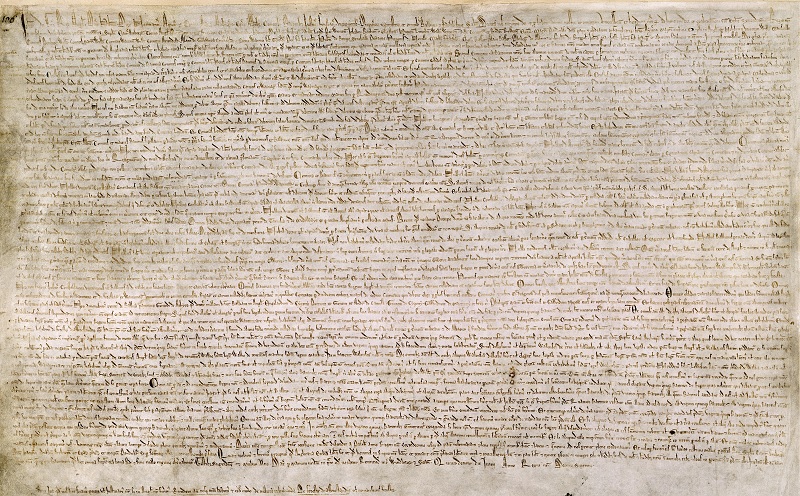
Thirteen copies were written, at least, And probably many more – All passed from bishop to sheriff to lord, And pinned-up, read, and, finally, stored, Then rotted or burned or thoroughly creased, Until we were left with four.
But then, for many centuries, Their words were out-of-date – Their scutages and fishing-weirs Belonged to long-forgotten years, And busy parli’mentaries Have moved on the debate.
Their Latin text is cramped and clipped, With not an inch to spare. And just like half the baron knights, We cannot even read the rights We’re gifted by this foreign script – We have to trust they’re there.
But so what if the parchments fade ? They’re passing, mortal things – It ain’t the laws that they imparted, But the movement that they started – In their image we are made, Who bow to laws, not kings.
“We will remove entirely the kinsmen of Gerard d’Athée from their bailiwicks, so that in future they may hold no bailiwick in England. We will remove from the kingdom all foreign knights who have come to the detriment of the kingdom.”
Magna Carta, 1215
English rights for English barons: That was the cry at liberty’s birth – And though they’d gag at the thought, would the barons, Their rights would trickle down to the serfs. Slowly, slowly, and bloody hard-won, Till the days of the tyrant-kings were done.
But nothing but exile for Gerard d’Athée, Farewell to Engelard, can’t let you stay, Goodbye to Guy, and to Guy, too-da-loo, Au revoir, Peter, and Andrew, adieu, And Geoffrey and Geoffrey, your fate is the same: Deported by charter in liberty’s name. And Philip (and brothers), return to your sires, Ex-Sheriff of Derby- and Nottingham- shires.
So there it was: the English disease: Scraping-up some scapegoats for their sleeping in our bed. But never for a moment did we get up off our knees To kick out at the barons – so we kicked the French instead. This lack of disquiet from locals is telling: Just tugging at forelocks instead of rebelling.
But surely things have improved ? It isn’t as though the world hasn’t moved: It started a wave that has kept rolling on, So we’ve far more rights now than had even King John. But all the un-English may find us less caring, For English-born freedoms were not made for sharing. So tell, Magna Carta: just what are you for ?, But a thing to suspend when we’re neck-deep in war.
The quote above is actually elided from half of clauses 50 (which does indeed go on to name nine individuals as well as two additional sets of ‘brothers’), and also part of clause 51 which continues the thought – although in the original, the clauses were not infact numbered. The first to do so was George Ferrers’ English translation of 1534, while the modern numbering dates from William Blackstone in 1759.
Study of the Head of an Old Man with Curly Hair by Rembrandt
Nala
I know a man who’s all at sea, But that’s alright, for he can sail – He knows the winds, he knows the tides, And where the undercurrent hides. And back on land, it seems to me, He’s just as calm within the gale – He’s not afraid of getting wet, And trusts upon the course he’s set.
He knows his destination isn’t fixed, But just a stated aim – The breeze may have its own idea That he can’t fight, but still can steer. He is a man of air and water mixed, An old hand at this game – But even sailors sometimes wish For fresh dry clothes and no more fish !
I know a man who’s all a-shore, Who dropped his anchor on the land And found a port to beach his hull, And trade the blackbird for the gull. Yet still he hears the breakers roar, And finds the driftwood on the sand – But he’s content to furl his sails And leave the whale-road to the whales.
The urban billboards haven’t been updated now for weeks, Still enticing us to salons, bars, and holidays in Rome, Or advertising musicals that never got to open Or for services from businesses where nobody is home.
I always used to hate these hoardings, snapping at my eyeballs – But now they seem so innocent, with cheery friendliness. Their absence feels more communist, without their bourgeois mindwash, Replaced by public notices to queues and cleanliness.
June is full of unexpected flowers – We shouldn’t be surprised at such, We know these buds exist in theory, But we never think of them that much. I don’t mean roses or hydrangeas, Where the blooms are solely why they’re bought – But rather in the offhand places Where the flowers are an afterthought – The lively sprays of privet blossom, say, Or potato’s multi-coloured spawn, Or dead-nettles with snakeheads raised, And teasing frills of clover on the lawn. For ev’ry showy thug like bindweed, There’s small-and-many thyme and poison ivy – Where oxeyes lord it over the daisies, The plantain spikes are defiantly lively. A shock of yellow in the verges, Wastelands looking oddly brisk and bright, And brambles showing their softer side, While shy little sundews and chickweeds fleck with white. They don’t do it for us of course, These unassuming emissaries – And we’ll forget, then be surprised again By the Autumn’s unexpected berries.
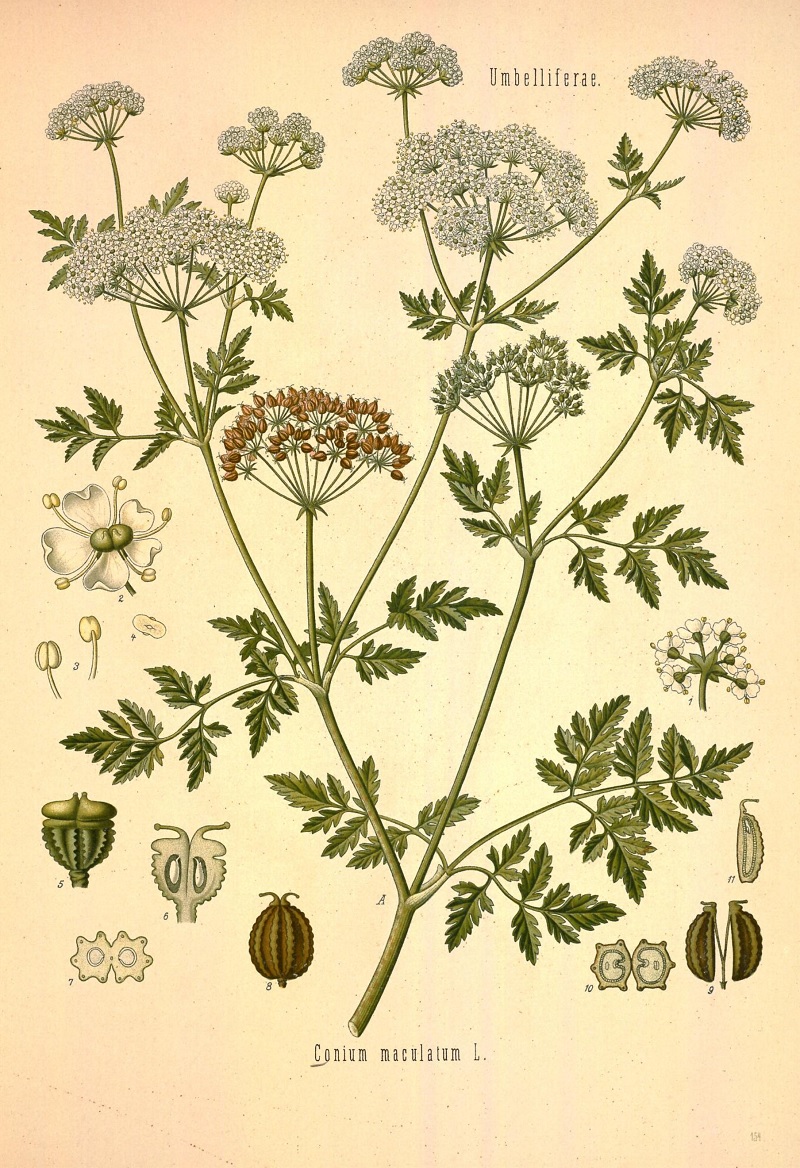
Hemlock, as shown in Medizinal-Pflanzen (Medicinal Plants) by Franz Köhler
One Plant’s Meat is Another Man’s Garden
Hemlock won’t kill us, Despite all its poison, (And not for the warnings that textbooks all parrot.) For why would we eat it, right there in the hedgerow ? It doesn’t look that much like parsley or carrot.
Since when do we sample the leaves and the berries Of any old weed in the wild ? How bizarre ! We buy all our veg from the market and grocer, Who hopefully know what the diff’rences are.
And meanwhile we cherish the monkshood and foxglove, And nurture their weapons without any fuss. But hey, there’s no danger admiring their flowers, For light cannot carry their toxins to us.
Buttercups, daffodils, rosemary, poppies, And holly and ivy, and conkers and yew. We’re much more at risk from a field of grain – From the carbs that we bake, or the booze that we brew.
Animals know well to leave them alone, Whether ragwort to nightshade – just ask any herder. And humans will likewise spit bitterness out – So we won’t die of hemlock…unless it is murder !
Siroccos blow across the Sahara, North from the desert to the inland sea, Where Mistrals meet them, off the Alps, To buffet the coasts of France and Italy. The Helm roars in from Winter Norway, And the Bora from the Steppes out East, But most of all, from gale to zephyr, None can blow as often as the beast – From out the West, with not a name but Westerly, He comes, and comes, and rarely drops for long. He’s blowing turbines, hats and weathervanes, From Summer-teasing soft to stormy-strong – Bringing the Atlantic in his clouds, And laden schooners in his wake, From Kerry landfall to the Humber, He’s the one for whom the branches shake. In truth, we rarely name our winds in Britain, Save to tell us where they’ve been – And Westerlies are born on ocean-blue, In cloudy-grey, to keep our island green.








 Rhyming Couplets