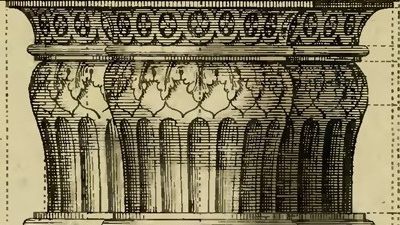
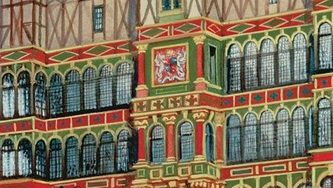
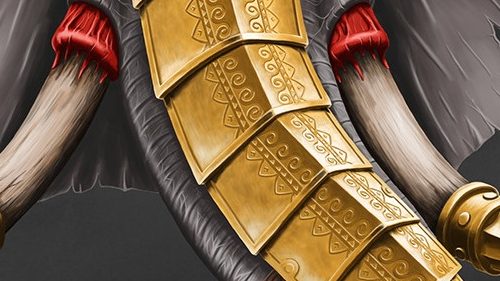
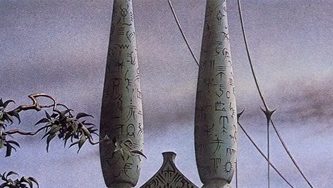
An illustration from Gothic Architecture Improved by Batty Langley, with engravings by Thomas Langley
Basilica Cistern
The columns are far too carved To just be buried neck-deep in water – They have to have been acquired from older stock, Reused to order. What once held temple pediments, Perched on Corinthian tops, Are now a vaulted forest Lurking underneath the shops. There swim some carps between the bases Of this Roman reef, That graze the algae off the wishful coins That glint beneath, While downside-up Medusas watch The tourist lines go by – They’ll still be here a thousand years from now, Through wet and dry.
Alas, yes. So here are this year’s entries. I’ll be honest, a few of these are a bit shoe-horny, where I had more than one idea for a word, so one of my verses would have to find a new home…
Remember as ever, these are just meant to be an idle doodle, not Pulitzer-bait. They’re also trying to be fun, so let’s keep it light. Also returning from previous years are the the random artworks that barely relate but are a good showcase for some interesting finds.
Beefeaters, wellingtons, toads-in-the-hole, Morris and molly and May-round-the-pole, Our feet may be English, but German our soul, As we spin to the Saxony stride.
Volkswagens, Porsches, and Beamers and Mercs, Beethoven, Handel, and Kraft-at-the-works, Our ears may be English, but German our quirks, As we turn to the Teutonic tide.
Some say Bavaria, Some say Vienna – The where and the when are Long lost in the swirl. Spinnen and spinnen, In cotton and linen – From Bath to Berlin, In a wurlitzer’s whirl.
Fish-and-chip, tea-and-jam, bubble-and-squeak, Stiff-upper sorries and tongues-in-our-cheek Our words may be English, but German our speak, As we pulse to the Prussian parade.
Rottweiler, doberman, alsatian, spitz, The Hamburger Hans and the Frankfurter Fritz Our names may be English, but German our glitz, As we shimmy with Swabian suede.
Wange to wange, From oompah to banger – It’s no doppelganger, But dancing for reel. Schneller and schneller, In ev’ry bierkeller – It’s no tarantella, But spooling its spiel.
Yet another piece of art That leaves me cold, alas. Just another and a yet-another ‘no’. The wrong approach, the wrong result, Too simpering, too crass, And my mood is never right to watch the show.
It makes me feel so guilty, So unworthy, so frustrated, To be whingeing when around me all are joys – I wish I could’ve relished All the culture that I’ve hated, But I can’t control what moves and what annoys.
Now, it’s fine to be quite vocal In a place where that’s expected, But let’s not dwell on the downers for too long – Just say our minds, then keep our peace, Don’t be so disaffected That we’re ever harping-on the same old song.
The world is full of other people’s taste Of ev’ry measure – All because the world contains both them, and I. Suppose I should be glad That it is bringing so much pleasure – And I don’t pretend it’s easy, but I try…
But the one thing I have well-learned (Though I don’t always obey it) Is to hush my humphing lips before they run – Don’t be a carping-critic Who will always loudly say it, To prevent my fellow viewers having fun.
Yet another movie, Or a song, or work of art – But hey, there’s so much more I’ve yet to see – Statistic’ly, there must be stuff out there That pumps my heart, Just hiding in the piles of not-for-me.
Cats love milk, everyone knows it, Even the cats know it’s true – All of common culture shows it, Cats just love the moo ! Since Aesop told the ancient Greeks, The white has dyed the wool – As ever since, our folklore speaks of it By the saucers-full. Except…they can’t digest it, No, not even when it’s creamed – They’re done with being breast-fed Since their kitten-selves were weaned. And yet, the tales are prominent Throughout the milky West – I guess we lactose-tolerants Think good-old breast is best ! But blame for this situation Is not ours alone, at that – For this dangerous temptation Is such catnip to a cat. For mogs won’t learn the lesson, As they glut with ev’ry lap, Never knowing how they’re messing With a lit’ral booby trap.
The reference to Aesop is a bit of a cheat, since his fable The Litigious Cats centres on a dispute over a piece of cheese rather than milk – but cheese is just as unstable to felines, so I reckon it counts…
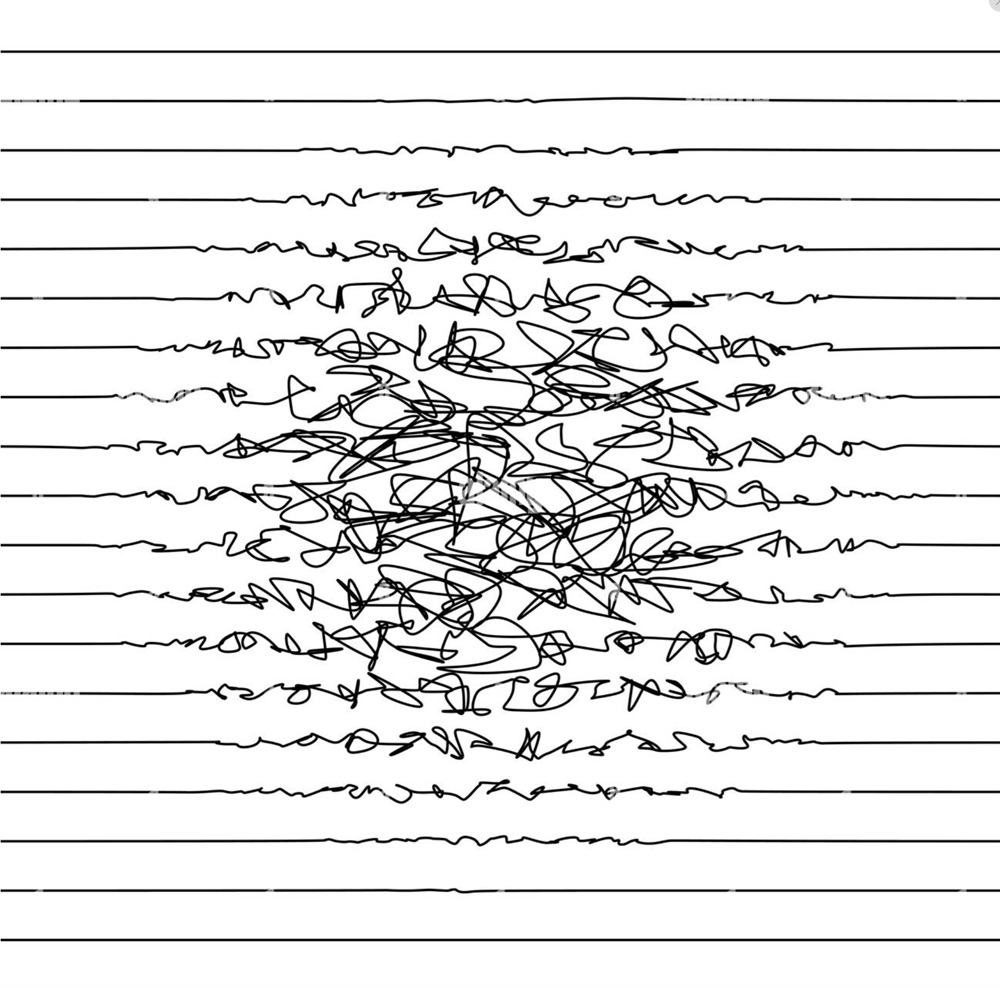
I cannot think of something worse Than writing long by hand – How much is my electric verse Beyond my wrist’s command ? It’s only thanks to ones and noughts My words are ever read – Or else, my messy, speeding thoughts Would never leave my head. For who would bother to unpick My blotchy, crossed-out pages ? But thankfully, I type and click My wisdom for the ages.
Humans have been farming fungus Since the old days of the Tang – The jellied-ear perhaps was first, And up the mycoculture sprang ! Shiitake and enoki, Grown on logs and straw and bran, Until in damp Enlightened France, The button mushroom crop began.
Strange, the Romans loved their fungus, Yet they never learned the knack – And the monks were so productive, Yet they only gave the yeast a crack. Although, it proved quite tricky Unless sterilized for pathogens – Far easier to forage in the woods That mess around with pens.
Meanwhile, folklore had been busy, Earthy names for ev’rything – Observe the toadstool and the stinkhorn, Bird’s-nest and the fairy ring. But where were all the memory-rhymes On which ones was it not worth risking ? Or how to tell a puffball From a death cap or a poison pigskin ?
Perhaps there are no generalities To indicate the vicious – One-by-one, we learn how white gills, say, Are deadly, or delicious. Ugly textures, noxious smells, May sometimes show vitality – Their looks do not align at all With fairytale morality.
These days, though, the urban myths Are more concerned with mould and spore, And in hallucinations, And the nuclear clouds of war. The time of the destroying angel’s Shrouded in mediaeval mist, Or from genteel whodunnits, Or a pith-helmet nat’ralist.
Humans have been farming fungus, Fascinated with their fruits – Not really understanding them, Yet sniffing truffles out of roots. These days, it’s all commercialised, To keep safe ev’ry cassarole, Without an unintended killer In our toadstool-in-the-hole.
The Chinese appear to have been farming Auricularia heimuer (aka the Black Wood Ear Mushroom) since the Tang Period (10618 – 10907 HE). Their local name for it is ‘heimuer’, subsequently used as the species epithet. However, I have been unable to find any guide as to how this is pronounced. I think it may be something like high-moo-er, but that sounds more like a cow who has been feeding on a rather different kind of fungus…
Self-Portrait as the Allegory of Painting by Artemisia Gentileschi – the poem isn’t about her, I just like her painting
Journeyman Artist
I’ve had to cut my prices, As my canvases decrease – No more ultramarine for Mary, No more golden fleece. My landscapes are a full foot shorter, My Christ Childs have eight toes, And the sitters for my portraits Must do so in simpler clothes.
Another painter has come to town, And she’s splashing her vibrant hues around – A lady artist ? Such novelty ! She’s practic’ly selling the things for free !
The trouble is, she’s also good – But who could have trained her so ? I’ve spent the last ten years with a master, Just to learn what I know. How is her flesh so creamy pink, And how are her eyes so white ? How does her satin fold in waves, And her corsets clasp so tight ?
Another painter has set up shop, And patronised by the very top. Such soft, quick hands – so how will I cope ?, As she grinds her pigments and crushes my hope.
What must I do to watch her work ?, As she blushes her client’s cheek ? And how can I stay professional, As her brush-strokes leave me weak ? But I must – she’s an artist like I’m an artist, We’re brothers of the palette, are we… But alas, she paints her angels and muses Just as pretty as she !
Another painter is plying her trade, And I know I should cheer the progress she’s made, So I daren’t compliment the curves of her dress, Or the delicate breasts of her shepherdess.