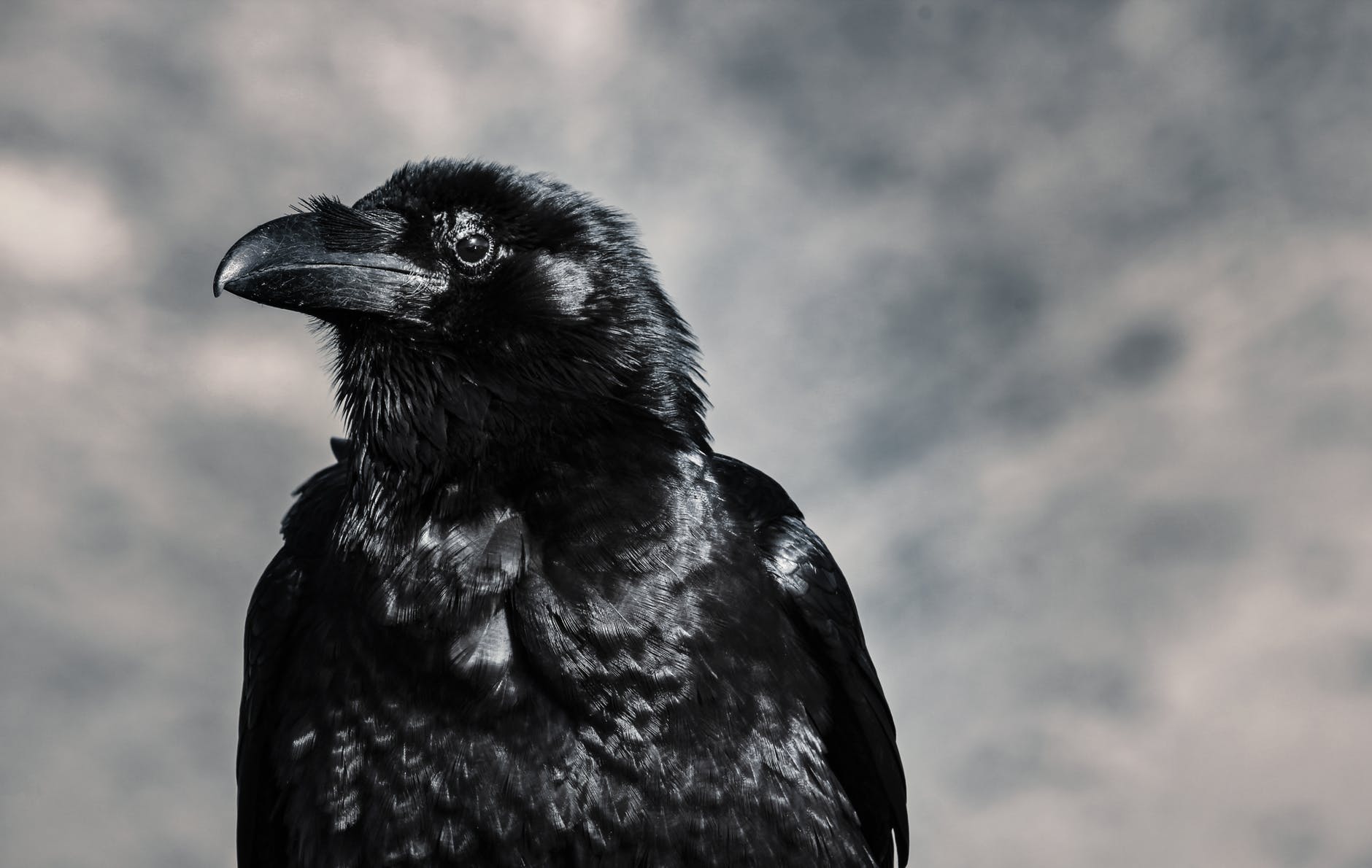
Why do ravens always wear black ? Do they want to blend in with the pack ? Are they just too shy to be pizzazz ? Are they just too moody, cool and jazz ? Why are they dressed in Sunday Best, not tweeds ? Are they decked in mourning, veiled in widow’s weeds ? Or are they maybe prison warders ? Are they priests in holy orders ? Are they fed’ral agents on the wing ? Or do they merely want to go with ev’rything ? Are they goths and metalheads – or maybe simply posh ? Or are their other feathers in the wash ? So why is it ravens always wear the black ? (But if they dressed in mufty, I guess they’d get the sack.)
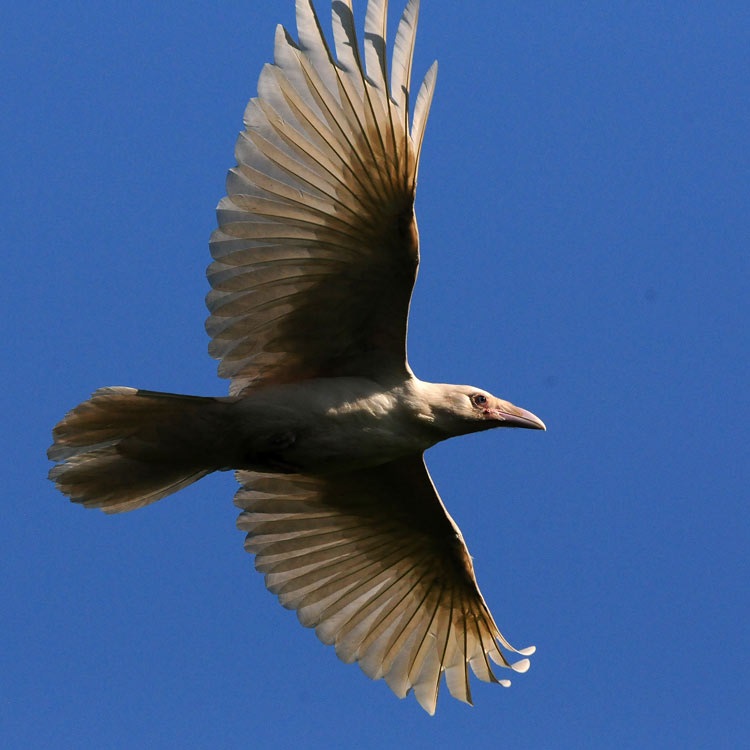
As a matter of fact, albino ravens do occassionally turn up, especially around Vancouver Island, as these gorgeous photos by Mike Yip show:
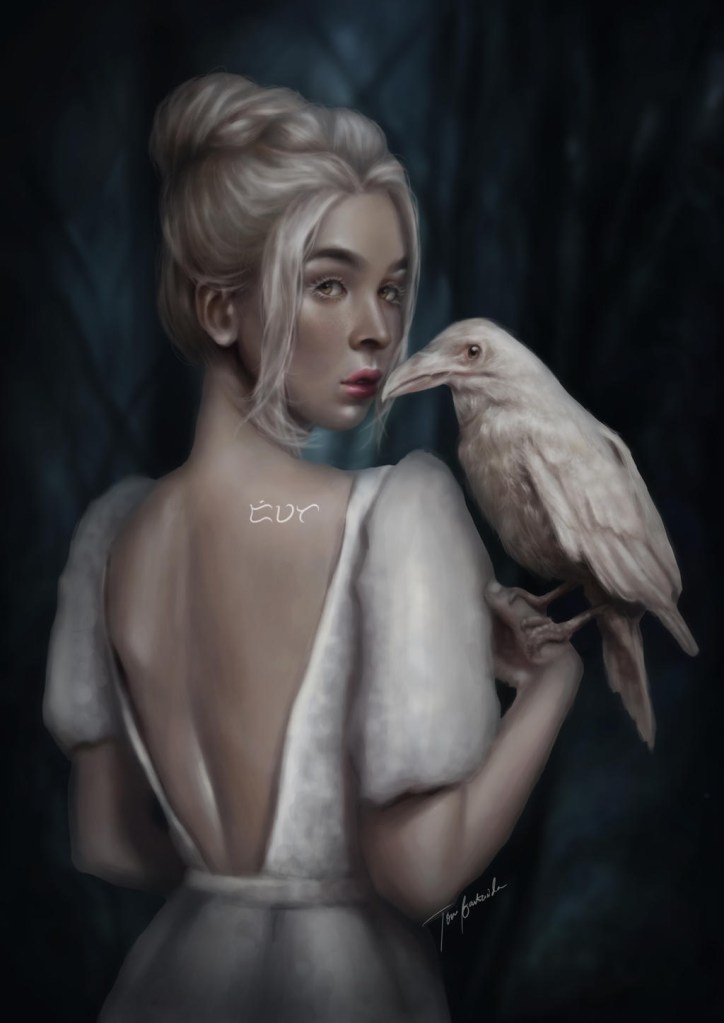
And while I’m at it, here’s a painting of one entitled Diwata by onrie07:
Vivaporous vipers give me the vapours, But I shall envelop these slitted-eyed scrapers. Rapture enripens their serpentine stare: J’adore l’addeur !Vive la vipère !
I’ll stick to the cutest constrictors for starters, I’ll string along threadsnakes, slink upto the garters, I’ll scale up the ladderbacks, slide down the smooths – I’ll dice with their snake-eyes, I’ll slalom their grooves.
Vivaporous vipers are venomous vermin, Yet I shall unfasten and welcome the worm in. I’ll love ev’ry squeezer and cherish each fanger – Ich liebe die Kreuzotter ! Heil die Schlange !
My nephew is into his dinosaurs, And he’s digging up mem’ries lain buried since school, (But still neatly sorted in synaptic drawers), With all of those crazy-long names by their scores, Though actu’ly some of them sounded so cool ! How should we say it ? The textbooks display it Phonetic’ly – tie-ran-oh-sore-us – of course ! So easy to get it, there’s no need to sweat it ! But sometime’s a wrong ’un would lodge in all twisty – And once it gets in there, it’s part of our hist’ry.
For instance, how much we all loved Diplodocus, And gave that third syllable all of our focus. So never Diplodocus, that sounded odd-i-cus, Plodding along with no hocus to poke us. And don’t get me started on cow-pat-a-saurus – Your patsy falls flat, see – just hear how we chorus This heavyweight’s name is – by god – Brontosaurus ! As known in the bones of all schoolyards before us. So pronto, restore us our sauropod’s nommus – Don’t think you can plunder our thunderbeast from us !
Which brings us around to the Puh-terodactyls – To eight-year old boys they were neater than fractals ! We’d doubt they could flap much, but bet they soared high – Though not dinosauruses…saur-iss-eez…saur-eye..? Brackies and Plessies and Tritops abounded – Though from diff’rent eras, so not all together – They’re non-chronologicus, just to be clever. We’d all love to fight for faves our faves for discussion Like Dimetrodon, cos he sounded so Russian, Or Archaeopt’ryx, with the bestest name ever.
And then there were the Trillobytes ! That’s how we called ’em in our local playground. That’s how we called ’em, so that’s how they were – And given a choice, then I’ll always prefer Our primary version to t’other way round – Brill-o-bites, thrill-o-bites, silly old Trillobytes, Nobbly or spiky, or all armadillo-like ! Cambrian glamour to Permian quitters, Those three-lobal, pan-global, crystal-eyed critters – Heroic, and stoic, and Palaeozoic !
My nephew is into his dinosaurs, But the toys have come on some since I was a lad With the latest researching reflected, of course, But the loss of those classic mistakes makes me sad – Take Stegosaurus, in Lego or plastic, It now looks fantastic, with tail held-up high – But I’m far too au fait to its droopy behind, With a second bum-brain (that we no longer find). But I guess I can’t really complain that we’re wiser – And hey, it’s still sporting a prize thagomizer !
But what of the T-rex, the king of the chompers ? I see that he still bears him his stubby front arms, But they’re no longer pronate – fergeddaboutit ! Cos my nephew informs me their bones will not fit, So they turn-in their palms, like they’re waiting to clap. And there’s vegan Iguanodon, slowest of stompers – A ponderous chap with a Godzilla-stance ? Forever a thumbs-up, the herbest of vores ! And yet now at a glance, he’s a boring old square, When reduced to all-fours with his arse in the air !
If only we’d known of Velociraptor ! If only we’d known of the feathers and fuzz ! Ah well, I guess that we’ve moved on a chapter, And I must adapt or I’ll end up extinct – But I feel that old buzz, and I swear it’s because Of the grin on my inner-twin child as he winked. And I see Brontosaurus is back with a bang – So that oughta well-learn ’em, don’t mess with this gang ! It’s time to return, but I’d best not get preachy – I’ve much to catch-up, but my nephew can teach me.
Do not mourn the dinosaurs, They had their time and lived it well. They stomped and roared for all their worth, They swam and soared and ruled the Earth.
Do not mourn the dinosaurs, Their bones at least remain to tell – They gift us sight beyond our own. To think we might have never known !
Do not mourn the dinosaurs, They caught the wave and rode the swell. Their genomes danced their warp and weft, They came by chance, and likewise left.
Do not mourn the dinosaurs, They still can weave a potent spell. Magnificent – and now they’re gone – They came and went, and life goes on.
Do not mourn the dinosaurs, They hugely reigned and hugely fell. Oh Brave Old World, who proudly bore Each wondrous, thund’rous dinosaur !
To any pedant itching to tell me that the line ‘they swam and soared’ is wrong because neither Plesiosaurs nor pterasaurs were actually dinosaurs, I’ll just point out that clearlyI was referring to Spinosaurus and Microraptor.
But speaking of which, we need a term that simply means ‘big and reptilian and pre-KT’, and I would like to propose the old neglected word ‘tellurian’. And yes, it can include the mammalian synapsids, since all mammals are really reptiles, as the pedants just love to tell us. And yes, I further know ‘KT’ is an old term as well, but tough titties…
On the Second Day of Christmas We rode out with the pack, And we galloped through the woods As we waited the attack. On the Second Day of Christmas We cast the braying hounds As they scurried for the scent And they ran the fox to ground.
So blow the horns and raise the cries, Let slip the hounds and shred the prize, And show to all your blameful eyes This menace needs controlling.
On the Second Day of Christmas We wished for peace on Earth As we hollered for the fox As we wrenched it from its berth. On the Second Day of Christmas As we cantered through the mud, And wished to all goodwill As we slathered for the blood.
So blow the horns and raise the cries, Let slip the hounds and shred the prize, And show to all your blameful eyes This menace needs controlling.
The thing about Phylums and Classes and Orders and all, They don’t really mean very much, from a-one to another – They don’t show a definite border or wall, Except that each member within is a brother. But how shall we simply compare, say, a Fam’ly of fishes With Fam’lies of insects or fungi, or some other race – For nature won’t readily yield to our wishes For systems and schemes with all life in its place.
What’s needed are rankings that indicate something specific, Like maybe the age when such clades were diverging anew – There must be a way to be more scientific That merely to shrug and decide “this’ll do”. Then maybe some Kingdoms or Phylums will prove to be hoarders, While others lack class in their Classes, now under-supplied. So finally, let’s bring an order to Orders, And give ev’ry Genus some Family pride.
It always struck me that the Linnaean ranks would be more useful if either all of their inhabitants shared a minimum percentage of genes, or alternatively that they were diverging at roughly the same time as all the others of that rank.
Note that in the old method, species is the only rank which has some actual science behind it and isn’t just vibes-based. Except…it turns out that the concept of a biological species is far murkier and less discrete than we used to think, so even this is not really true any longer. Hybrids, it seems, just keep popping-up…
But this will cause its own oddities, such as Cheliserates (arachnids & horseshoe crabs) diverging from the other arthropods in the Cambrian before all of the currently-recognised phylums had appeared, meaning these would need to be recognised as their own phylum too. So we are back to (hopefully) common-sense rough collectives showing nested sub-groups within – but this only makes real sense when we examine the specific heirarchy, but not much when we compare the same level from different heirarchies.
But either way, the idea of the phylums being the major body-plan divisions is well-established, at least in the animals. And having four intermediate levels between there and species feels about right – we now know that there have been an order of magnitude more branches (mostly petering-out in extinction), but we don’t need to capture all the complexity of the Shrub of Life, this is intended to be a layman’s tool, not a PHD.
Yet I do wish when talking of, say, the Order of Proboscidea, they would add when the split occurred – in this case, in the early Paleocene. You’re welcome.
Henry moves his vertebrates, And Louis tunes his tunicates, While Malcolm swims his sharks and skates To battle Olaf’s ranks of starfish pawns. Boris risks bacillus rods To fight with Oskar’s fungal squads, As Richard launches octopods To counter Philip’s shrimp-less group of prawns. So James arrays his gymnosperms, Like Ferdinand his cyan germs, And Otto’s nematody worms, At Charles’ yet-to-be-discovered spawns.
I should point out that the title is a mnemonic for the Linnaean ranks of life: Domain, Kingdom, Phylum, Class, Order, Family, Genus & Species. Actually, Domain is a relatively new addition, and plants have Divisions instead of Phylums (or Phyla if you’re a pedant), and the whole thing now looks hopelessly simplistic in the wake of cladistics, but it’s still a handy starting-point.
Are Water- and Cape- the more closely related ? Who knows ? Why are those ‘true’ while the Bison are ‘false’ ? I say they all are true buffaloes ! You label the grouping as polyphyletic, Like ‘shrew’ – But what does it matter their genes, when we’re talking Of big things with horns that go moo ?
So pedants and cladists may mutter and sleight, But Buffalo Gals, won’t you come out tonight ?
And did you know twenty-five cities and towns Disagree ? And how many towns in the States are called Bison ? Well well, only three ! So don’t try and tell me I can’t call the bison All ‘buffaloes’, mate ! Cos Buffalo Soldiers and Buffalo Bill, And Buffalo Springfield and Buffalo Twill, And the Buffalo Wings at the Buffalo Grill, Tell me you’re way way too late.
So pedants and cladists may grumble and snide, But Buffalo Gals go round the outside.