The Catholics do it ev’ry Friday, Or so they often claim, The Protestants, only during lent, Attempt to do the same. While unbelieving heathens such as I May join-in, if we wish, But just as an excuse, in the event, To share some tasty fish. We only seem to think of it in my day, Just as Easter comes. But still, the start of the weekend is well spent In batter or golden crumbs.
English sheepdogs, Highlands cattle, Marbled corneas in snakes, Stalk-eyed snails with pop-up headlights, Caterpillar eyespot fakes. Staring cameras tend to rattle, Black-walled, with a glossy sheen – So mask them, yet still feed them light, With eyes that see yet can’t be seen. So wear a pair of shades ? Sure, that’ll Make all nature look so cool… If only ancient life had bred right, We’d now be inscrutable ! Vision is a constant battle, How to let the photons in ? Yet we all see the infrared light Not through eyes, but through our skin.
Quetzelcoatlus, how did you fly ? By gliding on thermals ? Rarely flapping ? How did you launch your bulk to the sky ? And your massive head not handicapping ? Could you be becalmed ? Or even be-galed ? If the breeze were too strong, could it blow you over ? For every take-off, how many failed ? Were you more a hopper than cloud-top rover ?
Quetzelcoatlus, how did you fly ? When the zephyrs tugged you, how did you cruise them ? No point to ask evolution why – For you only grow wings if you need to use them. Could you be grounded ? Or just never land ? Soaring the oceans, wind in your hair ? Did you make runways along the strand ? The answers, alas, are up in the air…
By ‘wind in your hair’, I’m referring to their proposed feathers.
And since there are five of them shown above, should the painting be called Quatzelcoatli ? No. No it shouldn’t, as I’ve discussed here.
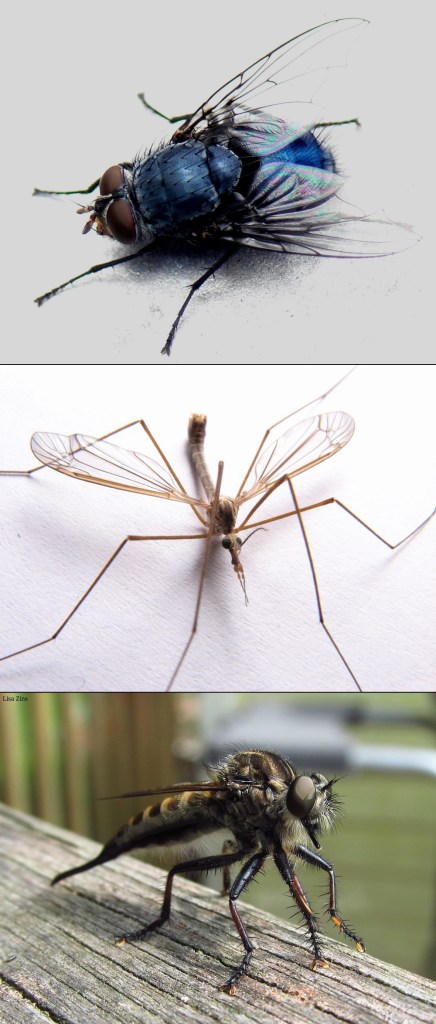
Compared to a tiny tiny fruitfly That we barely see, A bluebottle blowfly is a shiny guy, At half-a-bee. He must be big, because He is born to make a buzz – To-and-fro, darting, wheeling, Watch him go. Small enough to hang-out on the ceiling, Yet large enough to bounce against the window. My my, What a fly ! What a glow !
Compared to a tiny wee mosquito That we only hear, A cranefly is as silent as it’s slow, And nowt to fear ! Their leatherjackets may Be skeeter-eaters in their day, But there’s no meat on the menu Once they grow. And how they grow !, these slender-friends, These stilted-striders, palm-wide gliders, Gone in just a mo. My my, What a fly ! Magico !
Compared to a tiny tiny dancing gnat Within a cloud, A robberfly is big and fat, And ludicrously loud ! Aerial assaulters, Whose cheerleader-halters – Beat like a motorbike Or dynamo. With mouth-pike and bug-eye – Each giant part in all its art is big enough to spy – And what a show ! My my, What a fly ! Now you know.
There are plenty of people that will tell you that crane flies are not mosquitos and they do not eat mosquitos. They are wrong on both counts (for a given value of mosquito – they are certainly more closely related to each other than either is to a housefly, but they still went their separate ways way back in the Jurassic.) Most adult crane flies have no mouthparts at all, and their larvas are mostly vegetarian. However, with over 15 thousand species, there are always a few edge cases where the leatherjackets do sometimes eat those fidgety question marks that are mosquitettes.
Photo taken in South Korea by Hyeongchol Kim. I suspect this shows an attempt by the crow at mobbing.
Stirred-Up Eagles
As an eagle fluttereth over her young, and beareth them on her wings.
Deuteronomy 32:11
Moses, clearly, doesn’t know The first thing about a bird – The very idea that they carry their kids on their backs Is clearly absurd. Now ducks will swim with their chicks up-top, But no birds fly with the over-slung. I mean, how would they even flap And not dislodge their precious young ?
From the moment they are laid, they are watched – For racoons and owls are swift. And long before they’re fully fledged, They’re far too heavy to lift. They never leave the nest until they start to branch, And not for long. Until at last, they fly away, all by themselves, When the urge is strong.
Moses, clearly, doesn’t know The first thing about a bird – A shame, for the metaphor of these loving parents Should be heard. And a basic grasp of aerodynamics Would quickly scotch such a fantasy – But above all, enjoy them for what they are, And not what prophets would have them be.
The quote above has been elided to make it snappier, but its meaning hasn’t been changed. Some have tried to claim that the second half of the fully verse is talking only about Yahweh, and not about eagles – but if we squint hard enough to make this work out, it then becomes an appallingly bad piece of writing that changes the subject of its pronoun midway through. Perhaps this is more of a King James problem, as other translations separate the two clauses more clearly, but I guess that the Lord couldn’t be bothered to sufficiently inspire the Jacobean scribes. Either that, or the KJV is truly inerrant, and thus confirms that God is a women…
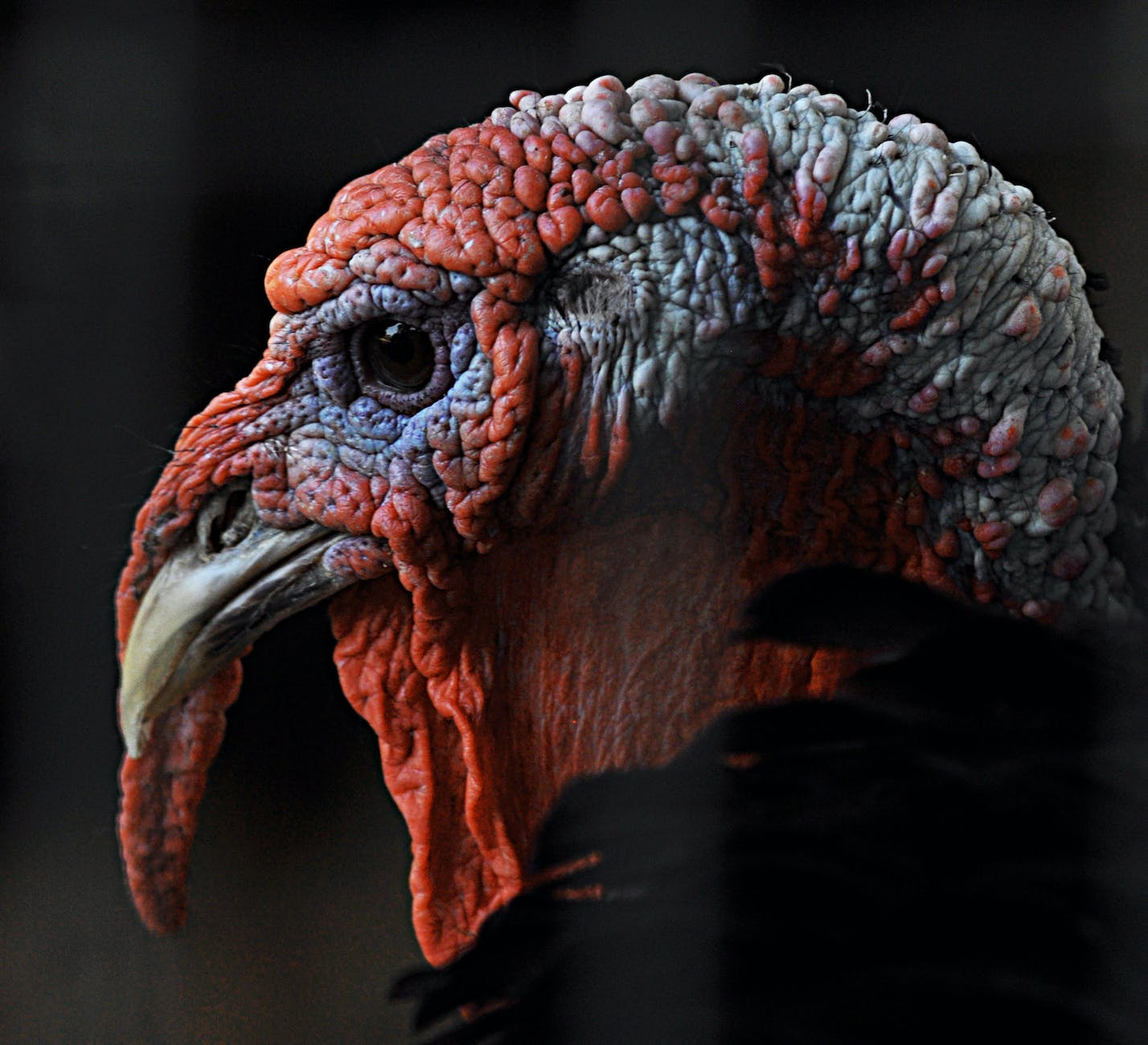
Turkeys – Flightless birds that secretly fly, Strutting, snooding, cocks of the walk Far too trusting, never shy, They land on our tables with barely a squawk. Despite a mislocated name, From Henry the Eighth to Norfolk farms, Across the Atlantic, on they came, With a boost from Scrooge to their pilgrim charms.
Turkeys – Flops and bombs and guano stinkers, Showy quills, but soon forgot Once back to work with Winter blinkers, Far from the rounds of the turkey trot. But still, they are a feast well-spent – And even cold, they set us free… With a pardon from the President, Or a gobble to bid bon appétit.
I grew up on farms, I knew my barns, And knew the owls inside. As paragons of myths and yarns, They sure did love to hide. But even with their silent wings, I’d sight Their calling card, And know they still clocked-in each night From pellets round the yard.
The barn owls are the perfect owls, In look and lore and size. With heart-shaped masks and earless cowls, And wisdom in their eyes. Until, that is, they won’t stay mute, But let loose with their speech – And utter not a single hoot, But a disappointing screech.
I heard the twits and twooing too, From tawnies in the trees, But only from a distance, flute and mew, In two-part harmonies. Yet round the barns, I only hear the shriek, Not the trill of charm – The wrong voice for the owl I seek, Of the poet of the farm.
Owls, of course, have their own concern, And do not care for me. And I should take their lead to learn To let their natures be. So when the golden hour is full of cries I now can grin As the night-shift owls in the barn arise And start reporting-in.
Diablophis & Ceratosaur by Julius Csotonyi. The former is exiting through the orbit and curling around the lacrimal bone (which looks like it ought to obstruct the vision of the eyeball behind, but I guess not…)
Canis lupus canis
Wolves, it must be said, Make a rubbish pet – They’re far too wild and free. So get a husky instead, If you want to get That echo of prehistory. And the malamutes as well Have the tundra feel, And even alsatians at a squint – Most laymen cannot tell Which ones are real, They’re built to the same blueprint.
But for all dogs look like wolves, With their shaggy coats In black and white and grey – They’ll act like dogs, not wolves, Won’t rip the throats Of our toddlers when they play. Our forbears spent many tens Of thousands of years, To breed-out the threat in the growl. To be our deceptive friends With the upright ears, Who will never bite, but can still howl.
Note that a husky is no more closely related to a wolf than is a pekanese or a dachshund. It’s true that huskies can still interbreed with wolves, but again this is true of all dogs (logistics notwithstanding…).
Whyever are woodpeckers Logged by how they’re spotted ? Why are we such checkers Of how many lots we’ve totted ? And is the greater-spotted greater In the number of its spots ?, Or is its name a commentator On the quality of dots ? Or is each polka such a size, They’re practic’ly uniting ? Or are the spots our searching eyes, Recording ev’ry sighting ?
Since woodpeckers are more likely to be heard than seen, perhaps it’s a reference to Spotify…?