From the First Notes of Dawn to the Last Chords of Dusk

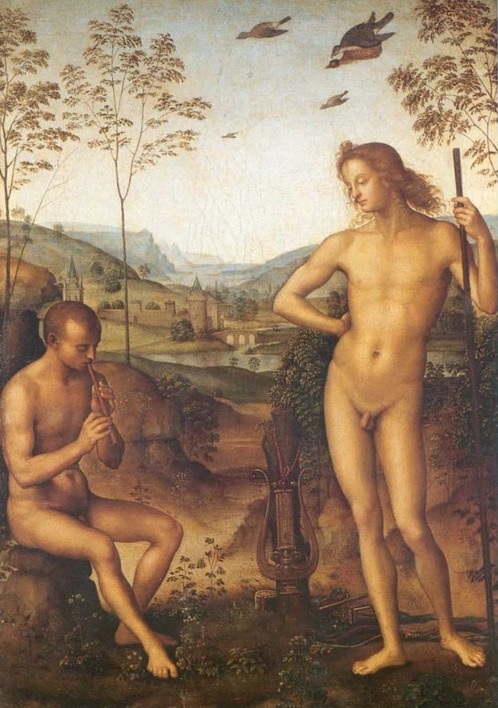
apollo & marsyas
Apollo & Marsyas by Pietro Perugino

From the First Notes of Dawn to the Last Chords of Dusk

        1.
Praise Apollo, Sun and Light !
Praise the hand-harp glorifier !
Plays them strings like dynamite,
Plays so far he’s outasight.
Bringing on the dawn with its mojo rising,
Day-long solos from his nuclear fire –
And as for his vocals, you should hear the guy sing !
From early-morning blues to evensong choir.
He plucks and strums it,
Twangs and drums it,
Whistles and hums it till his rays expire.

        2.
But to Marsyas the shepherd,
Dusk was no time to retire –
So he heckled undeterred
This yawning, lightweight, early-bird.
“Eager rising, my premising
Says is most unhealthy and absurd.
Dawn despising, my advising
Says is only nat’ral and preferred.
For those of us by music stirred
Think morning is a dirty word.
And what bards view his skies of blue or clouds of white ?
Or ever gets to see Apollo’s pyre ?
We rise with the lunar satellite
To score the shadows, sing the night,
And likewise dress in black attire.”

        3.
“So a challenge I declare,
Apollo,” said this acolyte.
“Dude, I gotta tell you square
I love your image, dig your hair,
So please don’t think that all my criticising
Is intended as a jealous slight –
But you, without your even realising,
Lost, I say, your promise and your bite.
Let us both play, if you dare,
Before the Muses, maidens fair,
To blow their fuses, lay them bare.
And they shall judge between us, good or dire:
Who’s all that or who just cruses,
Who’s got nout and who’s got flair.
(And man, those spacey chicks can sure inspire.)”

        4.
Thus the play-off was before
These groupies egging on the fight.
Order settled by the straw:
The kid played first.  (He’d lost the draw.)
This farmboy fresh from out the shire
Lets his magic flute ascend and soar
As swooping melodies explore
And drift in phrases reaching ever higher –
Never shrill, but weightless flight,
Aloft, a-dream, their souls alight,
He sates their ev’ry appetite.
Then comes a shift, the notes downpour
As raining from the sky they roar –
Led on, led on: this pilot-piping flyer,
Who brings them home with themes comprising
Of a thousand heights or more.
Surely now the gold he’s sizing –
How can old Apollo match this score ?

        5.
Picking up his trusty lyre,
Tuning up the strings a nock,
Stroking soft each tension-wire,
So he turned to his defier:
“Son,” he said, “for all you mock,
You’re not just crock, I’m no denier:
Prince of Pipes – the Fluting Jock.
Now, Mister, go home to your flock –
For I am King, and you will call me Sire.”
Suddenly by some strange sleight
His strings were ringing loud and bright,
The very air his amplifier.
He could make that catgut weep, and tenderly suspire.
Now the god was energising
Thrashing up the fahrenheit
Bass-enticing, tenor-prising
Vaporising kryptonite.
Squealing strings – discordant crier,
Then teased from the aftershock
A melody so pure and sprite:
The long-lost chord to which we all aspire.
“Son, for all your poppycock
You really tried, you weren’t just schlock
I’m almost sad to clean your clock –
But this gig’s mine, you neophyte,
For you might fly, but I can rock !

        6.
Waiting for the girls to sum it,
Who would get the nul point blight ?
Not our Marsy, for he’s won it !
Blow me down, the kid has done it !
He made all the dames ignite –
Faced the music, overcome it.
But this god won’t take the plummet:
“Just a moment, squire.”
Apollo turned his harp capsizing,
Upside-down he plays, reprising
All he played before entire.
“Can you do the same ?” came his enquire.
“Course I can’t !” the boy said, wising
To his sudden shaky plight.
“Flutes don’t work like that, as you know quite.”
“Okay, then, no need for spite,”
Apollo said, “I’ll turn mine right.”
And so again he played his harp – but still the artful tryer,
Now his voice was synchronizing,
Sweetly singing, improvising –
Such a voice !  And who can not admire ?
Swiftly was the kid cognising
How he’s losing out his prizing,
But his protests only mire –
For, Apollo makes surmising:
“Do you not use your breath to expedite
The notes within your flute ?  And might
Not I use breath to best excite
My strings, with my sweet harmonising ?”

        7.
Then came to Apollo’s aid
The Muses, (each a sweet-faced liar).
Soon the lad was cast in shade,
As Sunshine charmed each fickle maid.
They chose again their jollifier,
And upon the brow divine were laurels laid.
Apollo rent his godly ire:
Had that shepherd bound and flayed
He flogged the lad himself, to see him slayed.
Strip by strip his agonising
Sucked his wind and gasped his breathing tight –
The breath he blew with, this chastising,
Stole away forever, ev’ry smite.
“All this for a flute” he whispered as he paid,
“It is too much.  Your lashstrap is a critic’s blade.”
At this Apollo brought respite,
The execution briefly stayed,
To answer him on how he’d strayed:
“You thought my Sun was old, must surely tire,
Yet with age comes cunning and desire:
When we dim, we fight on smarter, ruthless, slyer.
It’s only talent makes the grade –
It ain’t what notes you blow, it’s how they’re played.”
Equant & Deferent

razor
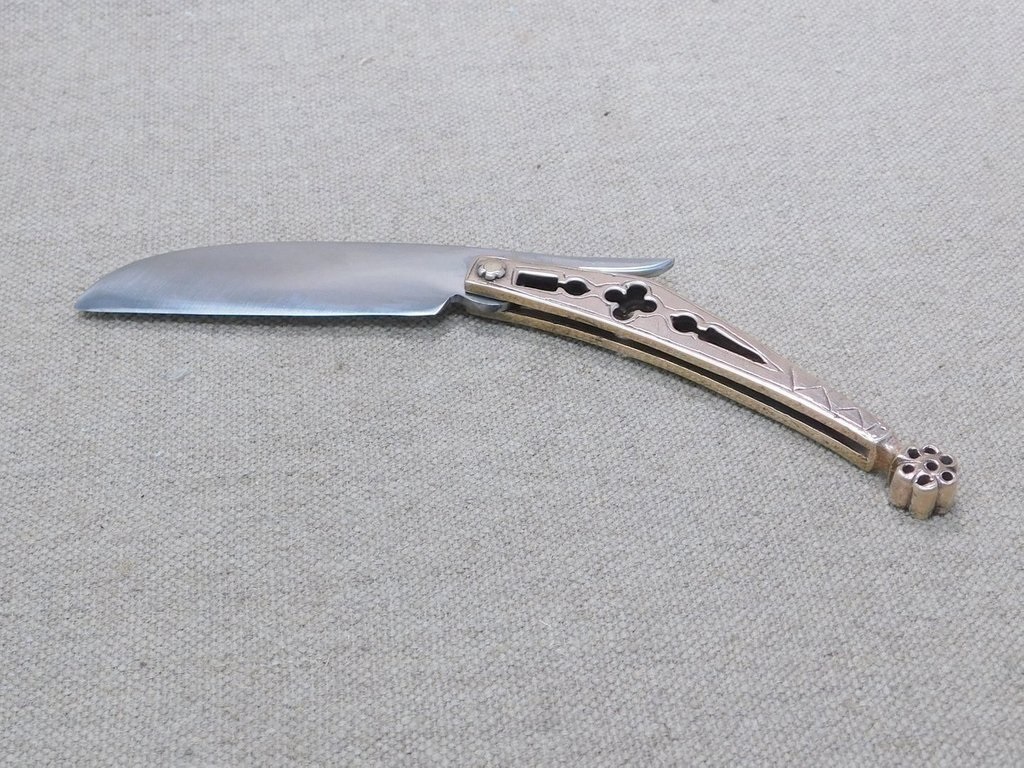
A reproduction of a 1300s razor by Tod Cutler

Equant & Deferent

The ancient Greeks were pretty clever,
Worked out that the Earth was round
From shadows cast by poles at noon
And by the Earth upon the Moon,
And how the sky was put together
Just from watching from the ground,
And some who guessed a central Sun
About which all the planets run.

But then along came Aristotle,
Then along came Ptolemy –
And they alone would set the tone
Till their mistakes were set in stone.
The hand is dead, but still can throttle,
Piously and solemnly,
Of any thought that might get out –
So hush the whisper, choke the doubt.

But still, but still,
The more we looked, the more we saw –
The though the heavens mostly draw
Upon the Ptolemaic law,
They sometimes would exert their will
That rubbed enquiring watchers raw.


You see, the ancient Greeks well knew
That crystal dome and ev’ry gem
That all the night, without a rest,
Would wheel above from East to West.
And like the stars, the planets, too –
Though slower, losing ground on them.
Except…well, that’s where trouble lies,
With yearly yet unruly skies.

Because they each would switch their motion,
With the stars, and overtaking !
Week by week, the Greeks would trace
The way the planets dance and race.
So Ptolemy proposed a notion,
Saved the universe from breaking –
Sure it was all fudge and spin,
But epicyles for the win !

But here’s the thing –
For all its complex shells and reels,
For all its windmills within wheels,
It somehow kinda always deals
With accurate positioning,
As though the sums would guide their heels.


So if the Greeks were badly off,
Well, spare that scoff – they did their best
With nothing but a pair of eyes
To theorise what they can’t test.
But did they ever pinch their gaze
And mutter at the tangled ways
In which the heavens spend their days ?
Did even Ptolemy have doubt
And long to hack the deadwood out ?


The Romans, though they changed the names
(From Krios, Aries, from Ares, Mars),
They kept the skies just as before,
For fourteen hundred years or more.
And though the planets’ little games
Were thought as written in the stars –
A monk proposed a new appraiser,
Slashing bunkum with his razor.

Simple answers, they’re what matter !
Less is more than meets the eye –
If two proposals have to fight,
The simplest one is often right.
And all those epicycles clatter
With a clean, efficient sky –
Forget the Church and ancient stuff,
Copernicus has had enough !

And yet, and yet,
Despite his perfect circles round
His central sun, we quickly found
Like Ptolemy’s, they ran aground,
Till Kepler and ellipses met –
And suddenly, the maths was sound.


Truth be told, Copernicus
Had little proof on which to base
His unbound Earth and steadfast Sun –
In faith alone, his planets spun.
But still the world must turn, and thus,
Young Galileo took his place –
Perhaps with fewer facts than hope,
But this time with a telescope.

And in the eyepiece, clear as night,
The moons of Jupiter were seen –
As though the planet gave them birth –
And not in orbit round the Earth !
And better yet, the startling sight
Of Venus phasing inbetween
A smaller full and larger new –
And then the revolution flew !

So here’s the thing –
With claims of modern matter dark,
And energy with unseen spark –
Has it the proof of string and quark ?
Or do they chase around a ring
To make the model fit the mark ?


And like Copernicus, they could be right,
Despite a lack of evidence.
Or like old Ptolemy, they could be wrong,
Yet strong in their defence –
His theory held up, truth to tell,
In matching observations well –
But oh, it was a complex hell !
So scientists, and heaven-gazers,
Never lose your sharpest razors !

No Rest for the Blessèd

zombies
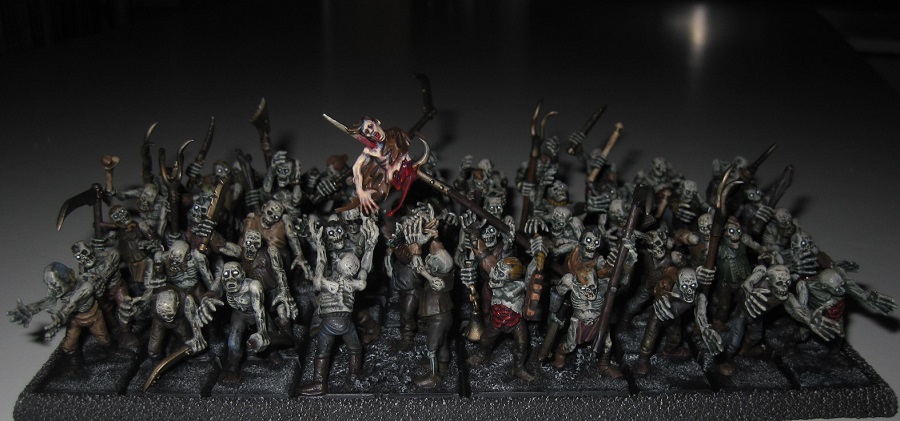
Zombies by podagrog

No Rest for the Blessèd

“And, behold…the earth did quake, and the rocks rent; And the graves were opened; and many bodies of the saints which slept arose, And came out of the graves after his resurrection, and went into the holy city, and appeared unto many.”

– Matthew 27:51-53

And the very earth shook beneath us,
And the sky came dark and the veil of the temple was rent –
As the Son at last came to leave us,
So the tombs where slept the saints were breached as He went.
And there they sat, arisen yet still,
Since so long dead, they patiently waited
For a night and a day and a night until
On Sunday morn, they arrived belated.
        Zombies on the loose, they come !
        Zombies in Jerusalum !


And yet not a word was spoken,
As He was interred by Joseph of Arimathea,
Of other tombs that were broken –
For surely he witnessed the quaking’s rough aftermath here ?
For there they sat, arisen yet still,
Awaiting the one who had yet to be buried –
So lay Him within the sepulchre’s chill
And roll up the stone, his soul long ferried.
        Zombies yet procrastinate,
        Zombies lurk and zombies wait.


And lo, not a word was spoken
By the Marys on Sunday making their way to His tomb,
As they passed all the saints newly woken,
As another earth-tremor gave sanction to auto-exhume.
No more they sat – unprisoned, unstill –
Now great was their stagg’ring and groaning as any –
As stumbling and jerking, they lurched down the hill
To Jerusalem, to the marvel of many.
        Zombies, rotten of complexion !
        Zombies join the Resurrection !


And never a word was spoken
By the Twelve at the Pentecost, just a few weeks on,
With their tongue-gabbling voices choken –
Yet never to ask where now had the dead all gone ?
Where now they sat ?  Or risen they still ?
Where went their mission, so silent of news ?
What is the purpose they mean to fulfil ?
Is this what is meant by Wandering Jews ?
        Zombies, born again through Christ !
        Zombies, torn from Paradise !


And still not a word is spoken,
And the puzzling verse is never read out in church.
No statue or stained-glass token
Celebrate animate saints as they stumble and lurch.
And those who are sat in the pews quite still
And pretend that the verse is a metaphor or test –
I guess they haven’t the need or the will
To admit to themselves that it might be a jest.
        Zombies, clinging to their mask,
        Zombies, too afraid to ask.

Following Yonder Star

magi
The Three Wise Men by James McConnell

Following Yonder Star

“There came wise men from the East to Jerusalem, saying…we have seen his star in the East.”

– Matthew 2:1-2

When we first saw the star, we knew.
The whole of our lives we were waiting for signs,
And here was just such a clue –
And oh, what a clue !  How she shimmers and shines.
What is her news ?
A King of the Jews !
And just in time for the midwinter feast !
A saviour is born,
So set off at dawn,
And follow His star in the east.

As we followed that star, we thought
That our route would take us a strange way yet –
For if Judea were sought,
Then why does she lead us on into Tibet ?
But on we must trek
With the star as our check,
Until the ocean was stopping us dead.
So we chartered a ship
To continue our trip,
Because she was waiting ahead.

So we followed the star by sea –
Always due east would she lead our band,
Until we wise men three
Were finally washed on an unknown land.
And on we went
’Cross the continent
And strange were the people and customs upon.
Then at the next moat
We hadn’t a boat,
So we build one – and so we sailed on.

And we followed the star some more,
Across the African sands we were coming,
Until at last at the Jewish shore
We reached the land for which we were plumbing.
We took from our camels
Fine skins and enamels,
And spices and lapis, all fit for a priest,
And strange silks and feathers
We’d gathered together
From all of the lands of the east.

We knew we could trust her, we sighed,
She brought us all safe where we needed to be.
Now where is the child ?  we cried,
Where is the one who we travelled to see ?
We told the bazaar
How we followed the star
To the King of the Jews, of whom we bespeak.
Then up spoke an urchin –
“How long you been searching ?
They just nailed that guy up last week.”

Waiting for the Adoration

nativity
Nativity Scene by Craig Mitchell

Waiting for the Adoration

Twelve days waiting in a barn for them, we were,
For two weeks, nearly, with the horses.
Two weeks waiting for a bit of gold and myrrh,
And a warning not to fall to Herod’s forces.

The shepherds came by early, but they couldn’t stay for long:
As they’d left their sheep all grazing in the pasture.
(I hoped the wolves weren’t prowling, nor the north-wind blowing strong,
And their truancy not noticed by their master.)

Surely now the census had been tallied up and done,
There must have been some room back in the inn ?
But there we slept, and waited, till the angel told us “Run”…
…Or was it we went home, back to our kin ?

And that, my lad, is how you spent a fortnight in a manger,
Upon the hay – or so we’ve always spun.
They must have used the Julian, those fine-attired strangers,
While you were pure Gregorian, my son !

The Three Orders

capitals

The Three Orders

Tusk-tusk, Tuscan,
You’re just a stripped-down Doric,
Sat squat upon your plinth –
You don’t fool me.
And don’t posit Composite,
You ain’t so long historic –
You’re just Corinthian
That’s running-free.

If Bassae’s still Ionic,
(And it is),
And so are Ammonites –
Then isn’t it moronic
To insist that Serlio is right ?
To favour Romans over Greeks,
And not allow some playful tweaks,
Patrolling boarders of the orders
Just to keep them pure from mutant freaks.

The Tuscans and the Composites
Were born in the Renaissance,
When Italians made counterfeits
To stand-up in response.
Well fair enough, by why stop there ?
Now that we have this president,
Let’s have a hundred orders blare
To prop-up ev’ry pediment.

Drowning in the Jordan

supper
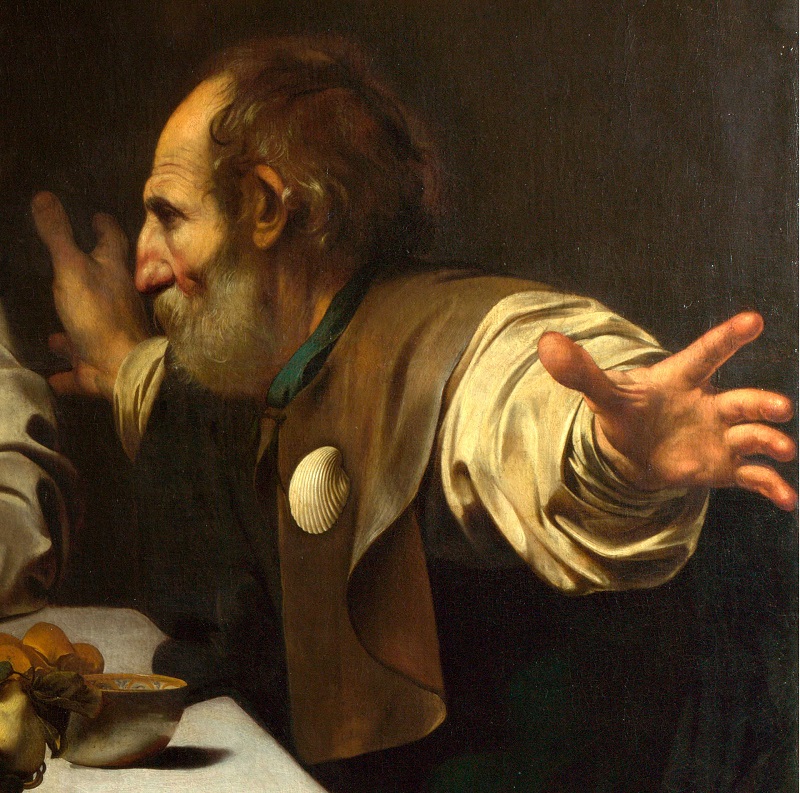
detail from Supper at Emmaus by Carravaggio

Drowning in the Jordan

Dead of winter, and Josh drinks alone –
His birthday today, and the years have flown.
Thirty today, and what has he done ?
Never been married, never had a son.
He feels he’s achieved far less than he’d oughta
Whittling the wood while his life’s getting shorter
“Gimme a break, an’ I’ll set the joint humming,
I’ll give unto Caesar just what he’s got coming !”


“I’m gonna
Rise with the dawn to pray and sing,
I’m gonna
Rise with the dawn and bless the poor –
They’re gonna raise me up an’ crown me king,
An’ when they think me beat, I’ll be back for more !”

Dead of winter, and Josh drinks alone –
All night he’s preaching in his slurrey drone.
He’s wasted round here, his vital mission –
There’s plenty to hear him, but none to listen.
Already he’s had two more than he oughta,
Knocking it back as though it were water.
He bangs down his grail with an angry thud –
“Gimme another, cos this is my blood !”

“I’m gonna
Find me some fishermen, and practice how to talk,
I’m gonna
Find me some fishermen and go from town to town –
I’m gonna cross the waves if I have to walk,
And if you wanna stop me, you’ll havta nail me down !”

Dead of winter, and Josh drinks alone –
This world is a bitch and it needs to atone.
He’s got his sermons and hymns to dispense –
He’s telling his stories, but they don’t make sense.
“Why won’t you bastards listen like you oughta ?
Why won’t you hark to the lessons what I taught yer ?
The love of money is the root of all malign !”

But the barman doesn’t care as he charges for the wine.

“I’m gonna
Work with my hands till I raise some sparks,
I’m gonna
Work with my hands till they heed what I tell,
One day so these palms are gonna bear marks,
An’ if you don’t believe me, I’ll see you in Hell !”


Dead of winter, and Josh drinks alone,
He’s got his second wind, he’s rolling back the stone –
Says he’s gotta leave and join the cherubim,
To do unto others like they’d better do to him.
He knows he’s delayed for longer than he oughta –
Someone’s gotta be the Devil’s holy thwarter,
Someone’s gotta sow so the reapers reap their seedful,
Someone’s gotta help all the camels through the needle.

“I’m gonna
Quit this hick town and walk the Earth,
I’m gonna
Quit this hick town and bang my drum,
I’m gonna walk out and show them what I’m worth,
I’m gonna walk out till kingdom come !”

Decline & Fall

The Course of Empire: Destruction by Thomas Cole

Decline & Fall

The Romans faced decline, they say,
A hundred years or more,
Before the Goths stole Rome away,
All in one day.
It wasn’t just a day, of course,
With forces building at the core
Throughout the hundred years before.

So were there Romans in that fray
Who watched the turning of the tide,
The steady slide, the slow decay ?
And were they powerless to stay
The endless slump of getting worse,
The creeping curse, the seeping sore,
The gradual fade to grey ?

Or did they never smell the rot
They’d got ?  Perhaps too decadent,
Too drunk to see their own descent,
Too busy in the hay.
They maybe missed the skulking spore
Until the joists had given way,
And brought Rome to the floor.

But that was then.  We’ve surely learned
How Rome was burned from within as without –
The morals shine and loudly shout,
And history shall not be spurned.
And yet.., I sometimes look about
And wonder where we’ll be in, say,
A hundred years or more.

Verses in Hades

Art & Literature
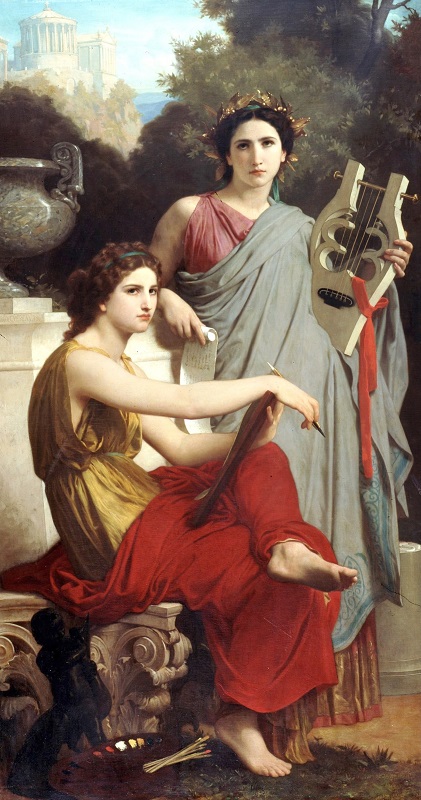
Art & Literature by William Bouguereau

Verses in Hades

Ah, those Classicists,
Those poets of antiquity !
They never faced the style fascists,
Never faced creative mists,
With lines that must engage in trysts –
They could keep it loose and gritty.
Rhythm, metre, drove their gist.
Their audience would ne’er insist
Their lines be docked and chimed and kissed –
How our plight they must so pity.
Sappho, Virgil, Homer, Horace
Never had to suffer this –
They never had their epic bliss
Reduced by form into a ditty.
Of all the literary crimes
Befallen us since ancient times,
I curse the most whoe’er invented rhymes.