Those clean-shaved chaps all suffer hell From a lack of stiffened upper-lips, Their razor-bothered mouths are far too sleek. When it comes to cunning twirling, well, They simply cannot get to grips – Their naked filtrums wobble when they speak. No rakish pencil wits For these tongue-tied sunburned Brits, But the unconnected stubble of the meek. No bushy walrus manliness On faces long on gangliness, Whose claims to hairy days are bare-faced cheek !
Spiders have eight, and box-jellies twenty-four, Scallops have hundreds, and dragonflies thousands, And digital cameras even more ! But vertebrates make do with two, Plus the odd ocelli peeping-through – But only a couple of retinas – A pair of light-bucket dishes – Well, except for a few strange fishes ! And I don’t mean the four-eyed anableps, Who see through both the water and air, And focus the light through diff’rent steps But onto the same old patch of cells, That parallels the ones we chordates share. No, I mean the brownsnout spookfish – They may not look as swish as barreleyes, Until we realise that here may be The ancestor of a whole new tree Of multi-looking vertebrates to arise – That one day may just populate The future Earth with their future eyes.
Life is one long side-quest, With its sub-plots and distractions – Existence is the Wild West, That is claimed by countless factions.
The through-line soon gets lost Amid the threads of deviations – For attention has a cost That must compete with new sensations.
I’ve never been much single-minded, Far too often getting blinded By the flash of something new. I’ve never had much use for blinkers, Seem to me to just be shrinkers, Shutting down the field of view.
Wait, what’s that they’re playing ? Now it’s lodged into my brain… Sorry, you were saying…? Guess I drifted off again…
Ev’rything I’ve ever written, Ev’ry poem, ev’ry play, Are strings of ones and zeros on a flickering display. Permanently hidden In a hard-drive or a cloud, So hard to leave behind for work so proud. No-one knows my password, Save my hacker and myself, Since I never passed it on to someone else. This security we’ve mastered Will leave all my work unread – It might as well be locked-up in my head !
Out there in the wood Is the old oak tree, Just lapping-up the sunshine, All of it for free. But there in its branches, There lies the mistletoe, Just sucking-up the sap Of its clueless host below. And there on this shrub Is a little caterpillar, That’s munching on the leaves Like a cute and stealthy killer. And inside of the bug there lurks The grubling of a wasp, As it chews-through the organs, Squatting like a boss. But inside the grubling Is another, smaller maggot Of a teeny-tiny wasplet That will wear it like a jacket, And inside of the maggot Is a nematody worm, And further inside that There is a microscopic germ… So they each are chowing-down, And they each are getting fatter, Till they burst-out of the body, That they leave in such a tatter. But the enemies of enemies Don’t turn-out to be friends agen – Just ask the plague that bit the fleas, Then bit the rats, then bit the men…
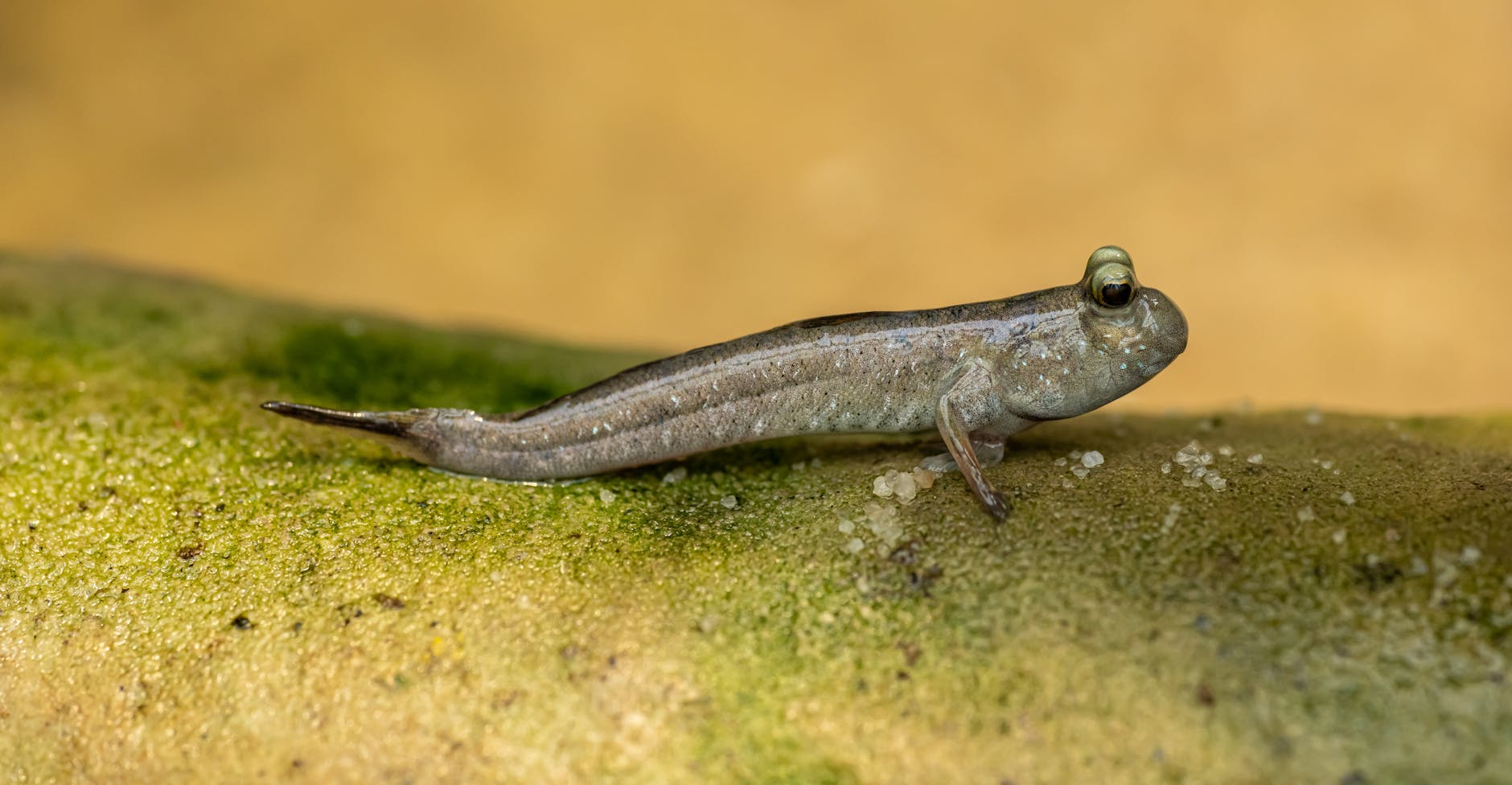
Bichirs, eels, and climbing perches, Sometimes swim and sometimes crawl – See their wriggles, flops, and lurches, Up up out of the water all. Like lobe-fins did so long ago, They make a hopeful bid to leap and grow. Distant species such as these, Who gulp the breezing air with ease – Distant species, all who please To give the land a go.
But why do gobies only skip the mud of late, And not before ? Just what has changed to make it worth the risk to skate Upon the shore, And dip their ray-finned toes upon the sands of fate Once more ? For surely, this cannot be new – This must be something that they do Since days of dinosaur.
I guess that they were out-competed, Couldn’t play the odds – I guess they found the land replete With hungry tetrapods. So why did they think they ought to ? Small fish from a big pond, Who sought beyond for everlasting worms, And spurned the nice-yet-dull – These fishes-out-of-water, Inventing bicycles.
Mudskippers diverged from the other gobies around 140 million years ago, or at around the time of the American Civil War according to this method. Of course, that doesn’t mean that their particular lineage of goby started venturing out of the water until much later, though I cannot find any details as to when this first happened.
For years, I built-up energy, Laying-down my layers of fat As batteries, never running flat. But now, those bonds are breaking free, Are draining-down, are being spent, Are liquified to pay the rent. Each breath contains a piece of me, A tiny sliver of my store That was sequestered years before – As all those good times, all that glee, Each choc’late cream or hearty stew, Escapes my lips as CO2.
Skeletons are wonderf’ly spooky, The freaks that lurk within – They look both menacing and kooky, Skinny without the skin. Skulls with empty orbits, Missing noses, plenty of chin – Now freed from the muscles’ corset, They can flash their toothy grin.
The shoulder-blades hang down behind, In-front the breastbone juts – While the ribs are like Venetian blinds, Or a prison with no guts. The pelvis is a pair of ears, To form the butt of our butts, And the legs and arms are rod and gears – All held by strings and nuts.
Skeletons are wonderf’ly spooky, Almost designed to shock – Though evolution is rather fluky, And frightens us ad-hoc. They’ve been the backbone of vertebrates for years, Our building-block – So ev’ry October, it’s good to say cheers – Deep down in our marrow, we rock !
Rust never sleeps, That’s why it looks so tired – Red-faced, unpolished, And so flakily-attired. It’s silent as it creeps, So unnoticed in its zeal – Until it has demolished All the strong but sleeping steel.
Photo by Miguel u00c1. Padriu00f1u00e1n on Pexels.com
I cannot think of something worse Than writing long by hand – How much is my electric verse Beyond my wrist’s command ? It’s only thanks to ones and noughts My words are ever read – Or else, my messy, speeding thoughts Would never leave my head. For who would bother to unpick My blotchy, crossed-out pages ? But thankfully, I type and click My wisdom for the ages.






 Rhyming Couplets