A cat may be a hairless sphinx, Or taleless Manx, or beefy Coon – But most are more a mini-lynx, That have no need to tweak or jinx That classic shape of ancient minx, That slinks beneath the Moon.
The Siamese design is striking, But it is a custom frame. The common tabby has been hiking Through our lands, and through our liking – Kept by Pharaoh, Greek, or Viking, Looking much the same.
But maybe, underneath that fur, A change is slowly going on. As certain traits succeed, and spur A rise in smarts behind the purr – They’re not the loners once they were In ancient Babylon.
We humans chuckle, and pretend That cats will do just as they suit – But truth is, they still sculpt and bend, Through generations without end, To suit our need to be our friend – And learn how to be cute.
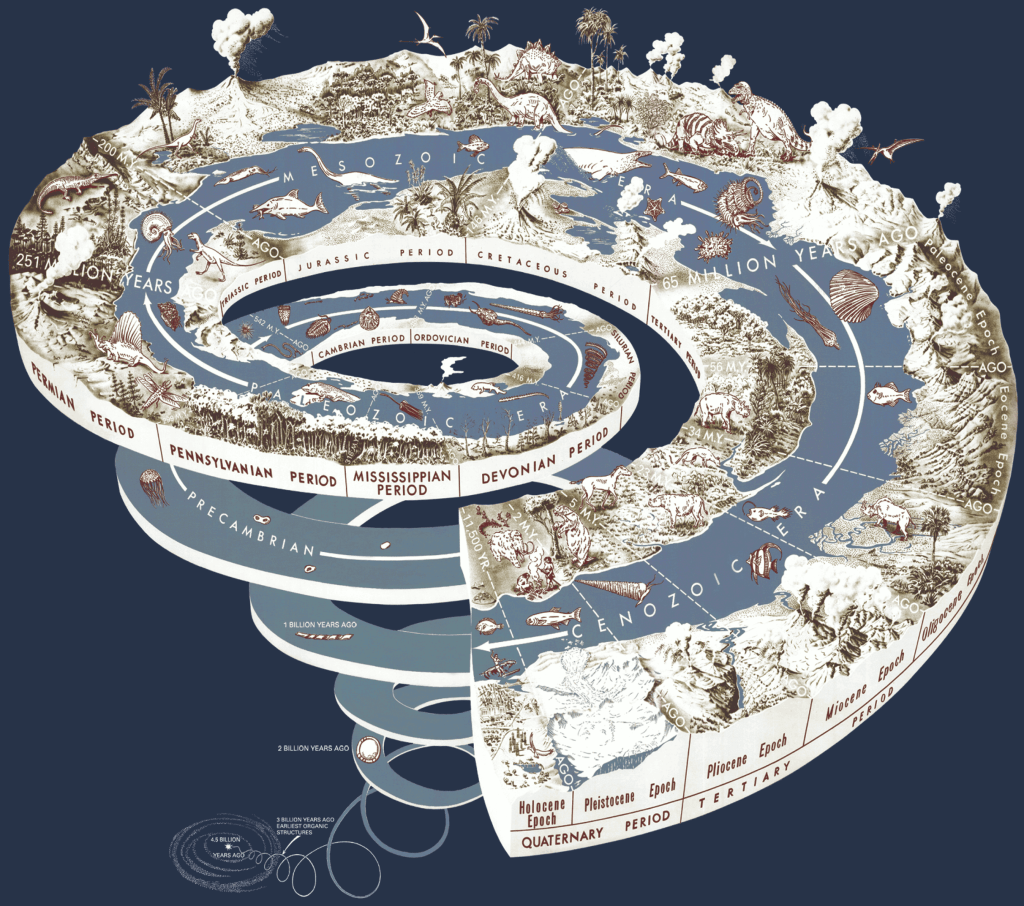
Geological Time Spiral by Joseph Graham, William Newman, & John Stacy
Counting Forwards
Imagine, if we like, To the Earth when it was younger – Let’s go back in our minds As Rodinia accretes and binds. Imagine all the life, With its breeding and its hunger, Is all within the ocean wide, While all the land is dead and dried. Go on back a billion years To when the Tonian began, And the first alga brave appears In the inter-tidal span. And let’s call this Year Thousand in our plan.
Now imagine, if you like, A thousand million later – To Britain, as it will become, Through evolution’s endless sum. Let’s use the past to take a hike, To be our ad-hoc dater – With ev’ry year that we explore That’s adding-on a million more. Ready ? Well then, come with me ! To Year One Thousand, long before, When Vinland Vikings rule the sea And early green specs dot the shore – And let’s see history expand once more.
1000-1280 The Tonian is a long old stretch, From Ethelred to Longshanks. We’re not sure when things happened quite, So none of these are strong ranks, But sponges would appear to appear Around the Fourth Crusade, Just as we leave the Dark Age, As the Boring Billion fade.
1280-1365 The Cryogenian grows cold, As the mediaeval warmth recedes – The plague upsets the status quo, As animals succeed. The monks and fossils leave their records, (Fewer than we’d wish), As peasants rise-up, and the jellies – Both the combs and fish.
1365-1460 The Ediacaran, through the Hundred Years War, Is a pregnant time. The Agincourt slaughter sees new forms of life Are on the climb. We’ve so little idea what, Though likely all the phyla we know Are going their separate ways back then, As the trade and prosperity grow.
1460-1515 Bang ! The War of the Cambrian Roses And Henry Tudor the Trilobite. Bosworth Field is awash with early fish, As eyes first see the light. Predators prey, so the shell evolves, And the codpiece probes the way to dress – And we know so much of those olden times Because of the Burgess printing press.
1515-1555 The Ordovician sweeps the monks away And ends in the great divorce – The Little Ice Age causes mass extinction, Though with a patchy force. Most of the phyla shrug it off, As do the merchants of the day, While plants colonise a whole new world of land, Down Mexico way.
1555-1580 The Elizabethan Silurian Sees vascular plants grow bodice and ruff, While armoured fish develop jaws As Catholics have it tough. The millipedes creep onto shore While Mary Queen of Scots must flee, And Francis Drake sails round the world, While scorpions swarm the sea.
1580-1640 Awaiting the tetrapod armada in Plymouth, Comes the Devonian span – Sharks and ammonites emerge In the Tempest of Caliban. King James writes his Bible On the wood of the early trees, Till the Civil War extinction Brings the shallows to their knees.
1640-1700 With the Carboniferous Restoration, Amphibeans arrive. There’s giant dragonflies in the endless forests, Where spiders thrive. They lay-down future coal, of course, As London is aflame – Till the Glorious Revolution, When the reptiles change the game.
1700-1750 The Permian now joins Pangaea With the Hannoverian line – Dimetrodon and future-mammals Have their chance to shine. But from the North, a Great Dying Sweeps them from their heights – The lava traps of Siberia, And the pikes of the Jacobites.
1750-1800 The Triassic sees a trident of firsts – Pterasaurs, crocomorphs, dinosaurs. The sea’s full of plessies and ichthies and turtles, An empire stretching to distant shores. But American lizards break away From rule they call draconian, And a great extinction’s coming-in That’s all thanks to Napoleon.
1800-1855 The Regency brings us the Jurassic, Victoria sees placentas get birthed, While the Chartists challenge the old big beasts, As the sauropods shake the earth. The allosaurs fight stegosaurs, While archaeopteryx soar above Of the Valley of Death as India splits, On their way to becoming a dove.
1855-1935 The Cretaceous next, but where to start ? Pangea well-and-truly splits, While flowers bloom for Victoria’s weeds, And spinosaurs are Edwardian hits. Veloceraptors perish in the Depression, But T-Rex jazzes the town With Triceratops to the very end, When the asteroid comes crashing down.
1935-2000+ Into the Cenozoic we go, As the atom bomb sees things get hot. Mammals and birds diversify, As hippy grasses grab their shot. Hominids climb down from the trees As Tony Blair brings-down the freeze – Then Christmas Day in ’99 Sees farmers plant communities.
Imagine, if we like, Where our journey goes from here – What might the next long thousand bring To life that’s ever-quickening ? And when extinctions strike, Then new forms suddenly appear. History shows progress all the while, Though fashions change the style. But here, for now, our trek is done, We’ve counted up the years we hold, From an Anglo-Saxon simple son To multi-cultured forms so bold. They tell the greatest story ever told.
Happy birthday ! Yes, it’s true, Rhyming Couplets is turning six, so here’s a special treat for anyone who’s still out there.
Similar to my championing of the Holocene Calendar, I hate counting backwards, and can’t wrap my head around the numbers. Therefore I propose the Paleontology Calendar, which can either begin at 0 (equal to 2,000 MYA) when the Great Oxydation Event was coming to an end, or at 1,000 MYA when the first algae was colonising the land. The latter is more useful, as it results in three-digit numbers rather than four, as we don’t have much evidence for what happened prior to the Ediacaran fauna emerging (they’re not called the Boring Billion for nothing…) However, I’ve adopted the former here so that the dates can line up with European history to make conceptualiseing the events easier, at least for me. By happy coincidence, 1000 MYA is also when Bicellum first appears, which might just be the earliest evidence we have of animals evolving away from algae…
Note that all dates prior to the Cambrian are tentative and likely to change in the future. Just when the animal phylums diverged is unclear as there are very few fossils, and rely on DNA analysis and molecular clocks. Furthermore, the current estimated dates may be a few years different from their historical counterparts for the sake convenience (for example, some think that algae first poked its head out of the water as early as 1200 MYA). Come on, this is a poem, not a textbook !
Quintessentially Redhead by VianaArts – apparently, this entire piece was created with only ballpoint pens!
Ginger Snaps
I know it must be Summer When my frecks come out to play, When my polka-dotted face Becomes a sunshine giveaway – When my pallid-grey complexion Finds a whole new way to live, With its tanning only happening As if beneath a sieve. They serve as a reminder For the cream and overalls – For I cannot risk the sun for long, Before the lobster calls. No harbinger of cancer, though – These are no liver spots – But a crop of chestnut mushrooms, Or brunette forget-me-nots. They pop-up on the first hot day of May, In time for lunch, And settle-in for Summer – Though they seem a jolly bunch. In a burst upon my bridge, And in a dance across my cheeks, They’re a throwback to my childhood, A tattoo for sunny weeks. Perhaps I’m not so pasty, But my darkness only bites In an extroverted flocking Of acute melanocytes. My pixels are in contrast, And my apples are in bloom – I know it must be Summer When my solar flares go boom.
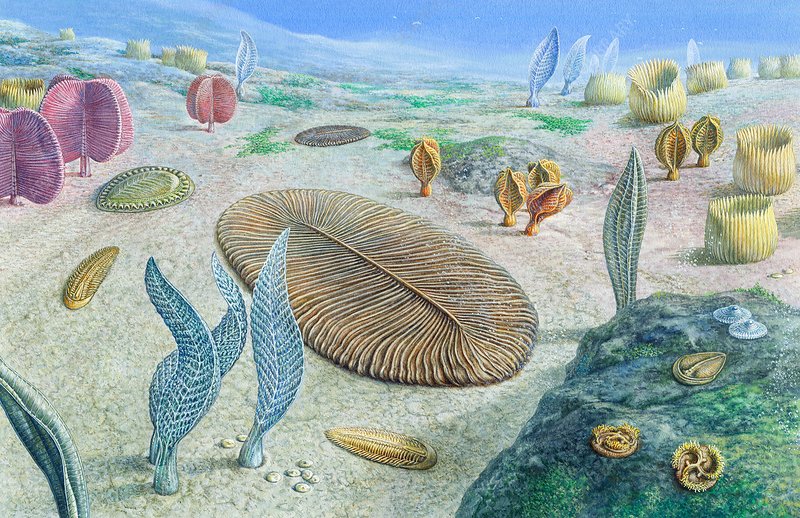
The Victorians couldn’t have known, of course, The abundance of life in the lifeless rocks – The explosion before the trilobites, With multicellular building blocks. The fossils are rare, but they are there, In Charnia and Kimberella. What were they ? We don’t quite know – Foundation in the stony cellar. Dickinsonia, Cyclomedusa, You flourished, then you died away. The Boring Billion birthed you all – Our great ancestral stray.
Yet still the Paleozoic begins, Long after the glories of Avalon. That makes no sense, not now we know What the Cambrian was built upon. Dismissed as children’s stories, We have had to wait a long long time – Yet the Pre- was not so pre at all, Its oceans teemed with some strange slime… The end of the Cryogenian, that’s the border, That’s when things got big – Spriggina and Aspidella are waiting – All we have to do is dig…
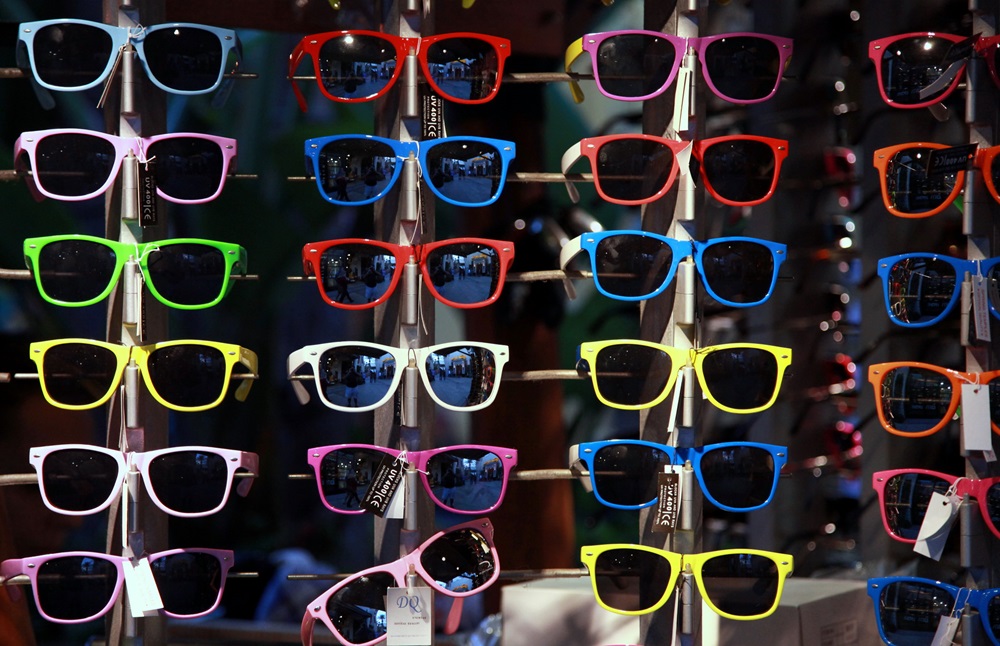
English sheepdogs, Highlands cattle, Marbled corneas in snakes, Stalk-eyed snails with pop-up headlights, Caterpillar eyespot fakes. Staring cameras tend to rattle, Black-walled, with a glossy sheen – So mask them, yet still feed them light, With eyes that see yet can’t be seen. So wear a pair of shades ? Sure, that’ll Make all nature look so cool… If only ancient life had bred right, We’d now be inscrutable ! Vision is a constant battle, How to let the photons in ? Yet we all see the infrared light Not through eyes, but through our skin.
Quetzelcoatlus, how did you fly ? By gliding on thermals ? Rarely flapping ? How did you launch your bulk to the sky ? And your massive head not handicapping ? Could you be becalmed ? Or even be-galed ? If the breeze were too strong, could it blow you over ? For every take-off, how many failed ? Were you more a hopper than cloud-top rover ?
Quetzelcoatlus, how did you fly ? When the zephyrs tugged you, how did you cruise them ? No point to ask evolution why – For you only grow wings if you need to use them. Could you be grounded ? Or just never land ? Soaring the oceans, wind in your hair ? Did you make runways along the strand ? The answers, alas, are up in the air…
By ‘wind in your hair’, I’m referring to their proposed feathers.
And since there are five of them shown above, should the painting be called Quatzelcoatli ? No. No it shouldn’t, as I’ve discussed here.
Surgeons, pilots, firefighters, Barristers, and presidents – These pseudo-psychopaths, From the boardrooms to the regiments, Who find calmness in the chaos And detachment in the fear, Who are able to exert control And keep their focus clear. They switch off their empathy When steady at the lever, To stop them dithering with love, Or panicking with fever. We need them in the frontlines, With their special kind of brain – But most of all, we need to help them Switch back on again.
I always find psychopaths in movies incredibly boring, but this poem was greatly inspired by the fascinating Vsauce2 video on the subject.
I’ve always hated that verse – To take a disobedient, wayward son, A glutton and drunkard, and maybe something worse – And to drag him to the elders, and call on ev’ryone To muster at the gate of the town To take up stones, and put him down.
But I recently heard a theory That asks what parents would willing follow ? After all, it costs them so dearly, And any sense of piety must leave them hollow. How extreme must their son appal For such a code to be needed at all ?
Surely this was only spoken To deal with the psychopaths among them ?, The ones who threatened until they were broken, The monsters and parasites dressed as young men. How else could they protect their town When a rabid dog was skulking around ?
But even setting the problem of evil aside, Is this the best defence ? Why must the Lord make the parents decide When enough is enough ? It beggars all sense – It’s just too cruel for anyone To have to denounce their troubled son.
But honestly, I have my doubts, That this is what is meant by it at all – And if it is, it needs to spell it out, Just why they’re thrust against the wall, To stop the zealots stoning ev’ry child By judging surliness as ‘running wild’.
Thank goodness we ignore such spite, And wonder why we keep such books around. For there’s a psychopath, alright, But he’s not the frightened kid upon the ground – Rather, he’s the one with crazy eyes Who gladly casts the first stone from the skies.
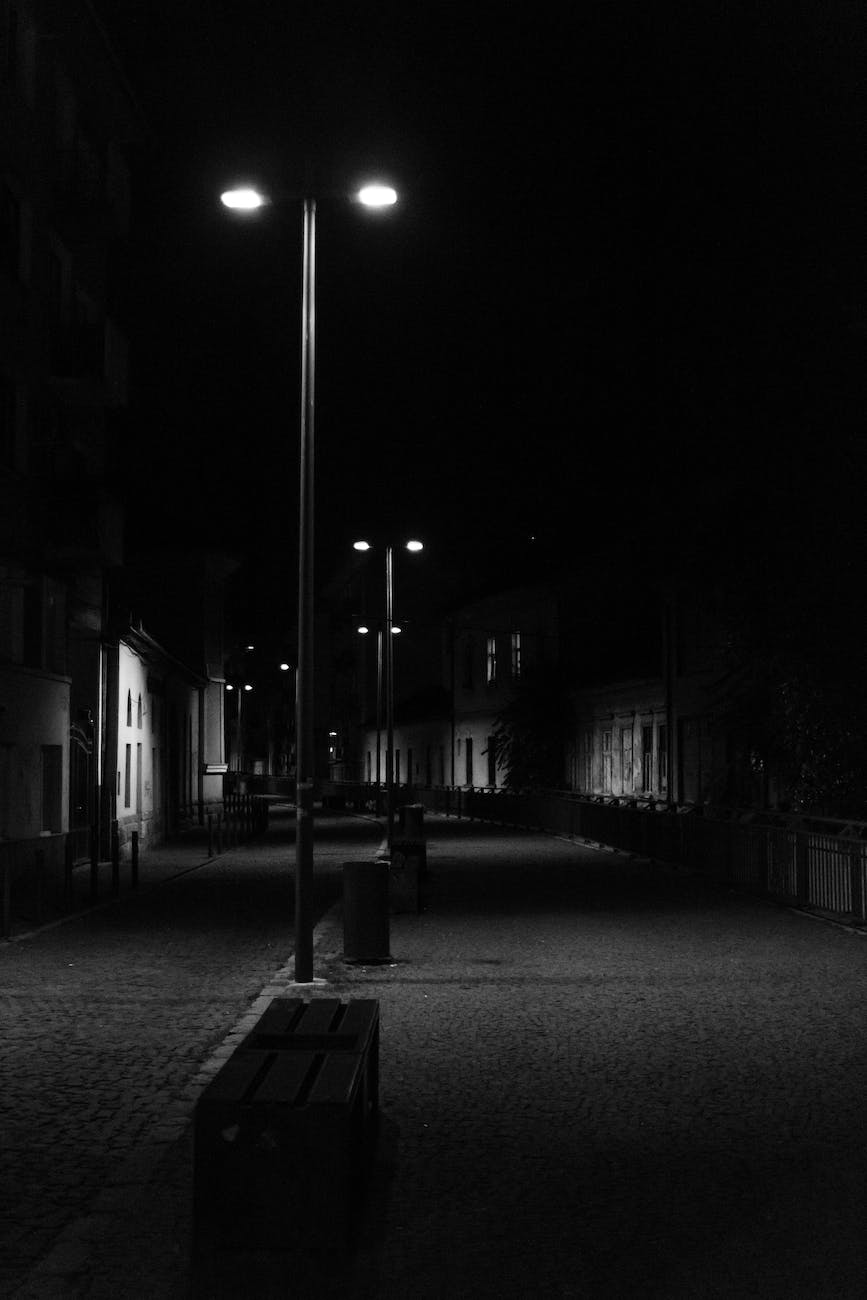
Do you feel the cold nip ?, Do you feel the dark creep ?, Do you feel your chest grip, And lungs rasp, and heart leap ? Whatever else is in this dark, You think, It’s not alone out here – For it must share this lonely park With both you and your fear. You hear that ? Hark… Don’t blink, Don’t make the blood rush through your ear. Ba-dump, ba-dump, Your throat a lump, Your calm but an veneer. Now all your senses are abuzz, To ev’ry twitch and sigh – You only feel alive because You’re too afraid to die.
Do you bite your numb lips ?, Do you count each heart thump ?, Do your prickled fingertips Clench fast each time your teeth jump ? Whatever else is in your mind, You think, It’s not alone in there – For it must stalk your misaligned And overactive lair. Don’t look behind, Just blink, Before your nerves fly ev’rywhere. Ba-dump, ba-dump, Your tremors pump, Your heart recites a prayer. And yet, be thankful when it does, For this, at least, is real – You only feel afraid because You’re still alive to feel.
Some plants only germinate through fire, Waiting out the years Until the tragedy appears. They need the forest hotter, tinder dryer, Even dropping oil To make a tarpit of the soil. But there hasn’t been a fire through here, I’m told, In fifty years of cold – I guess these trees are all the same-age-old.
Their life-cycle needs the flames be fanned, They need to taste the char Before they’ll shoot a single spar. They need apocalypse to sweep the land To birth their phoenix seeds, To grow within the ash of weeds. And there are even beetles who must birth Within the hell-scorched earth, (Though salamanders don’t, for what it’s worth).






 Rhyming Couplets