Turning the soil is Autumn work, Ploughing, forking, hoeing the loam, Breaking it up before it freezes, Driving the moles from their home. Airing the worms out, harvesting stones, And mining the black to bury the brown, Dredging the roots up, combing the waves in, Leaving the fields quite upside-down.
Now that the herd is in the barn, And now that the flock is in the fold, Then huddle close and I’ll spin you a yarn, The one my father told. And he was taught by his in turn, And he by his, the self-same airs That someday your own kids will learn When you tell them, and they tell theirs.
Sometimes, late at night, Out on the plains, or on the road, When the bats are in full flight To the singing of the toad, There can be heard the gallop Of a lonely charger wild, Through the ups of York and Salop And the downs of Kent and Fylde
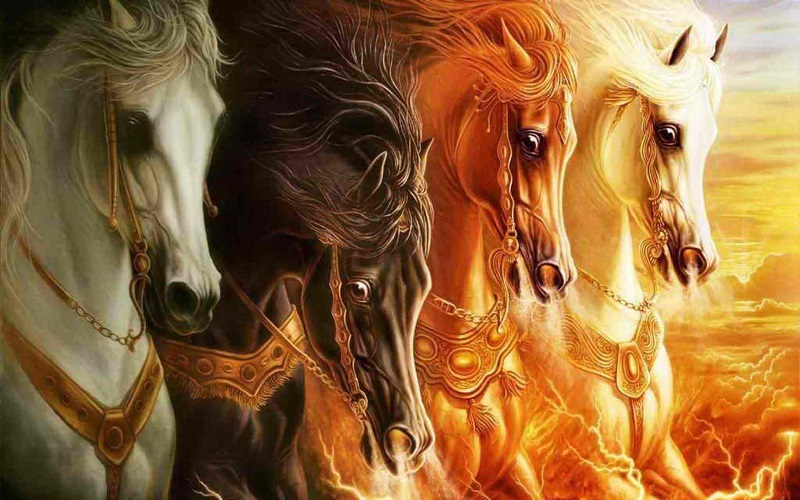
There’s those who claim they’ve seen him, And they claim he rides a grey, A snow-white grey so gleaming That the very stars give way. A king, they say, with bow and crown, And horseshoes of cold steel – And ev’rywhere those hooves stomp down, The people come to heel.
Though some say he’s not invading Through our castles, towns and huts, But rather the land he’s raiding Is our throats, and veins, and guts – Riding, riding, ever onwards, There is no defence – Though some may call him Conquest, And others Pestilence.
But many will say No!, he rides a chestnut When he roams abroad, And he wears a shining breastplate, And he holds a tempered sword – And he is War, yet not invasion, But one folk upon another, Year-on-year, at any provocation, Brother killing brother.
But fighting is fighting, and always near To the likes of us who are called-on to bleed, And arrow or sword, it’s the same old fear When facing-down the next stampede. Or maybe a few who see this horseman Get to then escape to tell – Yet whether Mongol, Moor, or Norseman, All those roads lead straight to Hell.
Still, I have also heard it told by folks That the horse is jettest black, And gaunt enough that each rib pokes, With scarcely strength for saddle or pack – But its passenger can’t weigh much, at least, He’s spindly as his balancing scales – Clearly the lord of the Famine, not feast As he measures-out losses from frosts and gales.
Then others say his is the best-fed mount In any town it passes, Glossy as the fur-coat of a count, ‘Gainst their threadbare nags and asses. And the dirt where its hoofprints have trodden is barren now, The only thing growing is the drought – The fields are always so shy of the plough When Famine goes riding out.
Yet the final vision of our phantom knight Is the strangest of all they claim have seen, When robed in black, or robed in white, On a pale steed – dun, or maybe green. Some say a skeleton, lacking flesh, And what does he carry ? An hourglass of time ? A downturned torch, or a flail to thresh ? Or a sickle to scythe the stalks in their prime ?
And they give him a name, they call him Death. But surely all these versions are that – So death by what ? From a poisoned breath ?, Or the slurry from the mines, or rancid fat ? Maybe our souls aren’t chaff to the miller, But the smoke in the lung and the acid on the stone – Pollution, that’s the next big killer – And surely worth a horse of its own.
So light all the candles and ring all the bells, To ward off the Silent Divider, And warn them in Wigan and Walsall and Wells Of the grizzled new face of the Rider. From Wetherby weavers to Tintagel tin, From the tar-pits of Derby to Sunderland soot, So each time we breathe we invite the rogue in And his fingers leave shadows wherever they’re put.
Then listen, my children, listen for his hoofbeat, Listen as he slowly yet surely destroys By dogging the trudging of your own two feet In the choke and the grime and the constant noise. His other visions are horrors of our past, But it’s in our future that we all must die – And the fourth of the horsemen will take us at the last, As he kicks up the dust as he’s riding-by.
I suppose Pollution should cover the mass-deaths by human-caused tragedies, while Pestilence cover those from other living things while Famine has the natural disasters gig. This would mean that a plague of locusts is definitely one for Pestilence, while Famine would deal with meteor impacts. But don’t even get me started on green horses...
The first to blossom was Daisy, Yet still a rather homely lass – Though pretty in a common way, She spent all year within the grass
The next to blossom was Iris, Bursting out in the warming Spring – Showy, delicate, desirous, Over quickly – just a fling.
The next to blossom was Poppy, A gothic girl in crimson red – A heady mix of sharp and soppy, Fascinated by the dead.
The next to blossom was Rosie, A redhead maid with cheeks of pink – Nothing about her was boring or prosy, And lasting longer than you’d think.
The next to blossom was Heather, Just as the leaves were starting to turn – Sturdy and tough, whatever the weather, And hiding a heart just waiting to burn.
The last to blossom was Ivy, Much maligned, but on the climb – Her bauble buds were small though lively, Coming of age at Christmastime.
I lived the life I lived because I found myself alive with life to spare. I sang the songs I sang because The songs were short, and cheap, and ev’rywhere. I did the things I did because The things I did were needing to be done. I trod the path I trod because I had to tread a path, and here was one.
Reapers sweep the scythe And sheafers bush the sheaf – Gathering the harvest, Gathering the grain – Threshers thresh the flail To tear the seed from leaf – Gathering the harvest, Holding off the rain – Winnow-women winnow, And siever-maidens sieve, Prizing out the pearls That the golden ears give – For to the corn we’re born, And by the wheat we live. Bringing home the harvest down the lane.
Once it took a village, And ev’ry boy to spare – Gathering the harvest, Stooked and ricked and mown – Now it takes machines, With no use for man or mare – Gathering the harvest, Gathered to the bone – Children of the corn And cottage-kitchen wives Are spared the broken backs And spared the broken lives, With Summers never shorn By the sweeping Reaper’s scythes – So bring us home the harvest on your own.
When the cuckoo changes his tune, it’s June, The month with the longest afternoon, When the golden hour will last an hour, And the floral clocks are forever in flower – It’s hardly worth the daisies to close When a good night’s sleep is barely a doze, And the nightingales must rush their glee Till the sparrows peep at the crack of three.
She was born at Solsticetide, And so they named her Summer – Blond and bright and beautiful, And all the Spring a comer. But once the longest day was done, She felt the nights draw in, Just waiting for the Winter low To let the next begin.
Now I will barely notice how The evenings have crept, Until the clocks have messed about To show how dusk has leapt. But then, she saw a greater change Than I, from day to day, For she grew up in Lerwick town And I down Jersey way.
Study of the Head of an Old Man with Curly Hair by Rembrandt
Nala
I know a man who’s all at sea, But that’s alright, for he can sail – He knows the winds, he knows the tides, And where the undercurrent hides. And back on land, it seems to me, He’s just as calm within the gale – He’s not afraid of getting wet, And trusts upon the course he’s set.
He knows his destination isn’t fixed, But just a stated aim – The breeze may have its own idea That he can’t fight, but still can steer. He is a man of air and water mixed, An old hand at this game – But even sailors sometimes wish For fresh dry clothes and no more fish !
I know a man who’s all a-shore, Who dropped his anchor on the land And found a port to beach his hull, And trade the blackbird for the gull. Yet still he hears the breakers roar, And finds the driftwood on the sand – But he’s content to furl his sails And leave the whale-road to the whales.
The sea is wide, my son, so wide, And the wind is free, so free – The sea is long to the other side, And the currents strong on the Westward tide. Don’t tarry here because I cried – Your boat is at the quay.
The land is big, I hear, so big, The boat is small, is she – But you must leave aboard this brig, To seek out better roots to dig. I know you won’t return, my sprig – You won’t return to me.