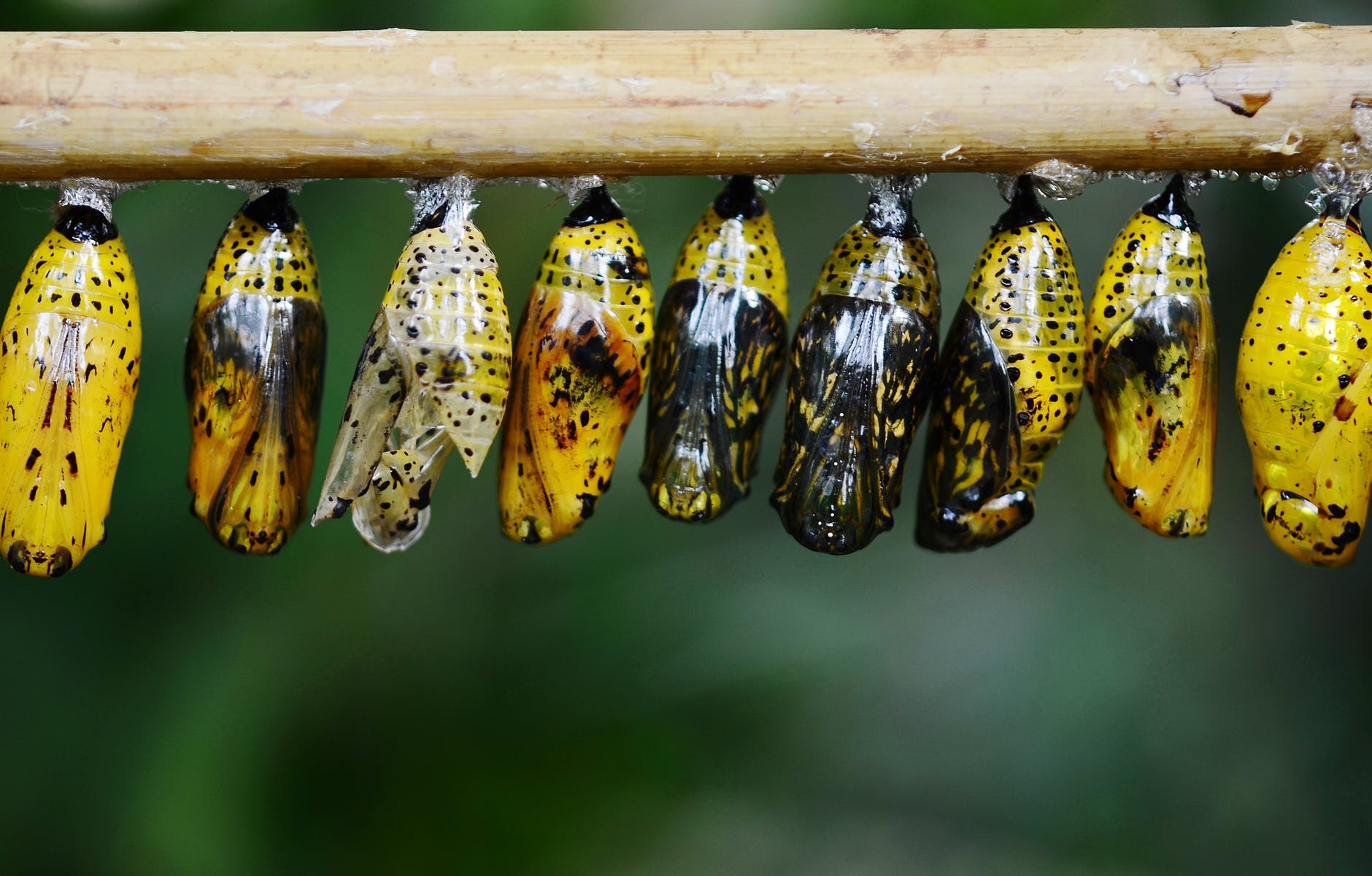
Caterpillars metamorph, from juvenile to butterfly, And maggots turn to ants and wasps and beetles, by and by, And tadpoles can be newts and salamanders, toads and frogs But when it comes to mammals, well, There’s little change of which to tell, For puppies only ever get to grow up into dogs. But you know, that’s not quite true – we’re changing too, Though the other way round: See, larvae are more evolved than their parents – Their bodies the new kids in town. But we, you and me, start out as a fish With proto-gills and a tail to swish In a primordial sea of warm – Then it’s time to move, to shed our skin, And let our reptile-selves begin: Engage, evolve, transform ! It’s time to metamorphosise, We mongrel robots in disguise, From instar into more-bizarre, Our restless genes must shift and swarm And take this blood-cold world by storm By becoming the mammals, the furry mammals we are ! But don’t stop now, the urge ain’t gone – I don’t know what’s next, but I feel it coming on…
Some worms are roundworms and some worms are flat, Some worms are skinny and some worms are fat, Some worms are stripy and some worms are brown, Some dress in velvet and some sport a crown, Some feed on slurry and some feed on nuts, Some live in gardens and some live in guts.
Some worms are serpents and some worms are bugs, Some worms are dragons and some worms are slugs, Some worms are speedy and some worms are slow, Some worms are eyeless and some worms can glow. Some on the surface and some underground, Some worms are flatworms and some worms are round.
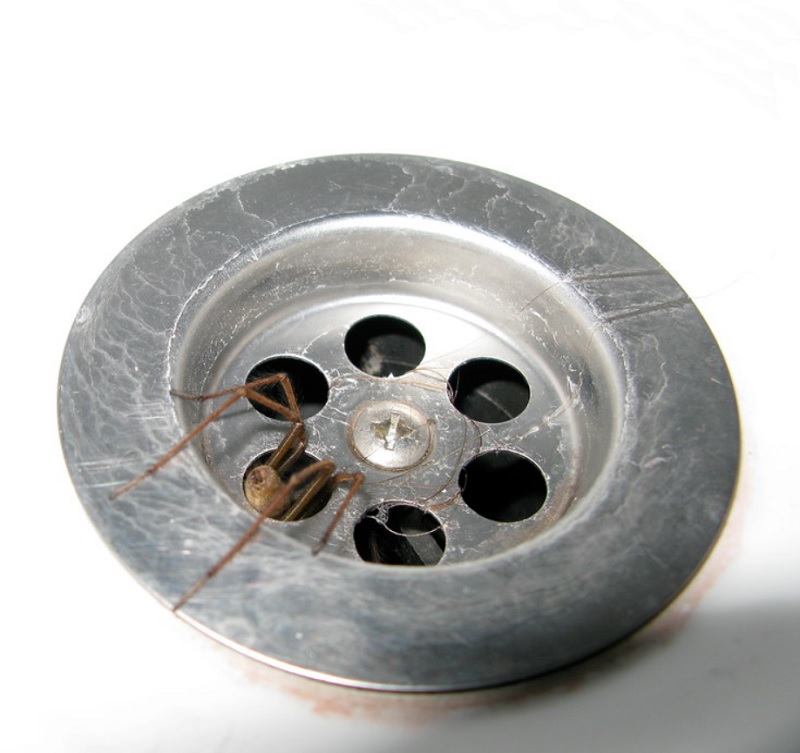
A year ago they built this flat, And only I reside herein. So how precisely is it that In just one year, my welcome mat Has ushered all these spiders in ? I’m not allowed to keep a cat, But pets a-plenty hide and spin.
Have they blown-in as eggs so soon, Or spiderlings on silk baloons ? Or hitched a ride upon a rat ? (I really hope it isn’t that !) Or did they creep up ev’ry stair I’m on the seventh floor, you know ! I’m sure they’re here – their webs say so !
“jellyfish – OED first citation, 1796 medusa – in this sense, 1752 sea-nettle – 1601”
What did we call the jellyfish Before we called them that ? Aristotle was the first To note what they were at – He called them akelephe In his mighty omnibus – While Pliny called them sea-lungs – That is, pulmo marinus.
At some point, they were likened To Medusa, with the snakes – So when Linnaeus crowned them that, He simply upped the stakes. But what about in English, From before the mighty Swede ? Shakespeare never mentioned them, Nor Caxton, Chaucer, Bede.
I guess those Middle Ages folk Just neither knew, nor cared – Though fishermen, at lease, you’d think, Would need to be prepared. Sea nettle, I suppose Could make the strongest claims, But hands that felt the stings were not The hands that wrote down names.
Yet surely they are tailor-made To populate in Hell ? It seems their nightmares missed a trick, When jellies did not gel. They kinda look like floating heads, (Though clearly going bald). Much like Cthulhu’s nameless ones, Who knows what they were called ?
‘Jelly’ entered Middle English between 1350-1400 via Old French, ultimately from the Latin root meaning ‘to freeze’. nbsp;’Fish’ is Anglo-Saxon.
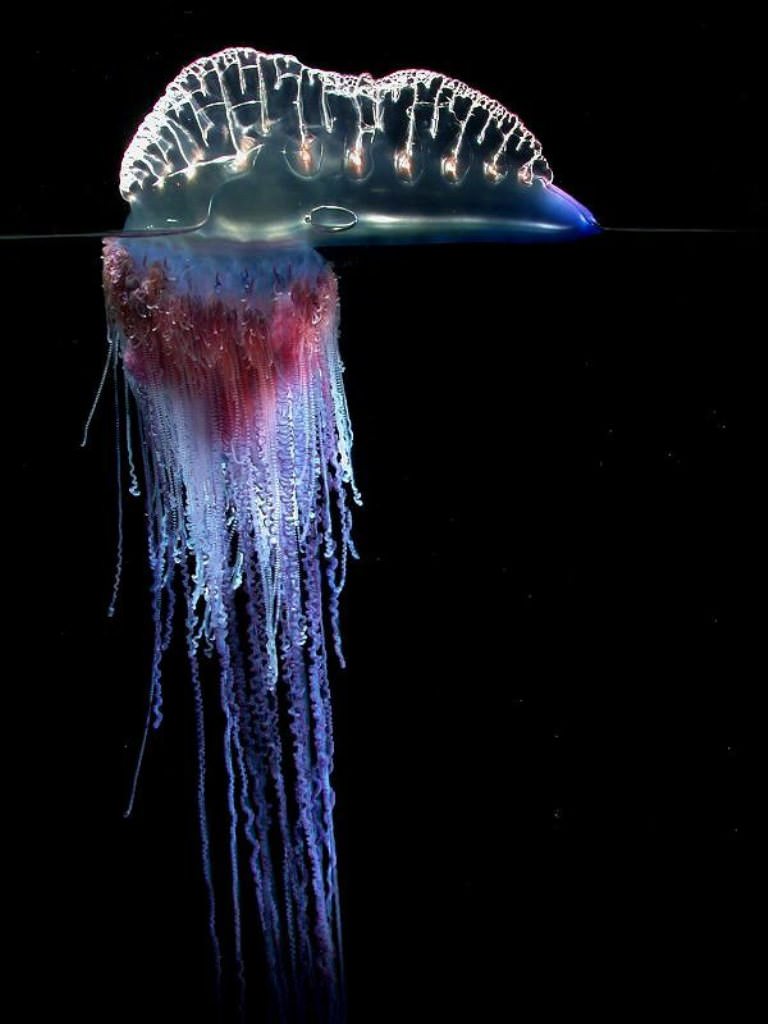
Detail of tentacle of Physalia microscoped by Rob Growler. Each of those finger-like projections is considered to be a separate creature. Or perhaps each separate tentacle is a single zooid – there seems to be much confusion on this.
Life in the Colonies
What’s the plural of man o’ war ? ‘Men’, or ‘wars’, or stays the same ? (And why are you so Portuguese ?) All told, a silly name.
But scientists insist That you’re already plurals, each. That what we see are vibrant cities Washed up on the beach.
See, ev’ry egg, once fertilised, Divides in two, and two again, Until a little larva, sized No larger than a grain.
You then begin your budding, Popping clones that stay attached. So from a single egg, it seems, A hundred brothers hatched.
Genetic’ly identical, But not such dead-on ringers, Specialising as they do, As feeders, breeders, or as stingers,
Sharing nutrients and tissue, And even gender too, we note. And one (and only one) will swell Into a gas-filled float.
But are you really colonies ? So should we view your ev’ry clone As sep’rate creatures ? Even though That can’t survive to swim alone ?
Perhaps it’s the lack of a nervous system That makes you many, not one – But do your individual zooids Each have their own, or also none ?
If the latter, why are these animals, And not mini-colonies all of their own ? I guess the stingers at least must feel A sense of touch (though they act alone).
Infact, the latest research says That they do all communicate yet – Though less as a mainframe brain, as such, And more of an intranet.
So, much the same as your jellyfish-cousins, Which are single, the sciences agree – I guess it’s just a matter of degrees, And the whims of the arbit’ry.
It’s like you’re halfway between your single-celled past, And their unified future – If we look close, we can still see the joins, Though they’re barely more than a suture.
Victorians proposed their status, As best as they could see – And we repeat their holy writ, Afraid to disagree.
Now evolution is wholly unplanned, But teamwork is what wins the cup – Yet the scientists would round you down, Where I would round you up.
You’re just like us – we’re not so special, We’re all made of cells, For all we call in pedants To deny the parallels –
Especially when we realise That zooids cannot change their role – From stems, they are assigned a job for life, To build a greater whole.
That sounds alot like organs, doesn’t it ? Time we came to terms. For we began the same as you – A ball of cells, a swarm of germs.
So as for what we call you, Just what kind of things you are ? ‘Men’ or ‘wars’, it matters not – Let’s call you singular.
Perhaps the boffins have got it right, and syphonophores really are collectives and are fundamentally different from single animals like jellyfishes. But they’re gonna havta do a much better job of explaining it. So kudos to The Octopus Lady for her illuminating video which is the first attempt I’ve seen to actually ask the question “but why do we think these are colonies…?” Her answer – because although the zooids cannot survive alone, it is slow starvation that kills them (because they cannot feed themselves in solo), not biologiocal breakdown as would quickly befall any of our shed cells.This feels like a decicion based on no more than a gut feeling, and until it is quantified somehow, I don’t want to hear a peep from all of you factoid vomiters out there who just love a sneery “well, actually…”
They’re coming ! Raise the alarm on the dockside ! They’re swarming, and pushing us out of the sea ! Their billowing sails, from Pembroke to Leigh, Are storming our beaches, invading our sands ! Their cargo is toxic, their ballast monoxide – These by-the-wind sailors, these rafts of medusa. Mohican’d above, while their dreadlocks hang looser – All laces and ruffles, and hooks ’stead of hands ! On the hottest of days, when the skies are clear blue, And the southerlies breeze off the sea to the shore, This deadly armada with venomous crew Are planting their colonies right at our door… These silent bluejackets are coming for you – These unthinking killers, these seamen o’ war.
I almost feel bad in how I’ve deliberately conflated the Spanish Armada with its neighbour (with whom Britain has had a continuous peace treaty since 1386), but good puns must be seized with both hands (unlike the creatures themselves, of course).
Incidentally, according to Wiktionary the nationality of the metaphorical warship remains consistent through most European languages: portugisisk örlogsman (Swedish), żeglarz portugalski (Polish), portugál gálya (Hungarian), and even caravela-portuguesa (Portugeuse).
Stink bugs, red bugs Pond skaters, bed bugs, Backswimmers, blue bugs: Reckon you’re the true bugs ? What about the caterpillars ? What about the slugs ? What about the woodlice, And the dust mites in our rugs ? What about the centipedes ? What about the lugs ? What about the spiders That come crawling up our plugs ? What about bacteria ? Who sets the criteria ? What about the itches, And the robots and the glitches ? Tell me, heteroptera, Just why are you the only bugs ? Just why must this old word refer To nothing but your sucking mugs ? Well, don’t start getting smug In your taxonomic snug – You buggers think you have the clout, But other bugs are bugging-out. How come you can appropriate A catchall word that used to state For any old invertebrate ? I ask and ask, but all I get are shrugs. Your copyright’s a crying shame When yours is not the only claim, So find another common name, And let all buggy bugging bugs be bugs.
A ‘backswimmer’ is an Americanism for a waterboatman. In this case, I used it because it has the right number of syllables. ‘Tunderbugs’ usually refers to thripses, but in my playground I remember it being applied to those tiny bright red spots that come out on the hottest days of Summer (probably red spider mites).
Look ! Spiders ev’rywhere ! Scuttling over ceilings, Hanging from their danglings, Watching from the walls. Webbing here, webbing there, Going ’bout their dealings, Lurking legs-a-gangling Or rolled up into balls. Let them be, don’t let them scare. Spiders, spiders ev’rywhere !
Ammonites are ceph’lopods With spiralling shells, A bit like the nautilus With gas-chambered cells – But larger and groovier, These kings of the ocean, These chosen of Ammon, These Jurassic movers, These Cretaceous shakers – In the Fathoms of Mammon, From sea-beds to breakers, Till the shark and the salmon Cast out these apostles. But there in the fossils, Their statues awake…
Moabites are ceph’lopods We’ve yet to discover They’re out there, still buried, In one rock or another – And each slab we lever, So hopes the believer, May yet be inscribed With this prodigal tribe: A bit like a nautilus, A bit like an octopus, A bit unlike either. And just like the ammonites, They need us to free them – We know not what they look like, But we’ll know them when we see them.
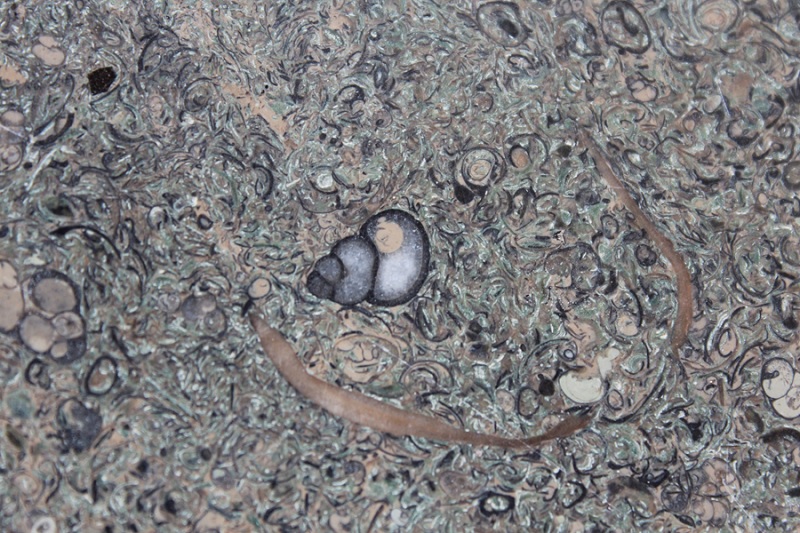
What is this power That holds up cathedrals ? That bring in the pilgrims, And keeps out the gales ? It isn’t lord Jesus, Nor bishops and beadles, It isn’t the faithful, Nor relics and grails. Forget all the masons With stone tetrahedrals, Forget all their chisels, And braces and nails – The answer is columns ! Those load-bearing needles, Those orderly uprights, Those masts without sails. And the finest of columns, So stately and regal, Use marble from Purbeck In multiple scales.
Now, wildlife in Purbeck, From roe-deer to seagulls, From rabbits to lizards, From fishes to whales, Are nothing compared To her beasts without equal – But who are these heroes ? Well, there hang some tales… For hidden in hedgerows, There lurk her great people: Like bees in her fields, And yeasts in her ales – But her mightiest creatures Have built ev’ry steeple: The lime in the limestone That polish unveils – For marble from Purbeck That holds up cathedrals, Is held up in turn By the shells of her snails.






 Rhyming Couplets