Thrillers whisper throaty in the night, Romances gush with a weepy sigh, Memoirs giggle, wits banter bright, Horrors rapture with a choking cry, Angry young men are shouting thunder, Hard-boileds wisecrack – gabbling, hawking, Folktales regale with a lyrical wonder – Hark – for the books, the books are talking !
Richard Feynman giving a lecture on the motion of planets around the Sun
Star-Glazing
(After Walt Whitman)
When I heard the Learn’d Astronomer, When the proofs and figures were ranged In columns before me, to add and measure, When shown his charts and diagrams strange, When I, sitting, heard the Astronomer, Where he lectured with much applause, How soon, tired and sick, I stirred And wander’d off by myself outdoors. There in mystical moist night-airs, From time to time I look’d up clear In perfect silence at the stars, (And thought them small, and rather near.)
This is my take on Walt Whitman’s poem of the opening line. I’ve shuffled things around and made it rhyme, but most of it is his words except for the last line. Turns out he was just a luddite after all.
(After Molière, The Learnèd Ladies, Act 3, Scene 3)
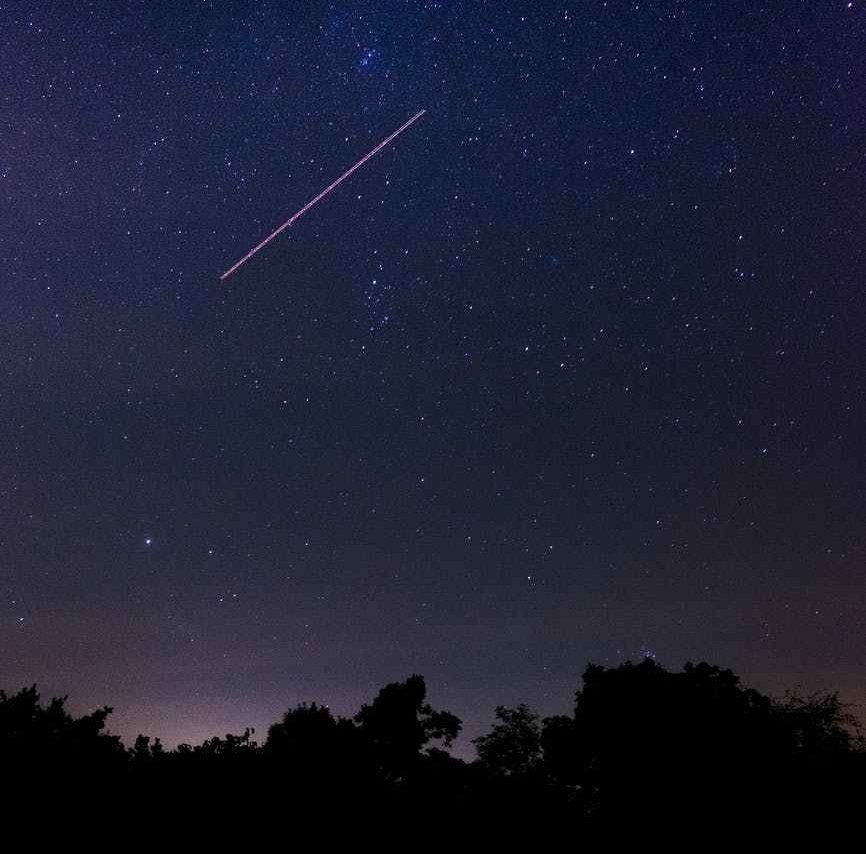
Another world has passed us by Just as we were sleeping, And fallen through our vortex as we lie – A happenstance unseen across our sky. For all the while the linens we were keeping, A momentary spark can live and die.
So many books and films and plays, So many greats of music and art, Loved by so many, lauded with praise – So why do I still feel apart ?
Why do these classics not fill me, When millions burn with the hope that they give ? Why does their beauty just chill me, When millions grab them as reasons to live ?
No. Don’t brood. I also feel, Though diff’rently from all of this – But I am just as sharp and real, And I deserve my share of bliss.
And sometimes, yes, I find a voice To tell me I’m not quite alone. This pickiness is not my choice, It’s just the way my brain has grown.
So many books and films and plays Are doing their jobs, and doing them well. I wish them luck, on our sep’rate ways As I pray for one to cast its spell.
What a bastard, What a bastard, What a bastard: Tommy More. Saint he is, exemplar fellow, Philosophical and mellow, But no pussy lib’ral yellow – Heretics, he is the law ! Not a bit like Tommy Wolsey, Tommy More will hear each prole’s plea – Takes their lives to set their souls free – He’s the Torture Chancellor. Got a Bible ? What’s it chattin’ ? Better be in God’s-own Latin; If it’s one Bill Tyndale’s shat in, You are for the stake, for sure.
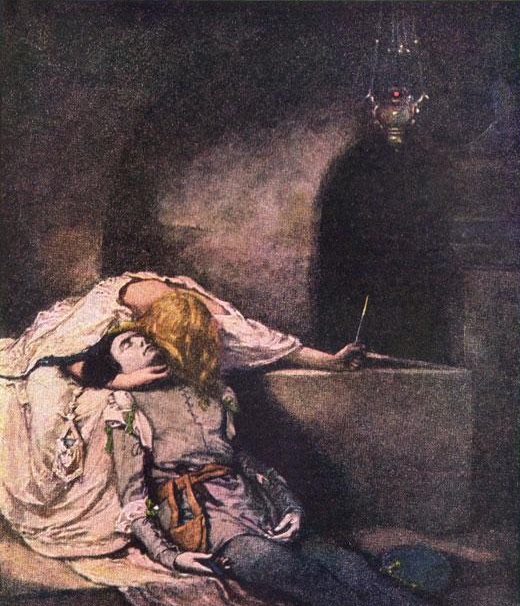
I was so shy and so urgent for love, He was so cocky and so unforeseen – Montecchi’s scion, forbidden and tough, Flaring my heart that was nearly fourteen. Ros’linda no more, now I shone so bright – Covert our courtings, the game thrilled me much. Made for a beautiful corpse, for one night, Till I awoke to my lover’s cold touch. Darkness his mistress, they lay ’neath my vault – Retching in dazement, I readied his knife. How could I live sans my Roman exault ? How could I die when I’d died and found life ? I did not follow my darling bereft – I betrayed him as he me when he left.
Don’t forget that Juliet was only thirteen, experiencing her first teenage crush.
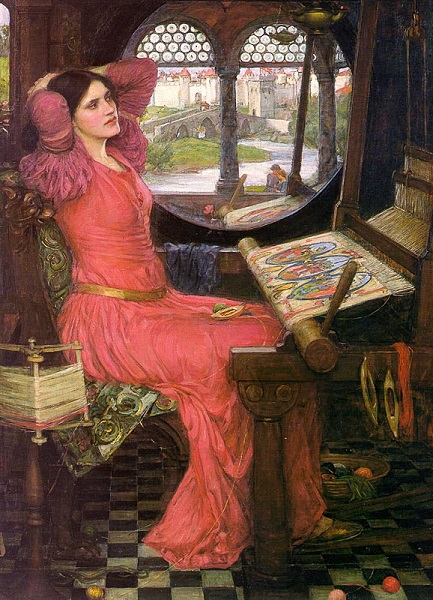
On either side the river lie The fields that stretch into the sky – Whose lowlands raise the beans so high, And grow the barley and the rye That feeds the folk in Camelot. And all this land beneath the hoe Is owned by she who will not show Her face to those who plough and mow – The Lady of Shalott.
She lives upon the river isle Where blow the lilies, mile on mile – Although she hasn’t left awhile, Not even to ride out in style To dance with knights in Camelot. She keeps within her ivied keep, Unseen by those who sow and reap, As if a hundred years asleep – The Lady of Shalott.
So life goes on and seasons pass, As sheep are grazed upon her grass – And any surplus we amass Is carted off by weight and class To market-day in Camelot. But any profits from the trade Are not for those who turned the spade – Instead, our labours all must aid The Lady of Shalott.
I’ve heard it said by those who say, That she is cursed in some strange way To never see the livelong day, To never be allowed to stray To many-towered Camelot. All the world, they claim, must pass Reflected in her looking-glass, And what she sees, so weaves that lass – The Lady of Shalott.
But as I dig another ditch And break my back to till her pitch, I think about my Lady’s hitch – And slowly I can feel an itch That none can scratch in Camelot. If she is cursed, then who’s the hexer ? Why would they choose this to vex her ? Such a fiddly yoke bedecks her, Lady of Shalott.
And do I really set much store In curses, blights, and ancient lore ? They’ve tried to pull this stuff before To keep them rich and keep me poor, In temples all through Camelot ! My Lady, is it really charms That keeps you warm and safe from harms, While we must shiver on your farms, Oh Lady of Shalott ?
So what would happen if you leave, Or look direct at what you weave ? Just who would care and who would grieve ? You are, I fear, the most naive Of any girl in Camelot ! But take a chance, and take it swift, And you may find the world will shift – And if you die, at least you lived !, My Lady of Shalott.
So Mistress, step out, if you dare, From out your crack’d and gilded lair, And pull your weight and crop your share, And help us haul it to the fair That summons all of Camelot. Or else, when comes the Winter’s freeze, And I need fuel and have no trees – I’ll raid, and burn, your tapestries, Oh Lady of Shalott !
This of course is a take of the famous Tennyson epic.
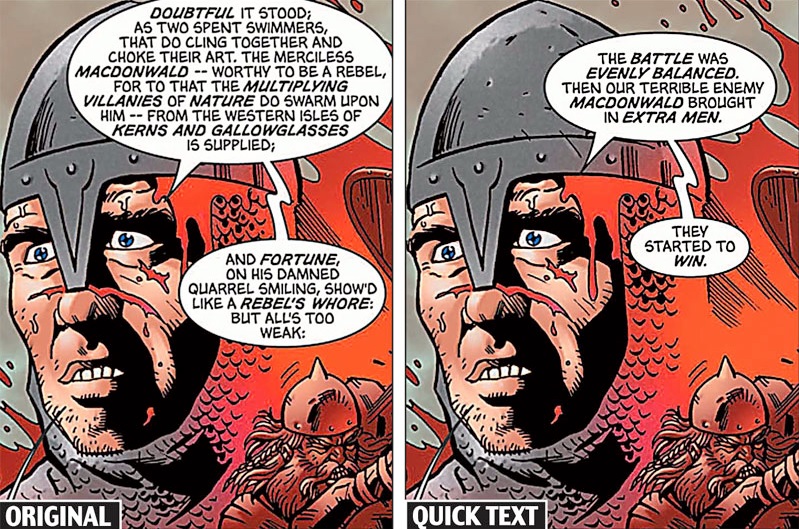
From Classical Comic’s translation of Macbeth, illustrated by Jon Haward.
The Bard & I
Ah Will, we were not meant for one another, For ours is not a marriage of the minds. What can I say, my literary brother ? We’re poets both, but very diff’rent kinds. So yours the fame and wealth and adulation, And mine the anonymity and debt – But then again, we glean our exhortation From very diff’rent mistresses, I bet ! For I could never write your verse, nor wish to – And you, I’m sure, could never capture mine. So you be Zeus, and I shall try for Vishnu – And keep my metre dry, and hold the line. And if some day I reach your heady skill – I’ll have the way – but always lack the will.
Concerning the left panel at the top, are we to believe that an exhausted and demoralised man-of-action such as the Seargeant (who is apparently suffering a head wound) would really speechify and wax lyrical ? To the point, man !
Take your modern world away, We have no need for it at all. We grow our food in nature’s way, And she shall fill our barns come Fall. So drive your cars and tractors hence, We have no fuel to fill their tanks. Our horses make a lot of sense, And need no complicated cranks.
My friends, you wish for isolation, That is clear: You shun all outside integration, Shun its news and stimulation, Make your parishes your nation Year on year. But when you lose the progress spark It always leads to Ages Dark – You long to gag and leave behind The sharp and seeking human mind, All out of fear.
And whence will come the steel and clay That won’t be found within your chalk ? When all your ploughshares rust away, I hope it’s not too late to talk. I guess your way, I guess your way must heaven seem When Summer days are all a dream, But our advance, But our advances must prevail When Winters bite and harvests fail.
For if you doubt our modern age, Then do not shun us, but engage ! And if you have a better way, Then spread the word and save the day ! Don’t mutter to yourselves with glee “Oh Lord, what fools these mortals be !”
Your modern world will not be missed – We have our God and have our seers. We do not need your scientists, Your doctors or your engineers. We have some books, we have some plays, An old guitar or homemade fife – We paint and act and sing our days, And have no need for modern life.
My friends, you wish for simple pleasures, That is clear: Finding in your simple measures Honest tasks and homespun leisures. All bestowing rustic treasures Year on year. But shrugging off our salaries Will also lose our galleries, By shunning our committee fights, You lose our films and city lights, All out of fear.
And whence will come the medicine That won’t be found within your herbs ? Before the pestilence can win, Pray let your Eden be disturbed ! We’ll still be here, We’ll still be here by south and north, To take you back and bring you forth. So look for us, So look for us by east and west, If you should quit your priestly quest.
For if our modern world offends, Pray do not hope for dreams, my friends For fairies will not feed the poor, Nor kill the germs nor mine the ore. So grab the future, all she’s worth, And put a girdle round the Earth.
This is a little-remembered play of Priestleys, edging into science-fiction while at the same time imagining a rural idyll that rejects modernity, with plenty of references to A Midsummer Night’s Dream thrown in.





 Rhyming Couplets