Hot Air & Cold Fronts

Photo by Enrique Hoyos on Pexels.com

Hot Air & Cold Fronts

A play in the open air, it was,
A drowsy Summer’s day –
I wished I were not there, because,
The sky was looking grey.

The monologues were droning on,
Soliloquies so slow –
And where the sun no longer shone,
The rain was sure to show.

Some pigeons pecked the grass between
The actors, undisturbed –
The breeze was starting to get keen,
To match the verbiage heard.

With not a cut within the script,
They read out ev’ry line –
But the mercury was not so gripped,
As it sped into decline.

Hold on there, what had I missed ?
Oh, nowt, the same damn speech !
Even the clouds had got the gist,
And looked about to breach.

The fools all capered round the set,
Right back where they began,
When the Heavens wept for Juliet –
Thank god !, I thought, and ran…

Auto-Graffiti

The more-interesting half of The Ambassadors by Hans Holbein

Auto-Graffiti

Dali’s watches melt in a dreamscape,
Rene’s pinstripes rain as a crowd,
Giuseppe’s fruit has a definite shape –
But Hans is oddly cowed.

He painted both the ambassadors
In a very sensible room –
Though maybe he found them a pair of bores,
That turned his thoughts to doom.

His heady jape, while showing-off,
Must sacrifice body for fizz.
Too weird to comment, too crude to scoff,
It doesn’t belong where it is.

It ain’t a secret, we’ve seen it for miles,
And why such a funny slant ?
Couldn’t he have worked it into the tiles ?
Or hidden by a potted plant ?

The pedant in me would like to point out the singular for graffiti is graffiti, because we’re speaking English not Italian.

Tartan Tarts

Tartan Tarts

I asked her what was the tartan she wore,
She smiled and told me Smith.
I’d never considered that Clan before,
But fair enough – the Smiths of yore,
The Sassenachs of Aviemore,
The flints in the monolith –
The common Clan for the ev’ryman,
The hammers and tongs of myth.

She asked the tartan in which I deck,
Buchanan, perhaps, or Brodie, or Beck ?
I smiled, and told her Burberry Check.

Read by Athelstan

It seems that the Gaelic word for smith is the origin of the Clan McGowan, but that even before surnames arose in the Highlands, some Scots had Anglisised their profession to ‘smith’.

Brick for Brick

Recreations of Hadrian’s Wall and The Great Wall, by artists alas unknown.

Brick for Brick

I grew up with castles and churches and manors,
Their architecture feels like home –
While Indian temples and Chinese pagodas
Were glorious aliens in stone.
It all made sense that Kublai Khan
Had not one dome in his Pleasure Dome

But when I saw the Great Ming Wall,
It all felt too familiar –
It looked like something the Romans might have built,
Had they reached this far
Rounded arches, crenellations, arrow loops –
All quite bizarre.

The only telltale signs were in the watchtowers,
And their roofs –
Simple saddelbacks, slightly concave,
They were hard-hill-hatted booths.
Not like the four-square hips of the Romans –
Projections providing proofs.

Except…on many of the towers we see,
These structures are robbed away.
And we’re left with familiarity
That’s out-of-place, astray.
Was it built-up piecemeal, really ?
At this point, who can say ?

From what I can see in images, the watchtowers had roofs that were a mix of hard-hill and hanging-hill, the difference being that the latter had slightly overhanging eaves as in the image below.

Photo by Tom Fisk on Pexels.com

To be clear, saddleback roofs (aka gable roofs) were not unknown to Romans, but not I think used atop their watchtowers.

Arbeia Gate by Michael Kooiman and Limes WP 3/26 by Carole Raddato, both showing recreations of what is believed to have stood.

Mistress Blacklock

detail from Saint Peter in front of his eponymous basilica in the Vatican, sculpted by Adamo Tadolini

Mistress Blacklock

Throughout the gothic city-states,
Secure with many doors and gates,
The greatest craftsmen in the land
Were those who crafted locks –
Protecting life and property
Behind the password of a key –
And yet, with just a twist of hand
It frees our hearths and stocks.

Thus, whereupon the plague is rife,
The locals dread their very life,
And conjured up a chatelaine
To rattle in the night –
A mistress dark and grimly tall
With sturdy boots and sweeping shawl,
And ring-bound keys upon a chain
To lock the dead up tight.

Never in a hurry, she,
Yet striding on determinedly –
She visits those who’s fever runs
As fast as runs their sands.
No lock can bar her solemn deeds,
For she has just the key she needs
To reach all lovers, reach all sons –
Where’er the fever lands.

The doors unlock, and slowly swing
Upon the rogue and saint and king,
And in she stalks with silent ease,
And stoppable by none.
She takes the ring about her waist
And cycles, never in a haste,
Through all her heavy iron keys
To find the very one.

And that she lifts and points toward
Her victim, all the rest ignored
And presses to his chest her shaft
That bloodless passes through.
The fingers of her left discern
The bow upon the shank, and turn
As smoothly as the masters’ craft,
Their workings, firm and true.

Her right she offers to he held
By him, that fear may be dispelled –
They say her bony, steady hands
Are warmer than you’d think.
And so his latches spring apart
To free his soul and stop his heart –
Her key withdraws from out his glands
With just the faintest clink.

And with that, speaking not a word,
And with no other neighbour stirred,
The plague has been about its chores
With not a jam or jolt.
As through the busy, ailing towns
She goes about her nightly rounds,
Of dousing lights and shutting doors
And drawing home the bolt.

Ophelia’s Pharmacy

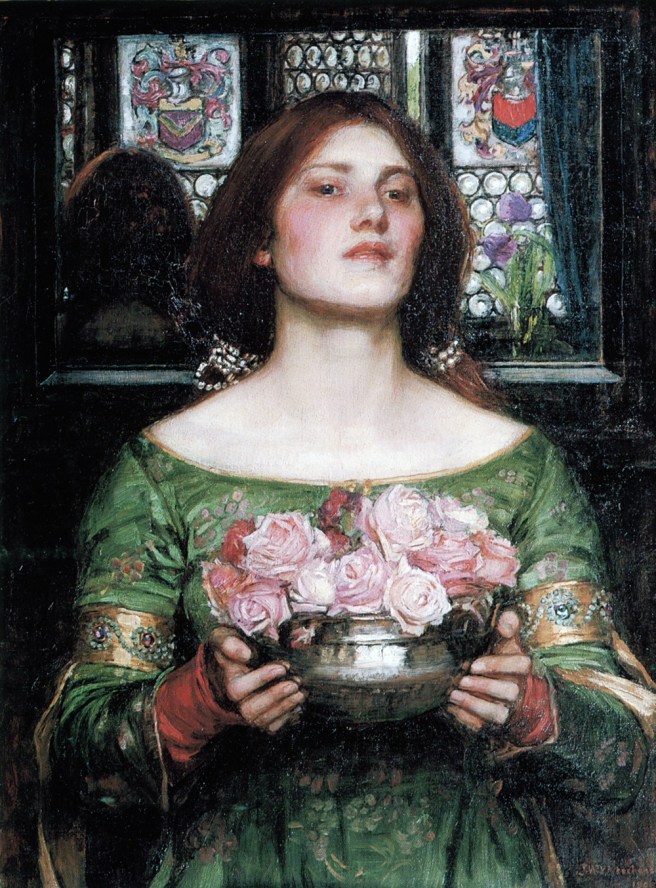
Gather ye Rosebuds While ye May by John Waterhouse

Ophelia’s Pharmacy

Here’s rosemary – for memory, some say,
But here I offer it up for aches,
And for the colic, here’s caraway,
And there, valerian for shakes.
I have the wisest sage for eyes,
And columbine for fevered brows,
And lavender, to drive off flies,
And camomile to help you drowse.
Some fennel to keep you regular, back there,
And thyme to rid the worms,
Here’s rue for you, but it scalds in the sun – take care,
Use St John’s wort for the burns.
And for the maidens, I’ve violet and pansy,
To keep your flowerhead free from weeds.
And if these fail, there’s purgative tansy –
Restoring your bloom, not going to seed.

Camomile is a type of daisy, by the way.  And it looks like Ophelia has also found a fresh supply of violets.

And yes, I know, I know, I’ve rhymed
worms with burns.  Not ideal, but sometimes you have to take a leaf from hip-hop’s lyric sheet and roll with ‘close enough’.

Purinoia

George Whitefield by an unknown artist

Purinoia

Vigilance Vance was a devil for the devils,
Finding them all over, in angles and in bevels –
He found them in his toolbox, he found them in his bed,
As they hollered from his bushes and they whispered from his head.
They dulled his steely razor, they sharpened all his wine,
They loosened-up his laces, they tangled-up his twine.
In ev’ry mouth of mutton and in ev’ry bite of apple,
They would choke him at the harvest, they would tickle him at chapel.

Vigilance Vance was awash in filthy devils
From the Westmorland Lakes to the Somerset Levels
He found them in the woodshed, he found them in the dray,
Teasing him and taunting him and tempting him astray.
He always knew they watched him, he felt their beady eyes
On the bulging of his biceps and the firmness of his thighs –
Ev’rywhere he found them, ev’rywhere he’d grapple –
Fairies in the garden, gargoyles in the chapel.

The title is a reference to puritan paranoia – pure-annoy-uh.

Quarter Days

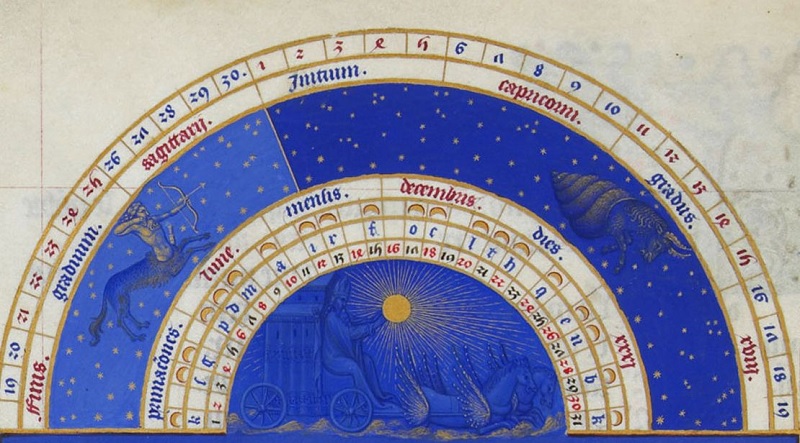
book of hours
detail of December from the Très Riches Heures by the Brothers Limbourg

Quarter Days

In March the Ladies have their day,
In June, the Summer’s mid,
And Mickel holds his mass, they say,
In late September, come what may,
Just as he always did.
And then we get to Christmas…
That well known day for paying rents,
And hiring staff, and starting school,
And other secular events
That prove there’s nothing new, alas,
In monetising Yule.

History Never Changes

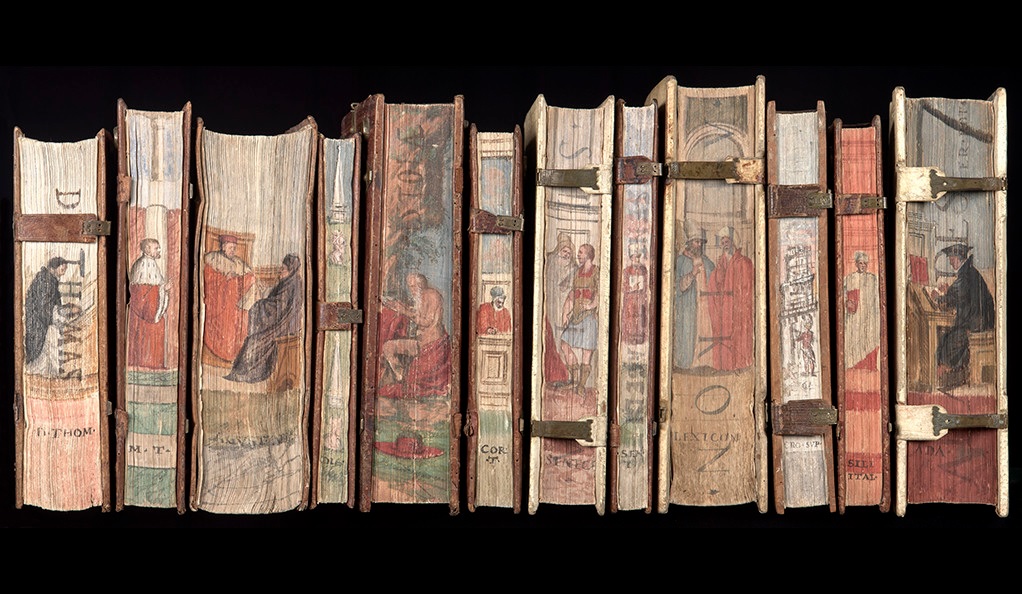
painted fore-edges by Cesare Vellecio

History Never Changes

The trouble with the past
Is that the past is pre-determined –
So we know just how it goes
Because it’s all already been.
Now at the time they must have felt so free,
Yet they’re confirming
That the past is fixed forever,
With no wiggle-room between.

Little did those little people know
There’s just one way for things to go,
And ev’ry time we play it back,
The same old things are still on track.
There’s just no way to keep hold of dinosaurs
When dead is dead –
There’s no way to replay the wars,
Or Anne Boleyn to keep her head.

But wait – if there’s a script to act,
We write it out together
From a million potential drafts
That could go either way.
For just like us, they got to choose
But once they chose, they chose forever.
The past is post-determined –
Once it’s set, it has to stay.