Old London Bridge & Nonsuch House by Peter Jackson
Nonsense Avenue
Why can’t our road names Be honest and neat, As regular codenames To Gardens and Street ? A road name is two-fold, That ought to be checked To see me and you told Just what to expect- A Lane should be narrow, A Way should be broad. Alas, this clear arrow Is often ignored – Our naming mis-uses And gives itself airs, With Prospects and Muses And circular Squares.
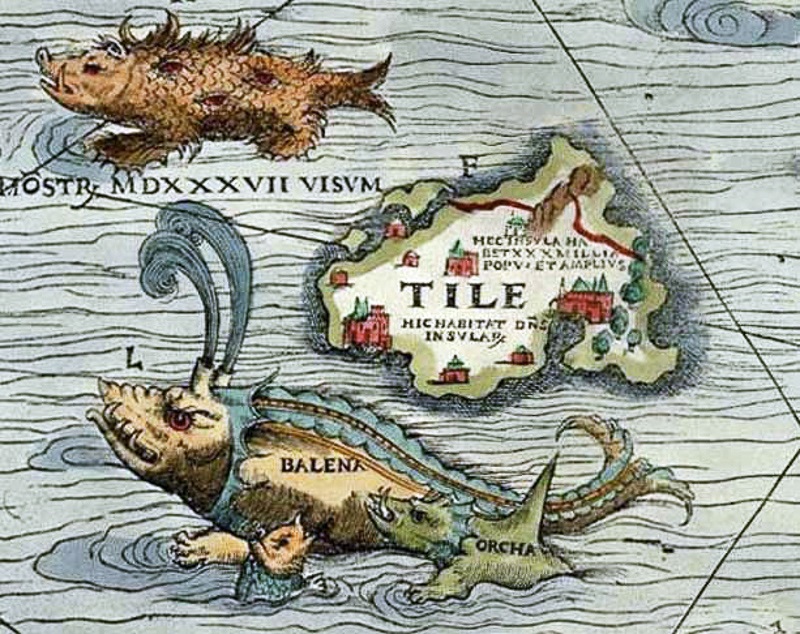
Pytheas claimed to have gone to the North In ninety-six seventy-six HE. As far as Thule, beyond the Forth – But where ? Nobody can agree. So the name was later applied to places – Shetland, Norway, Iceland, and on. Forever drifting North as the traces Of habitation were stumbled upon. The word was attached to Eskimos, As called by those who did the naming – And a rare-earth element, which shows The allure it held in its framing. Finally, in the hundred-and-twentieth century, A trading post re-used the term In Upper Greenland, the latest entry To plant the Grecian germ. An airbase later sprang up to claim it – And at last, Thule was a definite place – It had finally chosen to cash-in its fame And end its meandering chase. Until…the Air Force decided to change her, To strip out the exonym, rebrand the node. So Thule is free again, ever the stranger, To wander the North and with no fixed abode.
Thule is usually pronounced as Thool-uh (or perhaps I should say Þool-uh). However, I have seen Tool-ee used, even by myself.
I want to hear less of Uranus, That big gassy body found in the Bath. You see, you’re sniggering already ! It’s a noble planet, it’s not a cheap laugh ! Why use the Roman name of the Greek ? ‘Ouranos’ sounds not so silly. Or better yet, let’s see more of ‘Caelus’ For the methane found by the Willy. That’s Wilhelm Herschel, the man who slapped it Into the solar system. And named it after King George the Third – When he saw royal buttocks, he kissed ’em ! From its nether regions, this constant hot air Gets so petty, and I want it to stop – I want to see less of this childish smut, Or the pressure will make it go pop.
Urban Planning for Urbane Planets
You can’t build Uranus Circus in Bath – At least, not by that name. A quirk of language is having a laugh, And we all have a smirk in the game.
Uranus was discovered in 1781 (11781 HE), though it had been unknowingly sighted several times, possibly as early as Hipparchus in 9873 HE. This was the first time that the concept of there being a new planet had ever occurred to anyone, and there was no reliable naming convention to guide them. Yes, the ‘prehistoric’ planets all bore the names of Roman gods, but was this new object really another one just like them, or should it be demarked as something different ?
Indeed, although Uranus was proposed as a name within a year (and the equally-newly-discovered element Uranium so named in its honour), consensus around it wasn’t achieved until some seventy years later, and meanwhile other proposals included Hershel, Cybele, and even Neptune. But at least the eventual winner was considerably better than that proposed by its discoverer – Georgium Sidus (or King George’s Star). I mean, it’s not a star, is it ? Next you’ll be naming a chunk of rock an asteroid…
I wonder if Carl Linnaeus smiled As he coined a name for a water-snail As if a windmill in a gale. Perhaps the twist of its shell beguiled, But given its lack of energy, He must have seen the irony ?
Forever dubbed forever more By a name befitting of cavaliers To a bug with neither joints nor gears – In the age of steam, as the turbines roar, What did they think of their silent whirlwind, Forever failing to twirl and spin ?
But maybe our Carl was being sublime ? As cyclones on their well-greased heels, Like plugholes, perhaps, or waterwheels, But they did so in their own sweet time – Forever in motion, the will that drives, Revolving their shells throughout their lives.
Perhaps Carl was thinking of the popular hobby of snail racing ?
They used his full name, in the notice – And then carved it on his stone – I guess that he was born with this, So that indeed made it his own. But I never once have heard it uttered, Not be anyone who cared – Too many letters, far too cluttered, When he wore it unimpaired – With a friendliness in its brevity And no pretentiousness or strife – A name with great longevity, A name that lasted all his life. For some people, a single syllable Is all we need to say – And those others from their name in full Just get forgotten, tucked away. But now, formality’s a blessing – We understand, accept the change – And we know who we’re addressing, Though he sounds a little strange. But the man himself, of course, is the same, With this not-quite-pseudonym. Though odd, to see his Christian name As only ever God would call him.
Whyever are woodpeckers Logged by how they’re spotted ? Why are we such checkers Of how many lots we’ve totted ? And is the greater-spotted greater In the number of its spots ?, Or is its name a commentator On the quality of dots ? Or is each polka such a size, They’re practic’ly uniting ? Or are the spots our searching eyes, Recording ev’ry sighting ?
Since woodpeckers are more likely to be heard than seen, perhaps it’s a reference to Spotify…?
Never trust an author who Addresses all his male cast By surname-only, first to last, As if he never even knew Their given-names. As though he doesn’t really like them, Tolerates at best the lot, It makes you wonder why he writes them Just to be forgot. And quite unlike his wives and dames, With whom he’s less superior, Yet overly familiar. There’s those who see these names we use As either/ors, up for review – One part sensible, one silly, One name functional, one frilly – Always others get to choose Which one that we must answer to. It’s strange, these different forms – We say the Hadley Cell and Beaufort Scale, And talk of how in FitzRoy sits a gale – It’s quite the norm. And yet we’re first-name-chummy with the devastating storms.
So never trust an author, Or a teacher, or a sergeant-major – Never trust a posh-voiced pager Barking surnames with a clout, Intent to order them about. Never trust a critic who ostensibly admires, Yet then only calls his heroes like some underlings he hires. And yes, I have been guilty too, Not wanting to presume a closeness Or an overly-verboseness In my always using first and last each time, just in case. But I hope I’ve never made the crime Of calling someone bluntly to their face – As if I owned the place ! And you can call me Mister, If you need to call me anything – Just like I talk of Mr Windsor when I mean the King. But why are we insisting on such old formality ? It’s just not me ! So even if we’ve never met, You all still get the same rapport – To call me by my friendly name – Cos that’s what our forenames are for !
What could be more personal Than the name I bear through life ? Well…maybe it’s my mix of friends, And my one-and-only wife, Or maybe it’s my sense of humour, Maybe it’s my skills, Or could it be my fingerprints, My fripperies and frills ? At least I have a say in those, Unlike my bloody name – Which I have to share with countless others, Like we’re all the same ! We’re pigeonholed at birth, alas, While babes without a voice. So what could be less personal That someone-else’s choice ?
I asked her what was the tartan she wore, She smiled and told me Smith. I’d never considered that Clan before, But fair enough – the Smiths of yore, The Sassenachs of Aviemore, The flints in the monolith – The common Clan for the ev’ryman, The hammers and tongs of myth.
She asked the tartan in which I deck, Buchanan, perhaps, or Brodie, or Beck ? I smiled, and told her Burberry Check.
It seems that the Gaelic word for smith is the origin of the Clan McGowan, but that even before surnames arose in the Highlands, some Scots had Anglisised their profession to ‘smith’.
We know who is the hero of the story By their name, Who overcomes the Pharaoh And is master of the game. They may be short and strong, like John, Or florid, like Lysander. But nobody can take the conn When called by something blander.
Our names say who’s the hero, Who’s the villain, who’s the fodder – The latter, if they’re named at all, Are given names which keep them small. Who’s an agent of the Bureau ?, Who’s a desk-bound plodder ? Why do you even have to ask ?, Their nametags clearly show their task.
We know who is the hero, And the hero ain’t called Nigel But when your name is Nero, Then you’re Emperor of Rigel ! Kevins never save the day, And clearly Richards have to lose, The Mauds won’t steal our hearts away. And Tracys never make the news.
Our names say who are heroes, Standing-out from us bystanders. The latter, if they get a shot, Are only there to serve the plot. There’s millions – so many zeroes – Never Homer, always Flanders. Yet still the parents set the stage And give their children names of beige.




 Rhyming Couplets