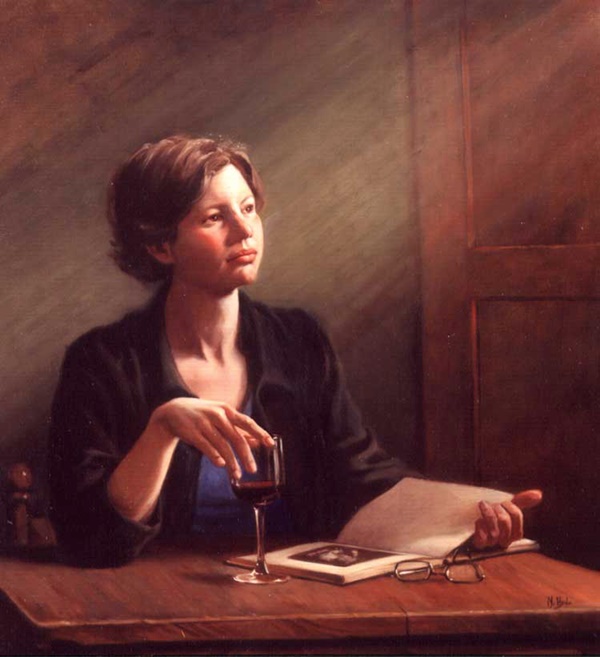
Now, where was I again ? Thinking, I think, about my thoughts, And how many do I have each day ?- How many zeros-worth, would I say ? And should I call them ohs or noughts ? And why is seven longer than eight ? And eight o’clock, is that too late ? So when does evening turn into night ? And goodnight – must it mean goodbye ? Can we say bad-bye ? Worth a try ? But is it really worth the fight ? Boxing ? I’ve never seen the draw, Unless the glove is hiding a claw, A mutant from a mad professor ! And don’t forget a screaming blond, Unless it’s bleached and we’ve been conned ! Poor mum was scammed just last month, bless her. Just last month ? Or the month before ? They go so quick, I’m never sure… But why no ‘h’ in ‘sure’, I wonder ? Seven wonders – pyramids… I used to love them…them, and squids… They’ve got some giant ones, Down Under. Down…below the upper feathers… Have they feathers round their nethers ? Where do birds go in the rain ? Still pouring, by the sound, My thoughts just spinning round and round. Now, where was I again…?
You know me much closer and touch me much deeper Than any could ever before – You bring to your table this soundest of sleepers, And open me up to explore. You rend me asunder with gentle‘est plunder, To survey my hintermost-lands – You ease my distress with your tender caress, With my life firmly held in your hands.
Whenever I’m stumped for an effortless rhyme, Whenever the words won’t fall easy, When wheezing about on the gravely climb – So that’s when the words come to tease me – Late-night linguistical lethargies seize me, Whenever the trumps are the harder to find. And oozing from creases all over my mind Come scuttle the lazy, the sham and resigned – “Who needs a poem to rhyme ?” so they whisper, “Nobody else is much bothered these days. You labour at making all endings the crisper But is it all worth it, the pittance it pays ? Every poet, from preacher to lisper Has long since rejected this overgilt craze. Why must it be you who won’t flinch at their goosing ? Still clinging to structures when others are loosing. Oh, haven’t you seen all the standards reducing ? And haven’t you seen all their rhythmless fame ? All of the while, so your petty obtusing, Is leaving you sleepless and out of the game.” And so on, and so on. I hear them, I hear them – At three in the morning, it’s hopeless to clear them. For all of their carping and mocking and chiming, And trying, so trying to foul and coerce. But still my resistance I’m loading and priming To shoot down their posy and prosy-like verse. If only, if only I unearth some rhyming, Some trove of concordance to echo my timing, Some anything, anything with the right sounding – Some something to stifle my wheedle’ing head. Something to root for, to bring their confounding, Something of proof that will shutter their hounding, Anything splendid and outright astounding – Anything quick, or the voices will spread ! I must end the poem, I must end the pounding, To let this poor poet at last go to bed !
An angel came into my room One night, and hovered by my bed, With subtle beats of golden wings, And gentle light about his head. And while my shock about my guest Continued, so he spoke to me: “Why, pray, shall you so hate God When all He shows is love for thee ?” “The Lord…?” I stammered once or twice, Then found some voice from who knows where To make reply “I hate him not, The truth is that I do not care.” “Now come,” the angel mocked with jest, “For all your claims of disbelief, Why would you spend so much strong speech On what should matter slight and brief ? If you upon such proof insist As only science can provide, Then, please, we wish you go in peace, And as you go, let us abide.” And as his light began to fade And too his form began to fly, I softly said, perhaps too late: “So I shall you. Shall you so I ?”
Oh, I could sleep for a hundred years – Sleep through bombardment or brass band or earthquake, Sleep through a hundred-fold stampeding steers, Sleep with more passion and vigour than when I’m awake, With a beautiful absence of fears – For so comes my guardian muse. You’ll think me too-slumbered, encoma’d, unwound – An elegant study in prone and supine. With hardly a care if I never come round, Each whispering breath but a sigh of repletion divine – So sweet is the stupor, so stormless the snooze. And tenderly, warmly, and soft she sedates, My deadlines dissolve and my duties unstream, My tension unstraps and my hasslements scatter – For there on my pillow, my mesmerous mistress awaits. And do I dream ? Perhaps. It really doesn’t matter.
Sometimes, no matter how hard I try To pay attention to the little things That happen anyway, Sometimes, it seems, I simply can’t apply My wayward focus to the nuts and springs Of yet another day: I stare into my screen as numbers fly – The day-long daydreams dream, the maybes sing, The permutations run… I couldn’t tell you how or when or why, But even as the tangents loop and swing, So still the work gets done. I’m barely here, but still my seeing eyes And typing fingers track and dart and ping Throughout each random trance. My mouth is talking – am I telling lies ? I couldn’t say, I wasn’t listening… But oh, how the dust motes dance !
Since long before the Russians shook your walls, And ere the Prophet’s prophets spread his word, Or Alexander feasted in your halls And found you even fairer than he’d heard – Your golden domes upon your golden sand Have tempted men and kings since Darius. Who needs the Muses when we’ve Samarkand ? What would ye, Ladies ? It was ever thus !
I met a maiden from an ancient clan, Who held a gaze as old as Summertime, She traded finest silks by caravan Across the Steppes that only camels climb I should have bid her health, and gone my way, And never mind the henna on her hand, But no, I had to make excuse to stay – Men are unwise, and curiously planned.
She showed a little of her precious stock, The bolts she brought from China to Tashkent: She laid them out upon the desert rock, And stroked the fibres of the Orient. Countless caterpillars gave their lives for each, In patterns joyfully superfluous – Not that they care what moral they may teach: They have their dreams and do not think of us.
We spent the chilly night beneath their thread, As she unveiled the promise of the East – But come the dawn, her cloths-of-heaven bed, Like her, had fled – and I woke ached and creased. I wonder if, in dehydrated spunk, I’d summoned her mirage at my command – We Englishmen, when we get hatless-drunk, We take the golden road to Samarkand.
Two Ways to Samarkand
What wouldst thou, Flecker, it was ever thus – Readers are wise and rhythmically planned. They have their Road, so do not make a fuss. They think your Journey never really scanned.
This is a sort-of rondeau redoublé, except that the first verse whose lines then get repeated as the final lines of the others is missing, and wasn’t written by me, but by James Elroy Flecker in his famous(ish) The Golden Journey to Samerkand. From what I can gather, the poem appeared both ‘album length’ in a play, and cut down to a ‘single’ containing only the last part, both of which end with the four lines I’ve borrowed here. However, different references seem to say either ‘Golden Road’ or ‘Golden Journey’ in the last line, hence my second poem. ‘Darius’ is intended to be pronounced with the enphasis on the first syllable – I realise that some people place it on the second, but that just wrecks my rhythm. Incidentally, by ‘hatless-drunk’, I mean sunstroke.
The beds that I’ve slept in, the beds that I’ve known – Each harder than vapour and softer than stone, From four-poster boasters to flea-bitten heaps – I’ve sailed on their billows and sunk in their deeps. From headboards to bedsteads, from duvets to sheets, From brass-knobs to tassels, from casters to pleats, With mattresses lumpy or stuffed to the seams – They each one and ev’ry are beds of my dreams.
But they never will be perfect – They’re close, but they never will. In all my sleeping days alive In which I ply my greatest skill, The bliss of never-knowing five ayem Is never quite as good in them. However much they rest me, They are always second-best – Why climb the hill to Bedfordshire To lie alone atop its crest ? The bed I most desire to keep Is in beside wherever you may sleep.
The beds that I’ve slept in, the beds I’ve called home – To lie down on eiderdown, horsehair and foam. From top-bunk to futon, from hammock to cot, I’ve slept in the worst and the best of the lot. Springs within pockets and springs within springs, From the smallest of cribs to the sizes of kings. A third of our lives is spend under their care, From a bench in a park to the Great Bed of Ware.
One night, I swear I’ll drift away, A hundred years a-snore, And float amid the elves and fay To where no dreamers dare explore, And free my delta-waves to play Where only Nemo came before. Until I’m tossed upon your shore again, To share once more your counterpane. For the perfect place for counting sheep Is right beside wherever you may sleep.