To the Future

grandad to us all
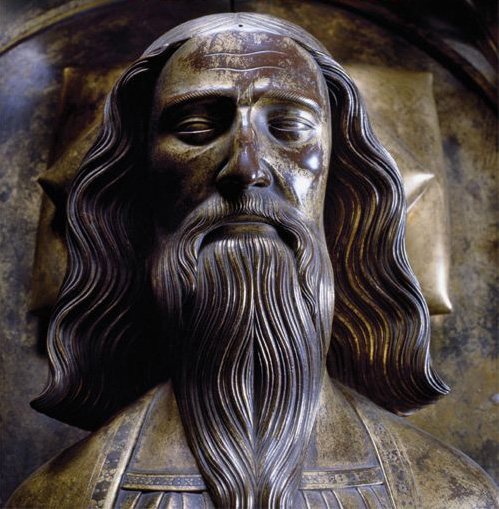
Bronze effigy of Edward the 3rd in Westminster Abbey

To the Future

My world was taught in your history class,
In half a chapter your teacher rushed through.
Somewhen between a turning point
And some other event which we never knew.
My world just probably made you bored,
Learning the dates of a notable few –
But not of my name – I never was found
In the textbooks on which you scribbled and drew.

Maybe then I was nobody special,
Somebody whom you can safely ignore.
Never improved a million lives –
Never brought hatred, hunger and war.
Maybe then I was nobody special,
Maybe achieved next to nothing at all.
But still I meant to a couple of dozen,
And for those the closest, an awful lot more.

You may then think that I was unknown,
Unrecorded in sadness and mirth.
Save for the parish’s register-book
Where my name’s still getting its three-entries’ worth.
Maybe you gotten my census or tax,
My causes of death and my weighting at birth.
But never be thinking that this is my lot,
All that I left from my time on this earth.

Never you think then that I didn’t count
Just cos you think I could never succeed.
Just cos you laugh at my primitive ways,
Never forget that we nobodies breed.
And if then I played in no big starring part,
But still my existence you so many need –
For there are yet hundreds, or thousand by now
In whose chain-genetics I mean much indeed.

It is claimed that anyone living in Britain today and whose family have been living here for several generations will lmost certainly be a direct descendent of King Edward the Third, who died in 1377.   Of course, if I’m, say, 24 generations down the line, that means I have over 830,000 great*21 grandparents, though quite a few of those will be dupliates.  Not that the poems about him, of course.

The Rigours of Indolence

there's a storm brewing
The Ball on Shipboard by James Tissot

The Rigours of Indolence

Ah, those aristos, who never worked a day,
Just sit back and wait for Papa to pass away.
While armies of servants and hard-working-clarsses
Would feed their fat faces and wipe their fat arses,
And loans would be brokered to fund wars of nations,
While riches would pour in from ex-slave plantations.

Ah, those aristos, who feasted on our sweat,
Those patrons of the arts, that lavish social set –
With artists and craftsmen and tailors and tours,
And houses and horses and operas and balls.
They almost were worth it, their style could defend it –
They didn’t deserve it, but knew how to spend it.

Usually I resist any attempt to rhyme ‘class’ with ‘arse’, but this poem was written in with a definite accent in ear.  ‘Papa’ of course should be pronounced with its stress on the second syllable.  This is an early poem, but I’ve started to preach a little less and let a little satire slip in.  The title incidentally comes from a line in Alan Bennett’s The Madness of George the Third.

Sheep Mayn’t Safely Graze

Photo by Nick Bondarev on Pexels.com

Sheep Mayn’t Safely Graze

We rack them out between bridges and nuts,
And crank till they must reply.
And those low, low throbs that we feel in our guts –
Well, the sheep feel them too, by-and-by.
But it’s never their bleats or their baas that are scored,
It’s never their voices that sing from each chord,
And it’s never their own requiem we applaud.
In life and in death, so their tension will always be high.

How many hundreds of thousands of sheep
Have our symphonies dispatched ?
Every cello has reason to weep,
And scream as its sinews are scratched.
How many flocks must we cull to the muse ?
How many sacrificed lambkins and ewes ?
On the altar of Bach shall their entrails ooze.
They live for this music, but always do strings come attached.

Mongers

Playing Marbles and Rag & Bone Man by Steven Scholes

Mongers

We used to be just simple merchants –
Iron, fish, and cheese,
And jack-of-produce costermen –
The traders in the bare necessities.
But now we’re only spoken off
As rumour, scare, and war –
We’re jack-the-lads of shadowmen,
Now hawking abstract concepts door-to-door.

The Engineers’ Plot

penge palace
Gems of The Crystal Palace, Sydenham by George Baxter, showing off the designs of Joseph Paxton

The Engineers’ Plot

Crystal Palace – it’s a suburb,
Station, park, and football team,
And a memory to a time
When this nation still could dream.
Once a product of Empire,
A palace to capture its roar –
Now just a flat-topped hill
In the Republic of Elsinore.
Straddling boroughs, pumping fountains,
Soaring towers, glass for miles.
Till flames across eight counties
Shattered her dreamy crystal aisles.

She no more beguiles – but that sounds Victorian –
Half vers libre, half Tudor sonnet.
Flirting with jazz and television,
Yet still bedecked in her bustle and bonnet.
She was no Bauhaus, no mere function –
Cast iron crockets encrusted her shell –
For all her prefab industry,
She always wore her baubles well.
Ah, she’s gone now – like her dinosaurs,
She’s of her time and place.
Though her place of course is the one she named –
You cannot say she leaves no trace.

Axis of Up

unravelled

Axis of Up

Flatland always had all three,
All three dimensions on it –
Anyone with sense can see
The Flatoids are upon it !
It’s true, they barely used the zed,
But still the zed was there –
But as for other strings that thread,
These cannot cube the square.

Via Metallum

mountain
Photo by Liam Gant on Pexels.com

Via Metallum

There is no metal in the metalled roads,
But still they’re made of steel –
They take the feet and hooves and loads,
And the ever-turning wheel.
The dust and ruts and highwaymen
Were swept away in dale and fen
By smooth and fast and tarmacked threads
With footed feet and watersheds.

But these have all been laid with stone
A century or more –
The job is done, the back is bone,
The soles are growing sore…
We surely now have roads enough
To leave the wilds unpaved and rough,
And only build our future trails
As metalled roads of shining rails.

Transatlantic Cable 14 – The Future

maiden lane
View of Broadway, north from Cortlandt and Maiden Lane, 1885

<<< Previous Part

Transatlantic Cable 14 – The Future

I write you once again, my love,
By paper and by boat.
The old-fashioned way’s
The only way you’ll ever get my note.

But have you heard,
A telegraph now spans between we two ?
Is this the modern world, my love,
The endless chase for something new ?

Though sometimes, when I think how long
We take to send our hearts’ desires,
I fancy, on the breeze, that angels sing
Along those wires –

Pensmiths, calling pensmiths,
What you write today,
You’ll get to say tomorrow –
Calling pensmiths from across the globe,
Your words shall span and probe,
This time tomorrow.
We shall gladly carry all your distant precious words,
The small, the silly and absurd,
From off your lips to willing ears –
Allying fears that letters reach too slow –
Come tomorrow.


It’s hardly for the likes of us, my love,
Who must still write –
No spark or semaphore will speed
These words as fast as light.

I cannot see how just one simple cable
Can unite us all.
Messages are paper still and boats,
For those whose means are small.

And yet, so many weeks until
Your next reply can stoke my fires,
If only, on the breeze the angels sang
Along the wires –

Scribers, calling scribers,
What you write today,
Shall fly away tomorrow –
Calling scribers from across the sea,
Your words are bounding free
This time tomorrow.
We shall gladly carry ev’ry distant precious thought,
The playful and the overwrought,
That bring their homes to foreign parts,
Assuring hearts that letters reach too slow –
Come tomorrow.

Musical AI version generated by Suno.com – find more of them over here.

Transatlantic Cable 13 – The Messages

progress
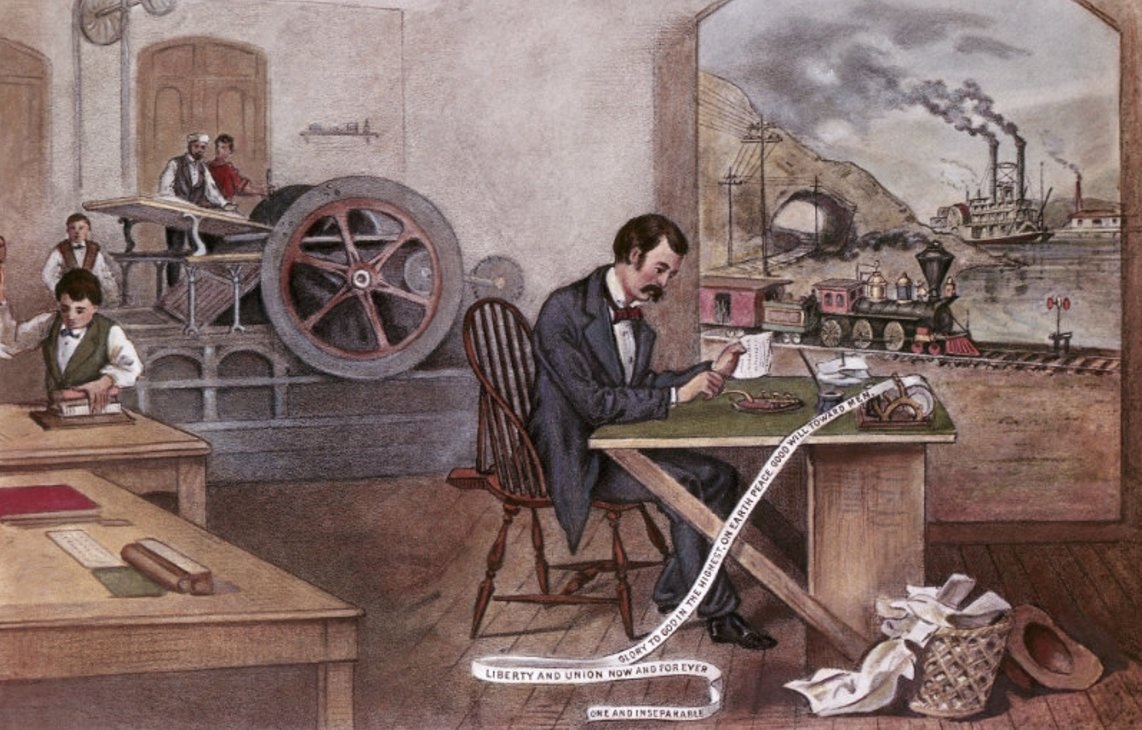
The Progress of the Century by Nathaniel Currier

<<< Previous Post

Transatlantic Cable 13 – The Messages

Ten full transmissions each hour, each way –
That’s four-hundred-eighty transmissions each day –
Four-hundred-eighty, and what will they say ?

Good news and bad news and news that can’t wait,
Tidings and greetings and offers and meetings,
And orders and pledges and threats and debate,
Departures, arrivals, and lovers and rivals.

Ten full transmissions each hour, each way,
Of profits and prices and projects and pay,
With no words misspoken or scattered astray.

Old news and new news and news of the world,
Battles, elections and plagues and infections,
As fast as the lightning, each message is hurled,
And back comes each answer – an undersea dancer.

Ten full transmissions each hour, each way,
Through storm and through snow and through come-all-what-may,
With no need to worry and no need to pray.

Peace and good will, they bade – what hath God wrought ?
Nation to nation in communication.
So is this the peace the philosophers sought ?
No need to be shy, just send your reply.

Next Post >>>

“What have God wrought” was the first one of the first telegrams sent by Samuel Morse in 1844.

Transatlantic Cable 12 – The Telegraphists

<<< Previous Post

Transatlantic Cable 12 – The Telegraphists

Dits and dahs and dahs and dits,
All day, all night, all year, relaying –
Reading, sending, hearing, writing,
Little bursts of sound and lightning.
Letters come in beeps and bits,
We do not think of what they’re saying –
In they steam without cessation,
With no room for punctuation.
Tappity, tappity, dit by dah,
The pulse of the modern world, they are.

We are the teachers, we are the clerks,
The upper working lower middle –
Literate, and handling secrets,
Tap it, jot it, never speak it.
We are the servants of the sparks,
Our social standing quite a riddle –
Overworked yet fairly paid,
We’re not professionals nor trade.
Tappity, tappity, ev’ry station,
All we move is information.

Next Post >>>