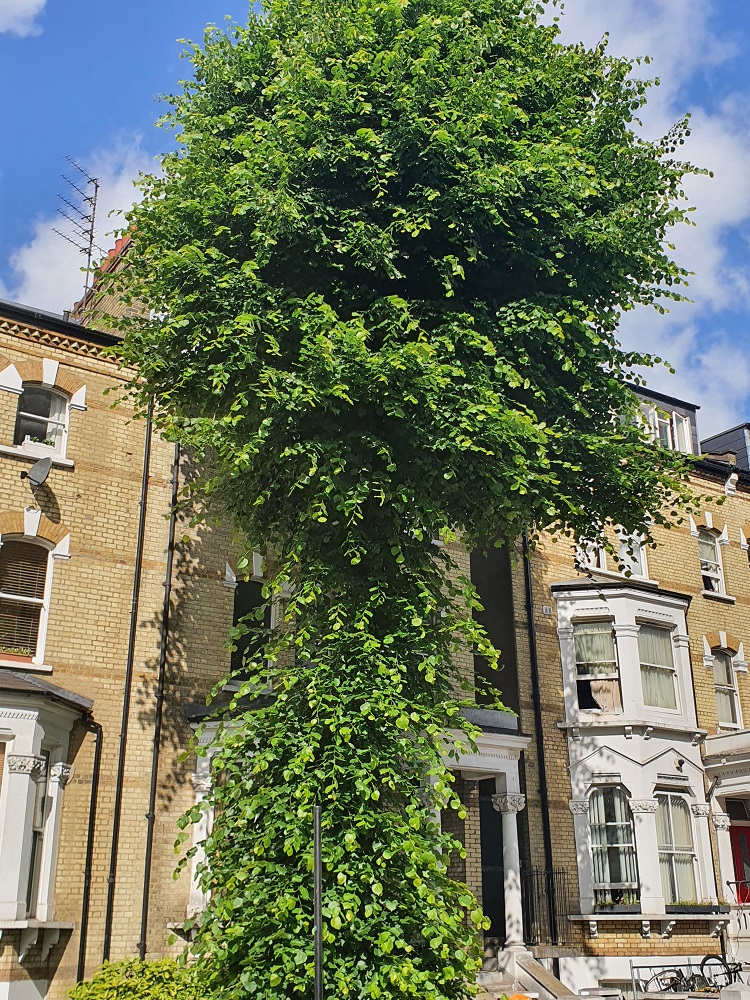
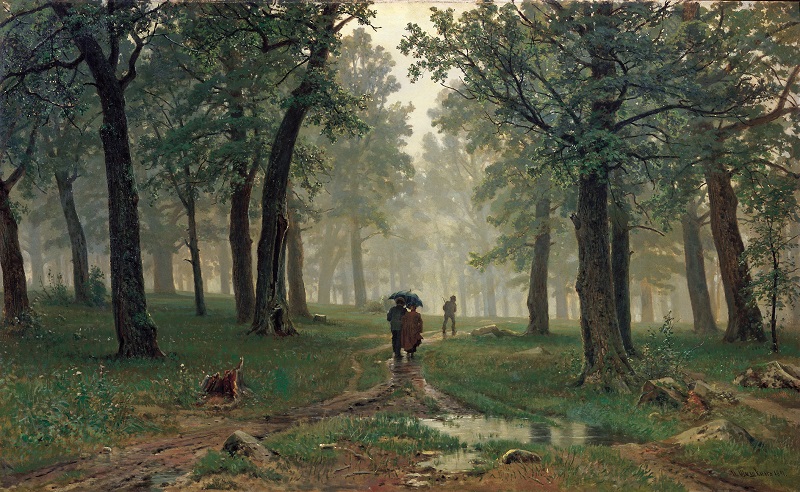
In Spring, I can sniff-out the sap as it rises, And comes overshooting the branches and twigs Of the cherries and lindens and suburban figs – A street full of pollen – my nose recognises That Spring has returned to the gardens again, In the asphalted forests of wychelm and plane. My hay-fevered neighbours are rather less happy, But I scent the chestnuts, the sweet and the horse, And the avenues of the acacias, of course ! Municipal headiness leaves me quite sappy – The syrups of sycamores, weepings of willows, That’s wafted by birdsong in sugary billows.
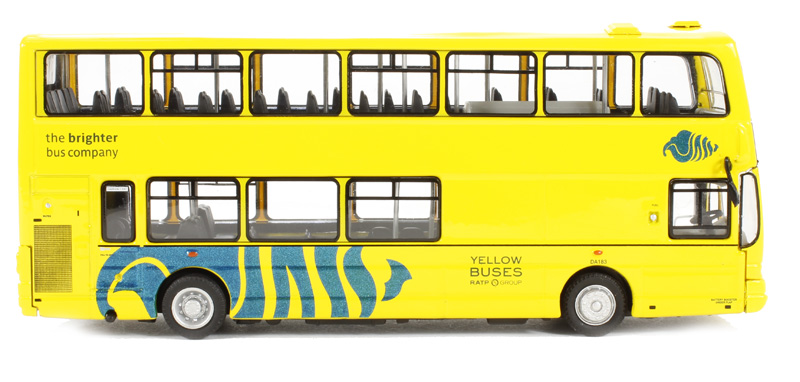
A Corgi model of a Bournemouth Wright Gemini bus. The model is discontiunued and RATP are no longer the franchisee, but at least the current buses are still yellow.
All Aboard !
Trudy Trusses loves the buses Which she rides to town – Urban-trekkers, double-deckers, Ones that bend around. Some are old and brightly bold, And red or green in colour – Some are new and grey right through, And others even duller.
Trudy Trusses makes such fusses Over diff’rent routes – The stops and times, the sprints and climbs, The stats and attributes. She watches who is in the queue, And who is getting off – The chef, the nun, the doctor’s son, The teacher and the toff.
Trudy Trusses swiftly susses Someone has to drive – The 12, the 3, the 7B, The weekdays 55. When she grows big, she wants that gig !, She wants to sit in front – To swoosh the doors of 24s And make their engines grunt !
Trudy Trusses sees the plusses In a job that moves. There’s folks to meet on ev’ry street, From pensioners to youths. You need a ride ? Then come inside ! There’s plenty room up top. Then home again through wind and rain, Just ring the bell to stop.
This poem isn’t necessarily set in Bournemouth, but I thought they deserved praise for one of the few places outside of London which still insist on the colour of their fleet.
detail from Saint Peter in front of his eponymous basilica in the Vatican, sculpted by Adamo Tadolini
Mistress Blacklock
Throughout the gothic city-states, Secure with many doors and gates, The greatest craftsmen in the land Were those who crafted locks – Protecting life and property Behind the password of a key – And yet, with just a twist of hand It frees our hearths and stocks.
Thus, whereupon the plague is rife, The locals dread their very life, And conjured up a chatelaine To rattle in the night – A mistress dark and grimly tall With sturdy boots and sweeping shawl, And ring-bound keys upon a chain To lock the dead up tight.
Never in a hurry, she, Yet striding on determinedly – She visits those who’s fever runs As fast as runs their sands. No lock can bar her solemn deeds, For she has just the key she needs To reach all lovers, reach all sons – Where’er the fever lands.
The doors unlock, and slowly swing Upon the rogue and saint and king, And in she stalks with silent ease, And stoppable by none. She takes the ring about her waist And cycles, never in a haste, Through all her heavy iron keys To find the very one.
And that she lifts and points toward Her victim, all the rest ignored And presses to his chest her shaft That bloodless passes through. The fingers of her left discern The bow upon the shank, and turn As smoothly as the masters’ craft, Their workings, firm and true.
Her right she offers to he held By him, that fear may be dispelled – They say her bony, steady hands Are warmer than you’d think. And so his latches spring apart To free his soul and stop his heart – Her key withdraws from out his glands With just the faintest clink.
And with that, speaking not a word, And with no other neighbour stirred, The plague has been about its chores With not a jam or jolt. As through the busy, ailing towns She goes about her nightly rounds, Of dousing lights and shutting doors And drawing home the bolt.
Late-on in the Spring, We’ll see the house-martins come again – In stylish black-and-white, And darting back-and-forth about the lane. They’re patching up their daub-and-wattle nests, The ones they left behind – The Winter muck is jettisoned, The inside cleaned and freshly lined. Are these the very birds we saw last year, The self-same mums and dads ? Or are these now the chicks they hatched at home, Inheriting their pads ? Though ev’ry year, I swear, They build another house beneath the eaves, And often touching in a terrace, Neighbours watching out for thieves – And those would be the sparrows, Feckless squatters in these high-rise flats – A better prospect than the hedges, Safe from cuckoos, frost, and cats. Hoping to be laid-and-fledged By hanging-out in hanging-domes, Before the grockles fly in for the season To their second homes.
Who is the Martin whose house these swallowets build ? The OED postulates that it is a contraction of Martinet, but that that in turn is a diminutive of Martin. Or it may be from a Latin term for a kingfisher. Or a bit of both – never underestimate the power of conflation.
Red Kite, photographed by Tim Flach for a 2019 Royal Mail collection
Look to your Lesser Linen
Red kites are as red As golden eagles are golden, And seen against the sky, they’re just as black. But there’s no mistaking that forking tail And fingered wings on which they sail, As slowly they embolden, Advertising how they’re back.
Just when Milton Keynes was thriving, So they were released upon Our unsuspecting hills and country towns – From Chiltern ghosts to national fame, So barely-flapping, barely-tame, From Leighton Buzzard to Ducklington, From Salisbury Plain to the Sussex Downs.
They breached the M25, of course, And rode the tarmac thermals on, Lazily and low above the brownfields and the parks – Ev’ry year they’re getting closer To the busker, judge, and grocer, Hamstead Heath and Kensington, Beneath their ever-wider arcs.
These eagles of the suburbs Are circling over school-run traffic, Just above the High Street rooftops, watching us all day. The City has its peregrines, But those are rare and tiny things, But these commuters are so graphic, Newly neighbours here to stay.
Picking up the roadkill, Perching on the weathervane, Weaving litter into nests, and drinking from the overflows, Stealing produce from the barrows, Scattering the cockney sparrows – Maybe London once again Shall be a town of kites and crows.
Suburban woods are managed affairs, They’re planted, pruned and pinked by blades – Such golden Autumns, verdant Junes, And endless Sunday afternoons. They’re so unlike the home of hares, These avenues and picnic glades – With squirrels a-dozen, and walkies-dogs, And no dead-heads or fallen logs.
Suburban woods are manages affairs, Of spotless clearings, sculpted shade – Each sparkled Winter, bluebelled Spring, And countless nightingales to sing. They’re so unlike the nettled lairs, These natures tamed and human-made – So banish the gnats and moles and crows To bark-brown field where anarchy grows.
Sometimes terrace housing opens-out onto the street outside, But sometimes there’s a handkerchief of garden as a buffer zone. It always serves as shorthand, a barometer of homestead pride Where neighbours draw-up judgements by how much it’s overgrown – Some are full of crazy-paving, some are full of wilted heads, Some are full of pots and planters, scraps of lawn, or gnomes in white, Some contain abandoned sofas, others dandelion beds, And some attempt to grow a forest, blocking ev’ry shred of light.
Coventry architecture before and after images taken from Coventry Now & Then
Ghost Town
Coventry once was the jewell of the Midlands, And Dreseden the Diamond of Saxony. The War did for them, of course, levelled them both, Cursed for their beauty and factories. But these days, one is a beauty again, And the other became a byword for blight – The perfect place for filming dystopian dramas, With not a tourist in sight. And half of its wounds are self-inflicted, As if the subconscious penance we pay For the vengeful bombing to tear down beauty – Is that why the concrete has to stay ? But the truth is, the Luftwaffe finished the job That the Council themselves had already begun. It streaks so grimy whenever it rains, Yet is equally harsh and grey in the sun. It’s called ‘brutalist’ for a reason – Because it’s so raw, like a wound across the eyes. And meanwhile Dresden has put on her ballgown, No longer cowering under the skies. Coventry once was the jewell of the Midlands, But now reduced to a national joke. It’s a place for slums and traffic jams, But it’s no place for Coventry folk.
My neighbour disliked her cherry laurel And asked to borrow my saw. She offered me all the wood for my fire In exchange for my muscle and jaw. And so we chopped and chatted all morning On what we joked was her ‘ranch’. She called it an invasive species As we tackled its largest branch – She certainly didn’t remember planting the thing, So out it went (Though she waited till all its blossom had dropped Which had lasted all through lent.) I’ve heard when burned it smells of cherries, But we scented almonds that day – She said, well that’s the cyanide, Remember, this laurel’s no bay. We made fair work of its lily-white wood Till we left its stump for bare, But we still got a slight furriness in our mouths, Despite our gloves and care. I offered her a seat by my fireside Watching her tree disappear, But she said I needed to season it first, So call her up in a year.
I’ve seen too many doors, And they’re nothing much, just doors – Just as expected. I open them, I close them, Or I pass them by unnoticed, Disconnected. I’ve turned too many knobs And I’ve knocked too many knockers In the gloom, Yet never thought about them Till I find I need a way To leave the room.
I’ve seen too many doors, Be they oaken, deal, or plywood, Or cold steel. I push them and I pull them, Or I sometimes have to slide them With a squeal. I’ve crossed so many thresholds And I’ve stepped on many stoops, Both front and aft, Yet never thought about them Till I find I need a way To stop the draught.