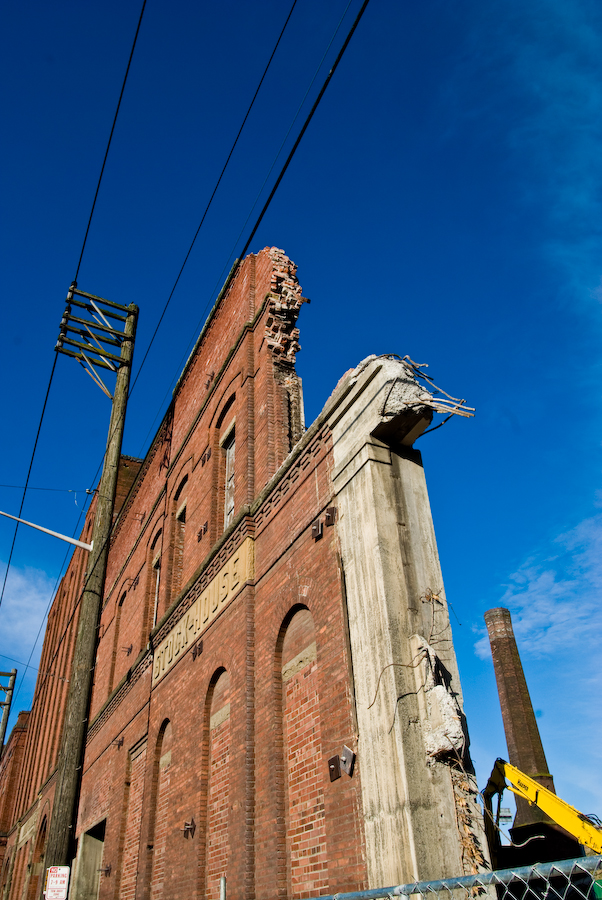
This building, is it still so great ? No masterpiece or pioneer- And now it’s looking quite a state, And none too safe in brick and slate – It really ought to face its fate, Admit the end is near.
It did it us proud, it served us well, But now it’s really past its best – And as its city-centre dwell Has far more worth as bank, hotel, Or office block – we had to sell, In public interest.
So down it comes, and in its place Development beguiling new: A fresh design this site will grace, A source of jobs and conf’rence space – We may yet choose to save the face, And gut the insides through.
These architects with magic touch That turns the golden into shite – Their helping hand’s a concrete clutch Which crushes, smothers eversuch And chokes the life they hate so much, Because it shone so bright.
And when they try to match the theme, They cannot think along that line – Just vague pastiche and stripped-down scheme. Yet form must come from vein and seam As penetrating all like steam, And scream these forms are mine.
Their new designs cannot be stood Besides the old, for both then wilt – So segregate each neighbourhood, And save the past whene’er we could For once it’s gone, it’s gone for good – Will never be rebuilt.
I n the last line of the second verse, ‘interest’ should be pronounced with three syllables.
And we can run, we just can’t lose the herds, And we can fly, we just can’t dodge the birds, And we can learn, we just can’t beat the nerds, And we can sing, we just can’t learn the words.
More nonsense. This is the sort of thing I come up with when I have writer’s block. I think stuff like this is okay in small doses.
I sit here so poised, just a-waiting to write, Waiting for fresh inspiration – And I sit and I wait for the flash and the light, And the spark of the birth of creation. But thoughts and ideas and visions I lack, Just feeble attempts from a half-hearted hack, I haven’t a notion that’s worthy a crack – An impotent writer’s castration.
I sit here so poised, just a-waiting to write, Waiting to fill up the hollow – And I sit and I wait, but though try as I might, I guess that I’ve nothing to follow. My ev’ry polemic is written and done, My anger is shouted, my wit had its fun, My dreaming is dreamt and my grief seen the sun –
Dead of winter, and Josh drinks alone – His birthday today, and the years have flown. Thirty today, and what has he done ? Never been married, never had a son. He feels he’s achieved far less than he’d oughta Whittling the wood while his life’s getting shorter “Gimme a break, an’ I’ll set the joint humming, I’ll give unto Caesar just what he’s got coming !”
“I’m gonna Rise with the dawn to pray and sing, I’m gonna Rise with the dawn and bless the poor – They’re gonna raise me up an’ crown me king, An’ when they think me beat, I’ll be back for more !”
Dead of winter, and Josh drinks alone – All night he’s preaching in his slurrey drone. He’s wasted round here, his vital mission – There’s plenty to hear him, but none to listen. Already he’s had two more than he oughta, Knocking it back as though it were water. He bangs down his grail with an angry thud – “Gimme another, cos this is my blood !”
“I’m gonna Find me some fishermen, and practice how to talk, I’m gonna Find me some fishermen and go from town to town – I’m gonna cross the waves if I have to walk, And if you wanna stop me, you’ll havta nail me down !”
Dead of winter, and Josh drinks alone – This world is a bitch and it needs to atone. He’s got his sermons and hymns to dispense – He’s telling his stories, but they don’t make sense. “Why won’t you bastards listen like you oughta ? Why won’t you hark to the lessons what I taught yer ? The love of money is the root of all malign !” But the barman doesn’t care as he charges for the wine.
“I’m gonna Work with my hands till I raise some sparks, I’m gonna Work with my hands till they heed what I tell, One day so these palms are gonna bear marks, An’ if you don’t believe me, I’ll see you in Hell !”
Dead of winter, and Josh drinks alone, He’s got his second wind, he’s rolling back the stone – Says he’s gotta leave and join the cherubim, To do unto others like they’d better do to him. He knows he’s delayed for longer than he oughta – Someone’s gotta be the Devil’s holy thwarter, Someone’s gotta sow so the reapers reap their seedful, Someone’s gotta help all the camels through the needle.
“I’m gonna Quit this hick town and walk the Earth, I’m gonna Quit this hick town and bang my drum, I’m gonna walk out and show them what I’m worth, I’m gonna walk out till kingdom come !”
Are Water- and Cape- the more closely related ? Who knows ? Why are those ‘true’ while the Bison are ‘false’ ? I say they all are true buffaloes ! You label the grouping as polyphyletic, Like ‘shrew’ – But what does it matter their genes, when we’re talking Of big things with horns that go moo ?
So pedants and cladists may mutter and sleight, But Buffalo Gals, won’t you come out tonight ?
And did you know twenty-five cities and towns Disagree ? And how many towns in the States are called Bison ? Well well, only three ! So don’t try and tell me I can’t call the bison All ‘buffaloes’, mate ! Cos Buffalo Soldiers and Buffalo Bill, And Buffalo Springfield and Buffalo Twill, And the Buffalo Wings at the Buffalo Grill, Tell me you’re way way too late.
So pedants and cladists may grumble and snide, But Buffalo Gals go round the outside.
Machines have always given lip. We used to use the rule of thump To make ’em jump-start with a jump, Until their clutches got a grip. So have things changed ? Not on your nelly ! When they claim ‘does not compute’ We kick ’em with a hard reboot – It’s just a diff’rent sort of welly.
The things you don’t know about me Would surprise you, I know – Or at least, I would hope so. If I thought that you knew, If you’d even a clue, Of the things about me That I daren’t let you view – Or if upon learning You showed no surprise – Then you’re far too discerning, And worldly wise. I know how I’d feel If I thought it could be That you find the appeal In the same crap as me – If I thought it were true, Then I think we’d be through – So I swear, never share, What you secretly do. We can laugh and engross, And pretend we are close, And gossip on who’s seeing who – But keep a firm grip So you never let slip All the things I don’t know about you. And maybe then, maybe, You won’t get to see All the things you don’t know about me.
The Romans faced decline, they say, A hundred years or more, Before the Goths stole Rome away, All in one day. It wasn’t just a day, of course, With forces building at the core Throughout the hundred years before.
So were there Romans in that fray Who watched the turning of the tide, The steady slide, the slow decay ? And were they powerless to stay The endless slump of getting worse, The creeping curse, the seeping sore, The gradual fade to grey ?
Or did they never smell the rot They’d got ? Perhaps too decadent, Too drunk to see their own descent, Too busy in the hay. They maybe missed the skulking spore Until the joists had given way, And brought Rome to the floor.
But that was then. We’ve surely learned How Rome was burned from within as without – The morals shine and loudly shout, And history shall not be spurned. And yet.., I sometimes look about And wonder where we’ll be in, say, A hundred years or more.
Wherever you have got, and how you got there, Is less than I could care – you come, you go – And sometimes you will telephone from out-there. You’re somewhere else, and that is all I know. And so I’m left back here, back in your old life, To vaguely wonder where on earth you haul – And if you can remember what’s my number, Then maybe I shall someday get your call.