They promised us of Things To Come: The Future’s oscillating hum, When dreams of Progress are unfurled And pitched to claim this Brave New World.
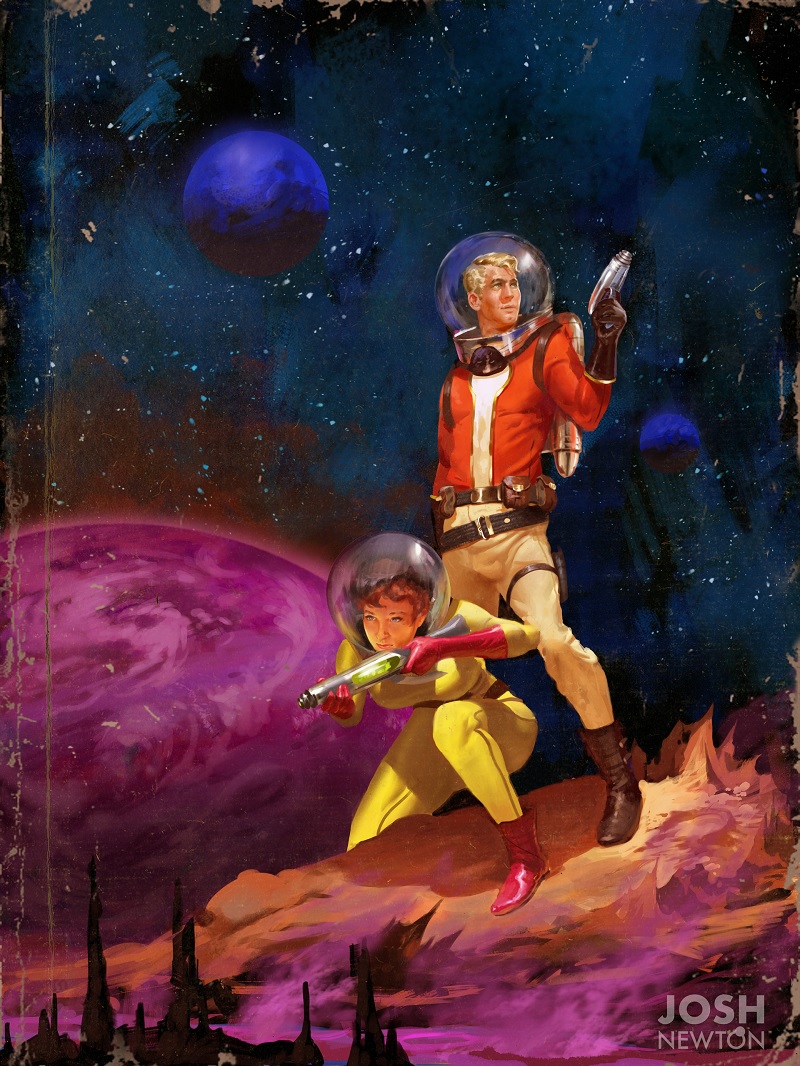
We always knew it’s coming soon, Those holidays upon the Moon, The robots, ray guns, rocket boots, The purple hair and silver suits.
But look at what infact we get: The wind-farm and the internet. Organic foods, not protein pills, And terrorists, not air-raid drills.
We never got to live like gods In fully-automated pods, We never got to touch the stars In UFOs and flying cars.
There’s no-one chilled in cryo-sleep, There’s no-one dreams electric sheep, There’s no-one swashes laser-swords To saves the Earth from Martian hordes.
We’ve waited, just to find, too late The Future now is out of date, Yet still unripe its promised plums – Alas, Tomorrow never comes.
Nothing can wash my sins away But water, And nothing can scrub my soul Except the steam. Nothing can slough my skin away In shorter, And nothing can soak me whole And all agleam.
Carrots, caulis, spuds…I’ll need some more, A pack of coffee – fairtrade ? It should say. They’ve haven’t any left ? Well, that’s a bore. A loaf of sliced should last till Saturday, Three pints of milk, or should I get-in four ? It’s only sold in litres, anyway.
A rosy apple keeps the doc away, Although, I ought to see the dentist more… Oh yes, some roses for the special day, And juicy steak – perhaps some sirloin boar. The things we have to do to simply say The things we’ve said so many times before.
Honestly, what do we do this for ? Did great-great-grandmama, back in the day ? And must our children’s children evermore, Until the very Earth has given way ? But who would ever wish to be that bore ? And so we bite our tongues and never say.
Is money to be made from love ? I’ll say ! It brings our brashful boasting to the fore: We peacocks strut and dance the night away And when we’ve had enough, we cry for more. But better to be Caesar for a day, And when the tide must rise, to ride its bore !
But don’t let bonhomie become the boor, Who talks too loud and always gets his way By swinging round a verbal two-be-four – Instead, let your initials have their say When paired upon a lovers’ sycamore. But there I go, just jawing on all day.
Now strawberries are good for five-a-day – Such passion-fruit the steamy hothouse bore… Champagne, of course – is this a good one, say ? No garlic, though…oh my, it’s almost four ! I need to get this supper underway, To let my wife become my paramour.
Vivaporous vipers give me the vapours, But I shall envelop these slitted-eyed scrapers. Rapture enripens their serpentine stare: J’adore l’addeur !Vive la vipère !
I’ll stick to the cutest constrictors for starters, I’ll string along threadsnakes, slink upto the garters, I’ll scale up the ladderbacks, slide down the smooths – I’ll dice with their snake-eyes, I’ll slalom their grooves.
Vivaporous vipers are venomous vermin, Yet I shall unfasten and welcome the worm in. I’ll love ev’ry squeezer and cherish each fanger – Ich liebe die Kreuzotter ! Heil die Schlange !
My nephew is into his dinosaurs, And he’s digging up mem’ries lain buried since school, (But still neatly sorted in synaptic drawers), With all of those crazy-long names by their scores, Though actu’ly some of them sounded so cool ! How should we say it ? The textbooks display it Phonetic’ly – tie-ran-oh-sore-us – of course ! So easy to get it, there’s no need to sweat it ! But sometime’s a wrong ’un would lodge in all twisty – And once it gets in there, it’s part of our hist’ry.
For instance, how much we all loved Diplodocus, And gave that third syllable all of our focus. So never Diplodocus, that sounded odd-i-cus, Plodding along with no hocus to poke us. And don’t get me started on cow-pat-a-saurus – Your patsy falls flat, see – just hear how we chorus This heavyweight’s name is – by god – Brontosaurus ! As known in the bones of all schoolyards before us. So pronto, restore us our sauropod’s nommus – Don’t think you can plunder our thunderbeast from us !
Which brings us around to the Puh-terodactyls – To eight-year old boys they were neater than fractals ! We’d doubt they could flap much, but bet they soared high – Though not dinosauruses…saur-iss-eez…saur-eye..? Brackies and Plessies and Tritops abounded – Though from diff’rent eras, so not all together – They’re non-chronologicus, just to be clever. We’d all love to fight for faves our faves for discussion Like Dimetrodon, cos he sounded so Russian, Or Archaeopt’ryx, with the bestest name ever.
And then there were the Trillobytes ! That’s how we called ’em in our local playground. That’s how we called ’em, so that’s how they were – And given a choice, then I’ll always prefer Our primary version to t’other way round – Brill-o-bites, thrill-o-bites, silly old Trillobytes, Nobbly or spiky, or all armadillo-like ! Cambrian glamour to Permian quitters, Those three-lobal, pan-global, crystal-eyed critters – Heroic, and stoic, and Palaeozoic !
My nephew is into his dinosaurs, But the toys have come on some since I was a lad With the latest researching reflected, of course, But the loss of those classic mistakes makes me sad – Take Stegosaurus, in Lego or plastic, It now looks fantastic, with tail held-up high – But I’m far too au fait to its droopy behind, With a second bum-brain (that we no longer find). But I guess I can’t really complain that we’re wiser – And hey, it’s still sporting a prize thagomizer !
But what of the T-rex, the king of the chompers ? I see that he still bears him his stubby front arms, But they’re no longer pronate – fergeddaboutit ! Cos my nephew informs me their bones will not fit, So they turn-in their palms, like they’re waiting to clap. And there’s vegan Iguanodon, slowest of stompers – A ponderous chap with a Godzilla-stance ? Forever a thumbs-up, the herbest of vores ! And yet now at a glance, he’s a boring old square, When reduced to all-fours with his arse in the air !
If only we’d known of Velociraptor ! If only we’d known of the feathers and fuzz ! Ah well, I guess that we’ve moved on a chapter, And I must adapt or I’ll end up extinct – But I feel that old buzz, and I swear it’s because Of the grin on my inner-twin child as he winked. And I see Brontosaurus is back with a bang – So that oughta well-learn ’em, don’t mess with this gang ! It’s time to return, but I’d best not get preachy – I’ve much to catch-up, but my nephew can teach me.
I’ve seen this spider around, I’m sure… Yes, yesterday or the day before – Precisely where she’s hangs right now, So there she was before, I vow. Hasn’t she got webs to spin – I wonder if she’s dead, or just a skin ?
I’ve seen that spider around, I know, Maybe a weeks or two ago – I’m rarely here about my biz, But when I am, well, there she is – Hasn’t she got legs to move ? A gentle blow…and yes !, she lives, I prove.
I’ve seen that spider around, I bet, From month to month, we’ve clearly met. She lurked right there, and always will – Just dangling from her strand, so still. Hasn’t she got flies to catch ? I guess she must keep guard upon her patch.
I’ve seen that spider around, I’d swear – This year, last year, she was there ! Hanging from the self-same thread – And all I know is, she’s not dead. Hasn’t she got eggs to lay ? But I’ll forget her once I’m on my way.
When I wrote this, I had quite forgotten that I had already dealt with this topic two years earlier in Daddy Longlegs, which is uncomfortably similar. I’m also not really happy with using biz, but rhyme-needs must.
In the days of the week, And the months of the year, We’re clinging on yet to our Paganite past – In the gods we don’t seek And yet still keep so near: Forgotten the stories, remembered the cast.
In holly and ivy, And heather for luck, They still work their magic on God-fearing hosts. In gargoyles so lively, In faerie and Puck: Heretical heroes now villains and ghosts.
In the names of the planets, And shapes in the stars, They still rule the heavens, till night-time is done They never will ban it, Too deep are their scars – We praise our new God on the Day of the Sun.
Swedish name day list for February 1712 – incidentally, notice how the month runs to February 30th.
Appellation Celebration
Name days – we don’t really do them in Britain, They just feel too Cath’lic and rather mediaeval. There’s no formal ban – the restraint is unwritten – It just isn’t done, it would cause an upheaval.
And anyway, what about Kylie and Kevin And Tracey and Daisy and Scarlett and such ? They haven’t a saint all between them in Heaven, So no second birthdays for Dylan or Dutch.
Though don’t give ideas to Clintons and Hallmark ! They’ll bunch us together and round up each stray – So Sepp bunks with Joe cos they’re in the same ballpark, And Dawn and Aurora must share the new day.
But Jack is no Jacob, nor Denholm no Dennis – Their origins differ, they don’t mean the same. But who cares in Athens or Moscow or Venice, Where Simon Says sharing’s the name of the game.
And actually, even within the whole region, They cannot agree on which dates should apply – So Emma is honoured in April in Dijon, But over in Stockholm, she’s praised in July.
Name days – we don’t really do them in Britain, It’s one of those rituals it’s best to ignore. And somehow, I doubt we will ever be smitten – Except, of course, Wodan and Frigga and Thor.
As far as I can tell, name days have not been a feature in Britain, even before the Reformation.
Ladies and Gentlemen, welcome, all – We’ll shortly be commencing: I promise we shall soon enthral Those senses we’re suspensing. So let me introduce, my friends, This ev’ning’s main recital – Where joy and anguish each contends, And lovers crave requital. An epic true, a ballad grand As stanza follows stanza, Heroic does this potent hand Bring forth extravaganza: The finest Truth on life and death That verse has ever captured. So hush the lights and stop the breath, And brace up to be raptured.
Snowdrops, pale and shy and still, As if they’re afraid to face the bracing breeze. Downcast propellers, silent in the chill, So loathe to disturb the hush beneath the trees. Always huddled together in their crowds With the neck of a swan and the wimple of a nun; Tensed to bare the worst from the clouds, And wilting away in the first warmth of the sun.