The Bard & I

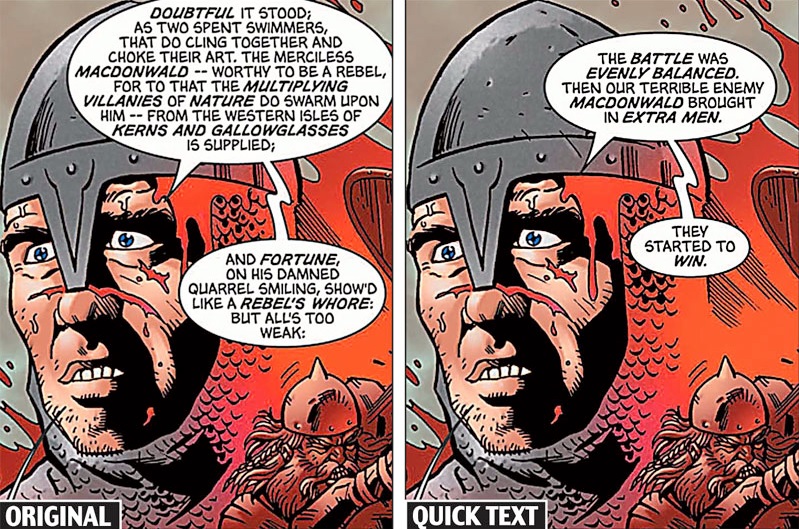
From Classical Comic’s translation of Macbeth, illustrated by Jon Haward.

The Bard & I

Ah Will, we were not meant for one another,
For ours is not a marriage of the minds.
What can I say, my literary brother ?
We’re poets both, but very diff’rent kinds.
So yours the fame and wealth and adulation,
And mine the anonymity and debt –
But then again, we glean our exhortation
From very diff’rent mistresses, I bet !
For I could never write your verse, nor wish to –
And you, I’m sure, could never capture mine.
So you be Zeus, and I shall try for Vishnu –
And keep my metre dry, and hold the line.
And if some day I reach your heady skill –
I’ll have the way – but always lack the will.

This poem was kindly accepted in the Spring 2025 edition of WestWard Quarterly.

Concerning the left panel at the top, are we to believe that an exhausted and demoralised man-of-action such as the Seargeant (who is apparently suffering a head wound) would really speechify and wax lyrical ?  To the point, man !

The Queen of the Cockles

black seashell beside beige stone
Photo by Pixabay on Pexels.com

The Queen of the Cockles

Fine scallops and oysters
For townlands and cloisters,
And cockles and mussels – alive, sirs, alive !
Come find one and pluck it
From out of my bucket –
It’s yours for a penny – or fourpence for five.

            Fresh from the beaches of fair Dublin Bay,
            Fresh from the sands where they thrive, oh !
            Fresh from the beaches, and fresh ev’ry day –
            Cockles and mussels alive, alive-oh !


There’s no need to scrimp it
With whelk or with limpet –
I’ll sell you no snails, sir – I’m clams through and through.
Don’t ask me for sprinkles
Of peries or winkles –
Why settle for one shell, when you can have two !

            Fresh from the wash of the fair Irish Sea,
            Plucked-out as soon they arrive, oh !
            Fresh from the sand to the boat to the quay –
            Cockles and mussels alive, alive-oh !


There’s some who dig beaches
For lugworms and leeches,
But they make a slimy and wrigglesome catch.
And scampi and crab, sir,
Will scamper and jab, sir –
But mine are like eggs that are waiting to hatch !

            Fresh from where seagulls love combing the sand,
            Fresh from where cormorants dive, oh !
            Fresh from Portmarnock and Dollymount Strand –
            Cockles and mussels alive, alive-oh !


So what do you say, sir,
To venus or razor ?
Just tease-out my beauties with jack-knife or steam.
They may hold a pearl, sir,
A feast for your girl, sir,
You’ll soon warm her cockles with cockles in cream !

            Fresh from the beaches of fair Dublin Bay,
            Fresh for your ladies and wives, oh !
            Fresh-in from Skerries and Claremont and Bray –
            Cockles and mussels alive, alive-oh !

This isn’t about Molly Malone, but one of her fellow-hawkers.  Though I do like to imagine Molly and Leo Bloom passing each other and stopping to share the craic.

Now When They Heard About the Resurrection, Some Began to Scoff

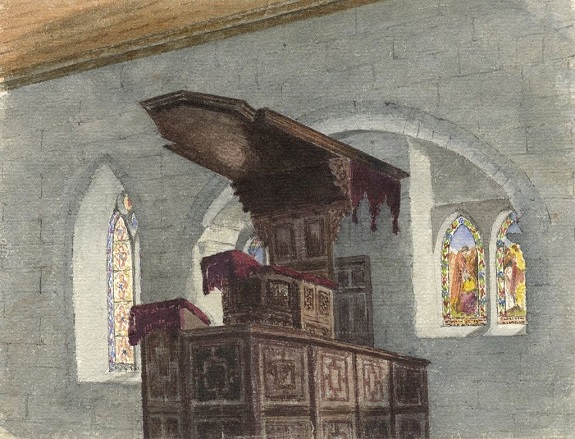
Oak Pulpit
Oak Pulpit by E E Cowan

Now When They Heard About the Resurrection, Some Began to Scoff

“The Church of England expects its attendance to continue its decline for the next thirty years.”

– The Sion Times

Here I stand, in my pulpit,
Looking down on yawning sands of empty pews –
And in the Sunday papers,
The stats and graphs and surveys tell the news.
Of course, we know the culprit,
This modern life is secular and on-the-go.
The Devil’s at his capers –
And yet, he seems to lack the will to spread his woe.
So year by year and prayer by prayer,
The congregations slowly cease to care.

We’re mocked and feared and left behind –
The faithful die, the faithless breed, the undecided shrug,
And life goes on.
Some are anxious, some are angry, some are smug,
But most are happy, most are kind.
Thirty years from now, then who will save their modern souls
When we are gone ?
But then, they will not need our help, according to the polls.
Can I begrudge their proof and doubt,
When Satan’s reign is peace and love throughout ?

The title come from Acts 17:32, slightly paraphrased from the various translations.  Of course, the world isn’t quite ‘peace and love throughout’, but as both Harold Macmillan and Steven Pinker point out, we’ve never had it so good.

Tags: Poetry Poem Religion Christianity Church

Doves & Cockerels

action adult antique blur
Photo by Jahoo Clouseau on Pexels.com

Doves & Cockerels

(A Tale from the 80s)

Born, bred and boarded in England, by chance,
Yet close as to Calais as Canterb’ry town –
Where the Channel keeps nibbling the chalky-white Downs,
And keeps her from cycling to France.
Trapped by La Manche
From Dunkirk to Rennes –
But still she stays staunch:
La Douvresienne !

Douze ans is she, in the town of her birth,
And watched by the Castle that keeps her kept here.
But the bright lights of Calais are teasingly near –
Yet somehow they’re out past the end of the earth.
Trapped by the rosbifs
Like Jeanne d’Arc back when –
This unwilling hostage:
La Douvresienne !

She lives by the gateway, she lives by the quay,
And watches the French as they come off the ferries
In Deux-Chevaux Citroëns and bob-cuts and berets,
With bœuf bourguignon and bagettes bearing brie.
She mimics their movement
Agen and agen,
With steady improvement:
La Douvresienne !

When the weather is right and the signal is clear,
She re-tunes her black-and-white into their station
And watches in awe at the sights of a nation,
And wishes she understood all she can hear.
She mimics their voices,
Both women and men.
She makes the right noises:
La Douvresienne !

But their language is tricky to lodge in her head
All accents and commas and genders to test her,
And sometimes it’s only a shrug or a gesture –
It’s just like their spelling, there’s so much unsaid.
She’s learning at school
With the rest of Class 10.
She’s sounding so cool
Is La Douvressienne !

She fancies herself as a Mademoiselle,
But family hist’ry declares her a Miss
But what do they know of Gainsbourg or Matisse ?
It’s more than genetics that makes her a belle.
It’s more than a pose
For this proud Madeleine:
She’s no English Rose,
But La Douvresienne !

Butterfly Bushwhacked

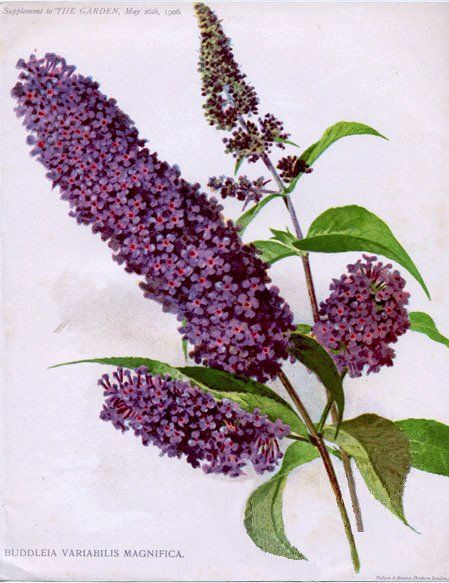
Buddleia
Buddleia davidii by unknown

Butterfly Bushwhacked

Buddleia !  Buddleia !
Ev’rywhere, buddleia !
Growing in gardens too small to contain it.
Growing in wasteland and making it muddier –
Railways and quarries won’t even restrain it.
And then in July, see it all turn to violet
As thousands of flowers bring stamen and style.
Soon, we think, soon comes each painted-up pilot
To flitter and dazzle and make it worthwhile.
But here in the suburbs, with bushes amassing,
There’s plenty of purple, but no Blues in sight.
Just when did we last see a butterfly passing,
Aside from the clothes-moths and odd Cabbage White ?
Here in the suburbs, these shrubs ramble well,
Yet we won’t see a Camberwell Beauty near Peckham,
Nor ravenous inchworms descending to wreck ’em !
So no Painted Lady, no Marbled and Tortoiseshell,
Won’t see an Argus, a Skipper or Admiral.
Monarchs and Emperors too have set sail,
So where the Fritillary ?  Wherefore the Swallowtale ?
Coppers and Brimstones have melted away,
Hairstreaks and Ringlets receded to grey,
The Gatekeeper’s keyless,
The Speckled Wood’s treeless –
A banquet of nectar, yet still not a single gourmet.
So where strut the Peacocks we avidly spy ?
Comma and Map and Wall,
Where do their larvae crawl ?
Where do their mothers all gravidly fly ?
Small Heath and Meadow Brown,
Not to be seen in town –
Naught but irruptions of davidii !
And soon it’s September, and blooming is ending,
And then they’re just weeds that need far too much tending.
Buddleia !  Buddleia !  Ev’rywhere, buddleia !
I tell you, the purple invasion is pending…

Swotto-Socks

Reading
Reading by James Charles

Swotto-Socks

I know a quiz-eyed girl
Called Cleopatra Cleet,
Who is bound-in-leather clever
In her bold and bootless feet.
With her teeming tomes of theory
And her hazel hungry eyes,
And her mother dear to query
If her wisdom is so wise.

“Cleopa, Cleopa, what do you study ?”
How does the mudskipper never get muddy ?
“Cleopa, Cleopa, what do you question ?”
How does an inkling become a suggestion ?
“Cleopa, Cleopa, what do you harvest ?”
Oldest and tallest and strangest and farthest.
“Cleopa, Cleopa, why the fly-temper ?”
There’s so much to learn, that I’ll never remember !


I know a stare-fast girl
Called Cleopatra Cleet,
Who is altogether clever
In her spotty-stocking feet.
With her busy books beside her
And her thorough-thinking brow,
And her mother dear to chide her
For neglect of here-and-now.

“Cleopa, Cleopa, what are you thinking ?”
How does the addersnake sleep without blinking ?
“Cleopa, Cleopa, what do you wonder ?”
How does the lightning so outrun the thunder ?
“Cleopa, Cleopa, what are you reading ?”
Pixies and pirates and guinea-pig breeding.
“Cleopa, Cleopa, why the long weather ?”
There’s so much to learn, it will take me forever !

Musical AI version generated by Suno.com – find more of them over here.

The Good Life

Carmelites
Carmelites in the Garden by Roger Guillemot

The Good Life

This abbey is the work of nuns,
Who sing her offices each day
Without a tenor in their range,
And in-between, they farm her grange –
They tend her pens and rabbit runs,
They milk her goats and rick her hay,
They gather greens and fatten veal,
With herbs to spice and herbs to heal.

They fish her trout and brew her ale,
They harvest cochineal from scale,
And tucked away in back-court sheds
Are pigeon-cotes and mushroom beds,
Her mulb’ry trees, that once were tried,
Still bloom – though all the silkworms died.
The snailery’s a better omen,
Raising broods of Brown and Roman.

They see her fields are sown and scythed,
Her sheep are shorn, her orchards plucked,
They see her queens are safely hived,
Her cocks are henned and drakes are ducked.
They churn her cheese and bake her buns
Until their tender hands grow blisters –
What this abbey lacks in sons,
She made up for in sisters.

Charge

lightning in sky at night
Photo by Pixabay on Pexels.com

Charge

A lightning flash –
        one-thousand-and-one
Its photons dash
        one-thousand-and-two
Into my eyes
        one-thousand-and-three
Through rain-soaked skies.
        one-thousand-and-four
I wonder how far
        one-thousand-and-five
Those flashes are ?
        one-thousand-and-six
Been brewing all week,
        one-thousand-and-seven
This cleansing streak.
        one-thousand-and-eight
Hang on, have I missed it ?
        one-thousand-and-nine
Or is it too distant ?
        one-thousand-and-ten
I feel a bit cheated,
        one-thousand-eleven
The clap uncompleted –
        one-thousand-and-twelve
You can’t give us flashes
        one-thousand-and-thirteen
Without giving crashes…
        one-thousand-and-f……finally !

A Cat in Hell’s Chance

close up photography of gray tabby cat
Photo by Kate photo on Pexels.com

A Cat in Hell’s Chance

They say our chances of success
Are on a level, more or less,
With those that face a cat in hell.
So don’t you see, we’re looking good !
We still could make it – yes we could !
Just like the cats, we’re doing swell !
For felines prosper ev’rywhere –
In slums and pits without a prayer,
They’re never doing less than well.
So even in the underworld,
You bet the cats are snugly curled !
They damn well make a heaven out of each abyss they dwell.

A Recipe for Iron Gall Ink

Oak Galls
Oak Galls by Roesel von Rosenhof

A Recipe for Iron Gall Ink

Welcome, brother, to my shed –
Brewing up the liquid words for countless books and scrolls,
Here is where we make the very thing that feeds our souls

First, we need the oak trees –
The abbey’s woods are growing us a thousand-fold or greater –
Pollarding is fine, and they can serve for timber later.

Next we need the gall wasps –
They lay their eggs within the buds, or else beneath the leaves –
Diff’rent wasps lay diff’rent eggs, but each invades and reaves.

Wait – but not too long –
The oak responds by swelling apples where the larvae hide –
The better galls are small and dark, with maggots still inside.

But leave the largest one-in-ten –
We need those wasps to hatch, and grow, and drill, and crawl away –
And only then, they’re homes are gathered, when they’re lighter grey.

Next there comes the vitriol –
Seeping out of iron mines, collected and evaporated,
Iron scraps are added-in until its sharp is sated.

Then there comes gum arabic –
The bled-out gold acacia-sap is dried, and sold for quite a cost –
The abbey cannot grow them, though – they do not like our frost.

Pestle each ingredient –
Steep the galls in brandywine until it’s brown and dark,
Then slowly stir in vitriol to blacken-up the bark.

Now our secret: powdered eggshell !
This is what the other monks of other abbeys never gauge,
And this is why their manuscripts have eaten through the page –

Filter out the sediment –
First with cheesecloth, then with sponge – and drain into a drum,
Then add a little charcoal dust, and thicken with the gum.

Pour to airtight bottles –
And there you have it: ink aplenty, flowing over vellum –
Anything they need to know, our ink can surely tell ’em !

This should last the year,
As the inkwells drain so slowly, dip-by-dip, in tiny rills –
But even this will only feed so many thirsty quills.

The blood of our society –
With which our brothers circulate the words from eye-to-eye,
And we must keep their ink-horns full, or else the words will dry.