You came to escape a war, And chose our shore as somewhere tame Where quiet days don’t end in flame – But now they are fighting no more, And you must up and return to your nation – Not an order, just an observation. I needn’t ask what for, And I note this not with pleasure, but alack – For now your ravished country needs you back.
Year after year, our language is changing And drifting yet further from Shakespeare’s day, Making it harder to known of his meaning, Making obscure as we’re slipping away. Writings updated retain all their meaning, But lose all their diction and word-play and flow – So when only scholars can read still this poem, Then do not translate it, but just let me go.
The Anglo-Saxons had their own names – Had no need for our Kate or James – Some, like Swithin and Thunor, perhaps, Are only found on churches and maps – Yet some, like Edward and Hilda, survive, Though Oswald and Cuthbert are barely alive – And Mildred and Wilfred are old-fashioned now, Yet rather less Saxon than Dickens, somehow. The same with Ethel and Edith – I swear They sound quite common, for all that they’re rare, While some like Dunstan, Wymond, and Wystan, Are as old-money posh as Aubrey and Tristan. And fun-fact, Ruth was a noun for compassion, Yet strangely never was used in this fashion – Yet Edruth and Ruthbert could’ve been (no joke), Though Gailjoy to them meant a wind and a yoke… Stanley and Beverley back then were place names, While Hengist and Offa are leave-just-a-trace names, And Osborn and Osmund are now only surnames, While Hrothgar sees Roger become the preferred name. So Alfred and Albert are still doing fine, But Harold and Winston are on the decline – And Edmund and Edgar are straight out of yore, While Winifred and Edwin are winners no more.
Note that the theoretical Ruthbert would probably be pronounced in modern English to rhyme with Cuthbert and not with truth-bert.
I know we love it as a symbol – Hubris, cheap materials and failure, While locals soak up tourist-dollars Selling canting paraphernalia. The crowds all prop it up in photos Loving that its old and broke – While laughing at the locals, Who are all in on the joke.
And now the authorities Have had to underpin the base, While taking care to keep the tilt That underpins their public face. I guess we do not get to choose What piques our int’rest, makes us smile – But here’s a tower full of piquant int’rest By the mile !
I think I am alone in wishing That they’d take it down and start again. I just want my cathedrals To inspire me, not amuse me, in the main. But here is a belfry Far too weak for bells and gravity’s demands – It’s just a shell, a cynic’s dream Who’s only wonder is how still it stands.
Ah, listen to me, what misery ! Just moaning off my sunstroke. Can’t I shrug and let them be, And maybe even get the joke ? I guess we do not get to choose What gets remembered, anyway – But this one’s sure to loom in mind, And hold us in its sway.
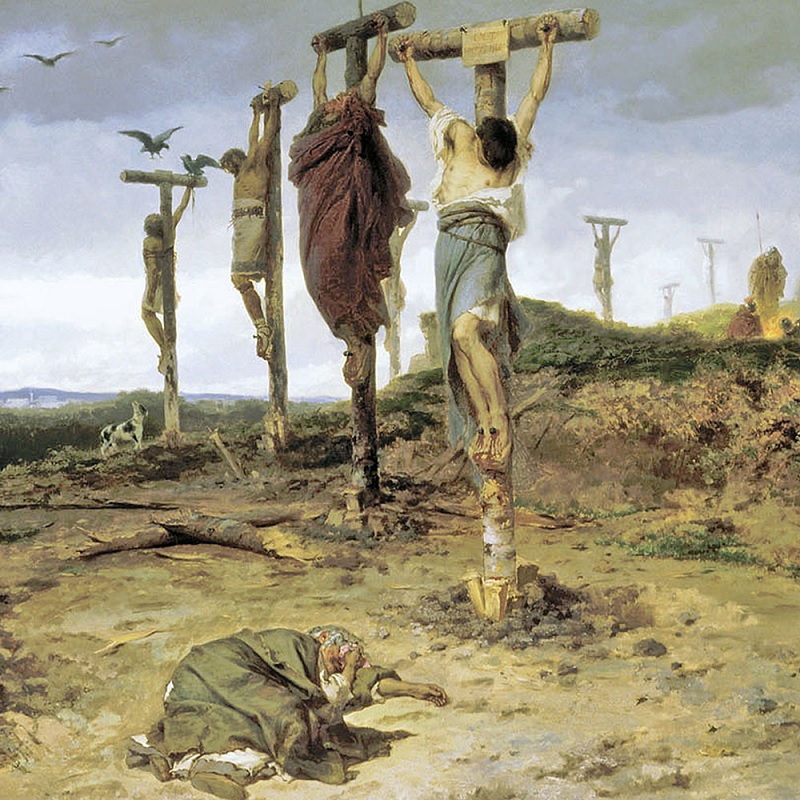
“Tell me, Roman, why this plan To execute this convict man ? Of all the ways to make him dead, Why hold up high with arms outspread ? Seeing him now crucified Just makes a martyr, gives him pride, It lets the martyr die with pride, So hero-like, so dignified.”
“But you are wrong. Now look again: The loincloth with its urine stain, The drooling lips, the bloodshot eyes, The excrement that cakes his thighs. To hang for days in agony – Now look again and show to me, Just look up there and show to me, The slightest shred of dignity.”
“Ah yes, I see, the lolling head, And yet…who cares once he is dead ? And history may not recall His wails and jerking fits at all. Despite what we right here may find, The crowd are of a diff’rent mind – And what they see within their mind Is all that you will leave behind.”
“Perhaps you’re right, and time will tell – But who can say he’s dying well ? And in three days, he lingers on For no-one, once the crowd has gone. Any execution can Create a martyr from a man – Yet here, we see he’s just a man And that is why this Roman plan.”
Bringing Juvenilia Week to a close with a typically iconoclastic poke at religion with some Real Science. Originally just the first two verses, it lacked the necessary back-and-forth to be the dialogue it wanted to be, so the latter two are new, though just as naff as a homage to the original.
Now, the perfect poem to follow with tomorrow would be this one, but it has already been posted.
First I took the high road, then I took the low road, (But I found the middle of the road is barely worth a mention.) I hit and hogged and kicked-the-can upon the long and winding road That’s sometimes paved with yellow bricks, and sometimes good-intentions.
Yet how many must a man walk down before they make him ? This hard road to Damascus is a lonely trial of tears. Please don’t lead to Rome again, but to the road not taken, For the golden road to Samarkand begins at Wigan Pier.
Ah idioms, where would language be without jargon ? This poem is so early, I was still allowing myself to slip in post-rhyme esses (tearS and pier), which I’m much stricter about these days, although they do still crop-up where to avoid them would make the syntax tortured (though usually in the also-rhyme position [lines 1 and 3], with a cleaner pairing on the prime-rhymes).
To take the example of gotten, Grammaticists so much malign This useful past participle Whose use was once most rife and fine. Crossing oceans, forth it went, Yet back at home its usage fell A shorter version came in vogue That was but little used till now. And yet these language experts Who tell us how to speak forthhence Forget this evolution, Forget that English is not French. They try to stop the creeping changes, Battle hard against the rot. “If we don’t keep our English pure, Well, what then have we got ?”
Language has long fascinated me, and here’s an early attempt of spinning some obscure lingual trivia into half a page, a useful fallback still when Mr Block comes to call. The bit about English not being French is a reference to l’Académie Française, (that’s right, Immortals, I capitalised the adjective – deal with it !) I heartily hope that the average Francophone ignores them with rigour. I’m sure an English equivalent would simply hate ‘forthhence’, though maybe with good reason on this occasion.
Oh London, my London ! Forever so fond, Yet I heard of the rumours of places beyond – For further than ring roads and suburban stations Apparently lies there a wealth of far nations. How greatly I dreamed of the boat and the train And the tropical sun, now washed out by your rain. For my riches are poorly, my cupboards are bare, My travelling stalled upon your thoroughfare.
Oh London, my London ! You felt my distress. And pitied my yearnings to quit your address. For penned by your broadways, I longed to escape – So you widened my cage from the Steppes to the Cape, From Hong Kong to Lisbon, from Cairo to Cork, From L.A. to Delhi, from Auckland to York. With bright lights and glamours, and chiming Bow Bell, You brought me the world, and their families as well !
Growing up in the boring countryside, I’ve always liked the idea of immigration – not for myself, far too lazy, but for the rest of the world to do the hard work of coming to me. Though I guess I am a kind-of immigrant into London, and this was written soon after my arrival as I was still marvelling. Looking back, it’s a bit dum-de-dum, but that pretty much summed-up my provincial output at the time. What my poems needed was a splash of colour, and London was just the place for that.
Oh People of Coventry, turn not away ! For not only Thomas should view this display.
Oh People of Coventry, look not in shame, She canters so proudly, erect in her frame.
Oh People of Coventry, unshield your eyes ! She wants us to watch her, to join her, to rise.
Oh People of Coventry, protest exudes, So cast off your shackles, your breeches, your prudes.
The story is based on a real woman – Godgifu, Countess of Mercia, who survived her husband Leofric and died soon before the Domesday survey of 1086 (which lists her former lands). The bareback ride doesn’t appear until the Flores Historiarum collected and retold by Roger of Wendover in the early HE 11200s (early 1200s AD), and Peeping Tom didn’t get a look-in until 11600-700s.
As for the poem, I wrote this so long ago that it feels almost as old as the legend. Strange I was trying to channel socialist values through a protest over lower taxes !







 Rhyming Couplets