You come so soft, sweet Twenty-Ninth, The sum of quarter-days – You take unmissed those surplus whiles, And solar-annual strays – And whether you are bursting Spring Or Winter’s final greys – You come for free, or so it seems, Through mathematic ways. We owe it all to Julius, Who’s clock the Earth obeys – He holds in trust your orphan times, And four years on, repays.
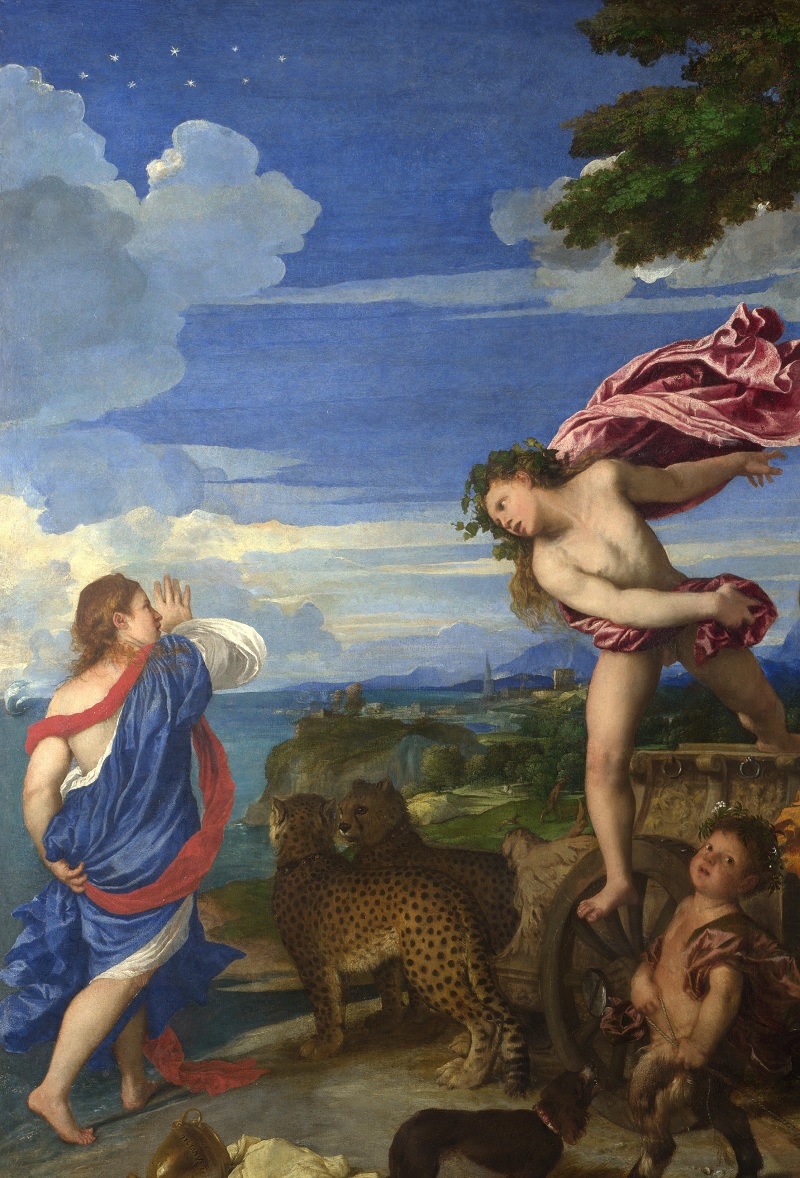
“Come and let me love you, let me gaze upon your face, Stranded on this lonely isle makes folly of such grace – You shall wear my coronet, to sparkle in their eyes. Naxos is no place for you, but up there in the skies.”
So promised Dionysus unto Ariadne fair As she took his hand in marriage and his crown upon her hair. After all these years marooned, this prison with no bars, A wine-god comes to save her and to place her in the Stars.
Alas, first came Orion with his hounds and bovine foe, Then Perseus and Hercules with entourage in tow, And Booties and the Argo with their own supporting acts Left precious little room up there for third-rate myths and hacks. So only Ari’s crown could then be squeezed between those hunks. The moral: never trust upon the promises of drunks.
We are pit finds. We fill museum drawers – Not that we mind how we crowd your shelves and stores. We excite you, we invite you, With ev’ry coin and bead. So much to learn from tax returns And obscure housing deeds.
The seeker’s pact, if knowledge is your task: – For ev’ry fact, a question more to ask. What tales were told on harsh nights cold ? The telling now is done. So add your choice to our still voice, Your best guess now our tongue.
You bring us back with trowel and expert eye, And patient knack. What gems in this dirt lie ? A piece of pot or leaden shot Or bones or spoil remains. With these effects you resurrect, Unearth us from the plains.
We are heroes of archaeology. Where now grass grows was our society. The soil is sieved on which we lived And which maintains us still. We’re sprinkled through this residue, We feed this grassy hill.
All we achieved now fill the trays of finds. All we believed, extracted from our shrines. Our ritual sites and codes of rites For life after we’re gone. And proof ! For see – in surgeries Our skeletons now hang.
In libraries, our wisdom told and bound – Within these leaves more answers may be found. Reporting news, our journals muse Events which come to pass. What headlines say in press today Are taught in hist’ry class.
We are not dead, as here I write these lines, Yet when they’re read, we lie beneath the vines. And one day too then so will you, Dear Reader, be consumed – And in your turn may others learn From your remains exhumed.
Gideon, Gideon, scourge of the Midian, Judge of Manasseh and tough as obsidian. Beating the wheat, he’s a young man of might, So Yahweh descended with orders to fight: To turn back the raidings of Midianite, And break down the altar of Baal.
The idol he smashed, but to Yahweh a snarl – “Prove you are greater than this god of Gog – Keep the fleece dry when the dew tries to sog.” Almighty proven, the lad must take charge He raised up an army, but thought it too large, And kept only soldiers who drank like a dog.
Now here’s an adventure to savour !, To pass a long and lonely night Within a small, strange room – Never mind about the Saviour, Read about the epic fight As Gideon brings Midian to doom !
Gideon, Gideon, hiding his light in a jar, Outnumbered by far, But winning the night with trumpets and pluck If only, if only the tale were all told, Of the faithful and bold, Of defending their homeland with Yahweh and luck.
But next came the slaughter, as wholesale as usual, All egged on by Yahweh at mercy’s refusal – When allies were wetbacks, he butchered the sods. Then forty years later, his reign was still feted – He died in contentment, unpunished and sated As he took many wives and he praised many gods.
Now here’s a tale of confusion… To pass a cold and friendless night Within a sad, sparse room – What moral should be our conclusion ? The lonely will not find much light To lead them out of an early tomb.
I’m not sure which Syllable to stress in ‘Manasseh’, being one of those words I’ve seen written but never heard spoken, but my subconscious wants it to be the second one, perhaps influenced by ‘molasses’. If it turns out to be the first then the second line won’t scan very well, so I guess will need to be changed to ‘Manasseh judge’. Ah, the vagueries of English…
detail from The Adoration of the Magi tapestry by Edwin Burne-Jones, Wllliam Morris & John Dearle
The Gifts of the Magi
The Magi came to Bethlehem As guided by a rising star, And there a newborn greeted them Beyond the busy brisk bazaar. So three wise men each bore a gift – The other nine just looked-on, miffed.
The first brought gold – a solid lump – An ingot, so the paintings show. That must have made young Mary jump As Caspar flashed his gift aglow. But prizes prising gasps aghast Should surely be withheld till last.
Then Melchior with frankincense To sweetly burn at times of prayer – The sort of thing we all dispense, To hosts and strangers ev’rywhere. Safe and useful, just the thing To give to clients, in-laws, kings.
And finally there came the myrrh – Embalming oil for the dead. A tactless gift to give, for sure, That only brings a parent dread. Poor Balthazar had left them cold – And wished he’d also thought of gold !
The Angel Appearing to the Shepherds by Govert Flinck
The Annunciation to the Shepherds
An angel found some shepherds In the lambing pastures, not too far, All keeping one eye out for wolves, And one eye on that bright new star.
And the angel said: “Behold ! Upon this night so cold, I bring you tidings great with joy ! In David’s royal city, a saviour-son is born ! Go see – for swaddled and mangered, Is a strangered, innocent boy, A cheat of death, Who takes his breath So calmly on this bold, still morn.”
Some shepherds found an angel In the lambing pastures, glowing gold, And after all its urgings, They sat and thought on what it told.
And the shepherds said: “That’s nice, But we must watch our precious ewes. For all your holy light, We cannot leave and risk to lose A single suckling sheep tonight. So go tell folk in Bethlehem – Those townies love to be beguiled… But we must keep our trusting lambs As safe as any child.”
Sketch of the bas relief on the Altar of Domitius, showing different stages of a census (the original is one long strip, here split in two. Judging from the armour, it likely dates from just before the Marian Reforms of 9894 HE.
The Counting Carol
[parts in italics are sung by all.]
The Romans go from house to house, Just counting – The Romans go from house to house To count each man and dog and mouse, And grub and flea and bug and louse, In city, plain and mountain. And when they knock upon our door To tally up our stock and store, Then what shall be our docket score ? But hark, [knock knock] But hark, [knock knock] But hark, I hear them knocking…
I count twelve notes that make a scale. So one last time, let us regale ! Twelve are the jurors, twelve are the scribes, Twelve are the inches and twelve are the tribes, And after a twelvemonth’s high society, Then twelve are the steps to dry sobriety.
Eleven players form a team, Be they ladies, be they gents.
Ten is the base of our number sense, Where digits get a neighbour.
Nine are the months of labour, From conception through to birth.
Eight the planets, like the Earth, Orbiting the Sun we are.
Seven diff’rent grades of star – Oh be a fine girl, kiss me ![/Oh be a fineguy, kiss me !]
Six the kingdoms of life we see – Do kings play chess on fine green silk ?
Five is the hour we harvest the milk, Five, five per day to thrive ! Five are my fingers, five are my toes, Five is the starfish and five is the rose. A hedgerow rose ? Well, I suppose. There’s always five on one of those. Five are the petals and the leaves she grows, Attracting the bees and attracting the nose.
Four are the forces, I propose, Forces nature shall have it be – Electromagnetic and gravity, And the strong and the weak attraction.
Three each science branch or faction – Bio, chemo and physio learning. Three the dimensions through which we’re turning, And three the hands on my watch tell time.
Two is the first and smallest prime, Two is the first of the even-kind. Two, oh two, you’re one behind, You’re second-best at bestest.
And then came one, and so we rest – We’ve counted each and ev’ry guest. For one is one, the last and first, The very best, the very worst. For one is one, is most perverse – The all-enclosing universe.
This is intended to be a cumulitive carol, like Green Grow The Rushes, Oh or that other one whose name I can’t recall. It starts from 1 and works its way upto 12, with cut-down verses to speed things along (they’re only sung in full when they’re introduced and on the final time). Thus the penultimate verse is like this:
The Romans go from house to house, Just counting – But hark, [knock knock] But hark, [knock knock] But hark, I hear them knocking…
Eleven players form a team, Be they ladies, be they gents.
Ten is the base of our number sense, Where digits get a neighbour.
Nine are the months of labour, From conception through to birth.
Eight the planets, like the Earth, Orbiting the Sun we are.
Seven diff’rent grades of star – Oh be a fine girl, kiss me ! [/Oh be a fineguy, kiss me !]
Six the kingdoms of life we see – Do kings play chess on fine green silk ?
Five is the hour we harvest the milk, Five, five per day to thrive !
Four are the forces, I propose, With the strong and the weak attraction.
Three each science branch or faction, And three the hands on my watch tell time.
Two is the first and smallest prime, Two is the first of the even-kind.
And then came one, and so we rest – We’ve counted each and ev’ry guest.
I am aware that although their are twelve notes in an octave (not counting the repeat of the root-note an octave higher), only seven or so will be used in any given scale – well, except the chromatic scale of course. Yes, that’s it, that’s what I really meant, I wasn’t being ignorant at all…
I’m also aware that the six-kingdoms view of life is probably out of date. But who cares, it’s Christmas !
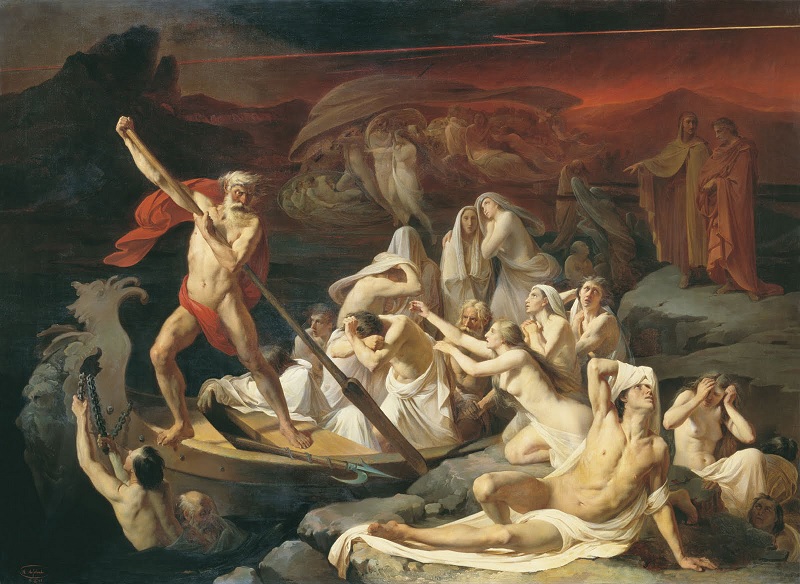
Charon Carries Souls across the River Styx by Alexander Litovchenko
The Charon Line
We lined-up on the shore, All so silently and patient, As we waited for the ferryman to come. The river was so calm, And the air so deathly still, And the souls were so sepulchral and so glum.
The sky above was black, With no moon or stars upon it, And yet light there was, from unseen candle wicks. The ripples barely washed On the river we all knew we knew: Some say the Acheron, and some the Styx.
The sand beneath our sandals Was a ghostly grey, and barren, And was bunched up by the groynes that strutted out. No birds were seen there wading, And no crabs were on the scuttle, And no barnacles or sedges, flies or trout.
Yet offering a focus Was a short and ancient jetty – Like a road to nowhere but the endless sea. And here it was we waited, With no sense of how long waiting, For we hadn’t any other place to be.
Then through the unseen nothing Came the faintest splash and motion, As a distant dory drifted into view – And standing at its stern Was the sternest man left standing, As he worked his ten-foot ore into the blue.
With a slow and practices action Of his stroke, recover, stroke, So his rust-red ferry glided to the shore With not a punt too many, He was docked upon the jetty, As he paintered-up and shoulder-slung his oar.
Bearded and burly With the bearing of a bull, Looking old as both the river and the boat. A loincloth and a cloak Were his only grubby garments, With his chest and thighs as hairy as a goat.
He stood upon the planks And he held his other hand out, Which we knew was for the taking of the fare. We reached into our mouths, And we felt beneath our tongues, And withdrew the coin deposited in there.
Some could find no obol And they feared they should be stranded, And they clutched their worried forehead in dismay But lo !, they found two pennies Had been placed upon their eyelids And they sighed with some relief that they could pay.
The boatman took the money Which he dropped into a leather pouch – He never looked, but fingers felt the coins – He knew which ones weren’t obols, And he tossed them in the river, And their owners likewise shoved against the groynes.
In life, we might have wondered Where he ever got to spend it – But now that was no concern of ours at all. Instead, we simply paid him In our final ever payment, And were left withouot a bead in wherewithal.
Those who proffered pennies Earned a scowl and muttered whinges On tradition, change, and numpties who know best. But rules are rules, and tolls are tolls – He pocketed the coppers both, Then waved them on his barge just like the rest.
He only took a dozen, As we sat on barest boards, While he stood upon the till and plumbed his oar. And those who couldn’t pay him Were the stranded on the strand, Who must wander through the wasteland evermore.
And what was waiting for us On that other, distant, shrouded bank ? We never tell, and you shall never know – At least, until the day you die And make the trip yourself – Unless, of course, you’ve somewhere else to go ?
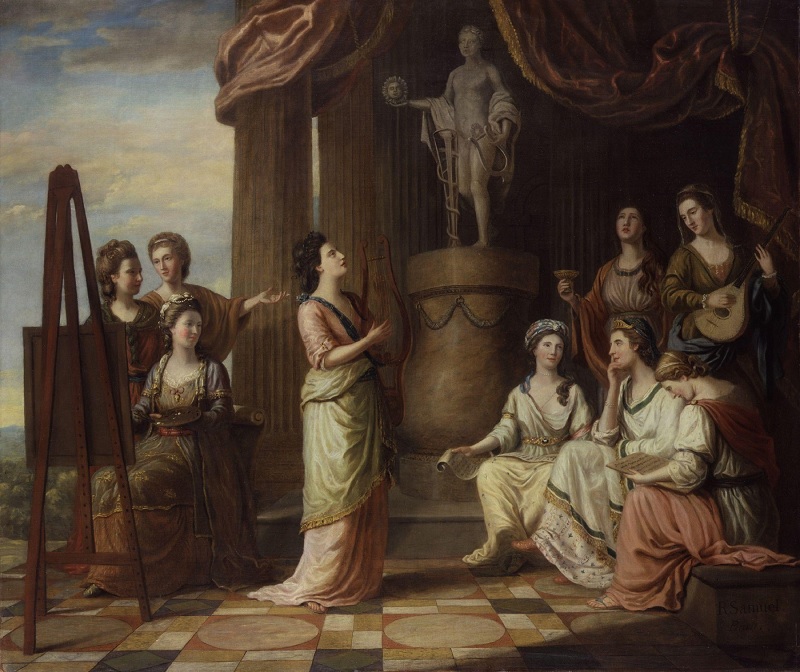
Portraits in the Characters of the Muses in the Temple of Apollo by Richard Samuel
Unamused
I used to walk with Grecians ev’ry day: Callíope would whisper in my eager ear Of battles fought for kingdoms won for heroes slain, While Clío often passed my way With tales of nations ancient, far and near, And Thália could make me laugh a hurricane.
Melpómene just loved a fallen king, While Érato was swooning over some romance, As pious Pólyhýmnia was lilting psalms. Eutérpe, now: that girl just loved to sing !, Which always caused Terpsíchore to up-and-dance While even swot Uránia had starry charms.
I used to dream with Grecians ev’ry night. And thanks to them, I wrote as fast as ink would run My songs and tales and poems, all my brain could hold. And all of it was doggerel and trite ! For all of my ideas, there was not a-one That captured even half an ounce of what they sold.
I’m better now – a lifetime lived and well, Of sights and thoughts and loves and wisdoms heard, Has brought me to the seasoned man I am today But I am now, alas, beyond their spell – For all of my ability to turn a word, I cannot think of anything I need to say…
The names are given in their Greek form, which is slightly different from the Latin alternative we may be more familiar with, hence the accents to spring the correct syllables.
Gaze into the gaze of Medusa And be forever transfixed, Petrified by our seducer, And the slither of her hips: Just a flick of the tongue and a hiss of a smile, Is all she needs to beguile her prey. With her sleek, sleek body and her big, big hair, And her cat-eyed long, long stare –
Back when slow-worms still had legs, Asklepios, a shy young god, Adrift without a cause or temple, Just a toga and a rod, Was blundering through Sarpedon, Up the valley, down the scarp, and on In search of sacred streams. And there, within a cave, it seems, While carefree and quite unawares, He found the girl of his nightmares and his dreams…
For they say that young Asklepios Had never found his way, Until he gazed upon Medusa, Fell in love that very day, And swore to heal all those who pray to him, On her behalf, And swore to ever after bear Her symbol round his staff. His temple was a shrine to her will, Where serpents freely slinked among the ill.
But these days, preachers rarely praise The grass-snake in the grass, The serpent in the Garden Isn’t welcome at the mass. Saints were crowned for banishing and slander – Or even worse, The mauling, groping, serpent-handlers, Just to prove a single verse – Snake-oil merchants, hick-wood hacks With diamond rings and diamondbacks.
But we who gazed upon Medusa, Goths and metalheads and geeks, Who don’t recoil from fang and coil, As steadfast as those ancient Greeks, Are blessed forever with her curse – To see in ev’ry child of hers Her beauty – deadly if unwise – In never-blinking eyes.





 Rhyming Couplets