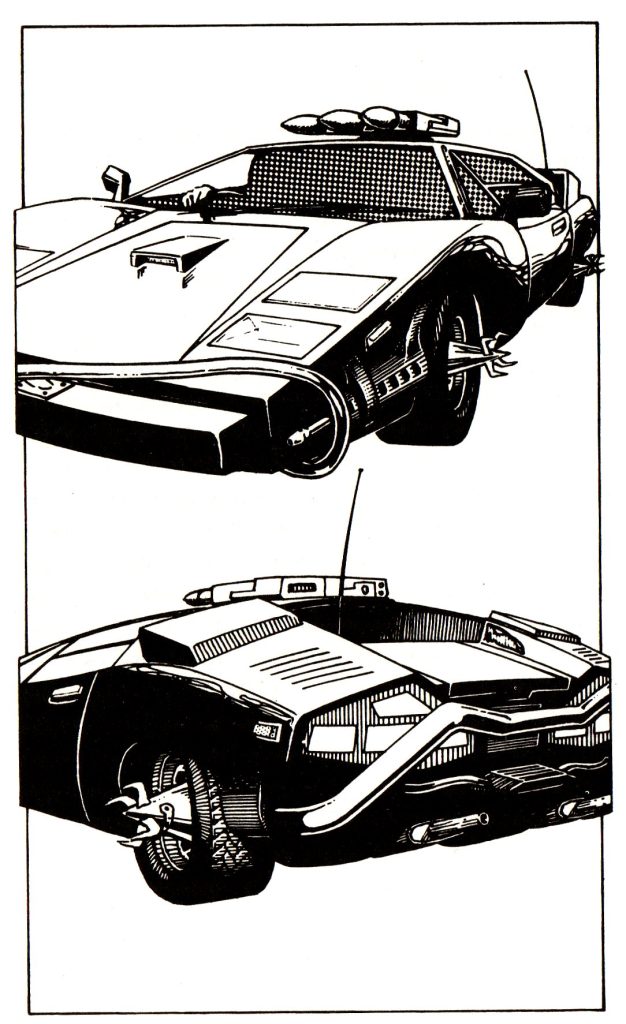
That ain’t a Dodge ! What’s a Dodge ? Something Yankee. Just trying to bodge with some Hollywood chic. But this was the Eighties, Capris and Mercedes – American cars were all tanks, they weren’t sleek ! For no British kid ever did Know a Dodge – And no stodgy old hodgepodge Could juice-up your toy. So out with your Rambo, And give him a Lambo, For coast-to-coast pure post-apocalypse joy.
The image above is from Fighting Fantasy book 13 – Freeway Fighter (1985).
Two blue-eyed parents ? Then how can a brown-eyed child be ? If brown is dominant, Her true-colours are right there to see. Ah, poor Hercule, Inheritance is trickier than that – It’s not down to a single gene To slot into a simple clever fact.
A type-O body ? Then how can there then be a type-A son ? This child is not his blood, Once the cutting-edge analysis is done. Ah, poor Lord Peter, Kinship is less iron-clad these days – It’s not down to a single letter, Pumping through the logic of your plays.
It’s not really fair, That your ingenuity is overtaken – You made us feel so clever When we thought we’d learned what science you’d awaken. Ah, poor hindsight, Your layman’s clues are too much on the nose. It’s not down to a single twist To show whose blood is blue and eyes are ohs.
They come, from out of the pages, Lurching-on for centuries, Reanimated for the ages By the editors and mages Harvesting our cherished memories.
Too valuable to rest in peace, They’re resurrected, forced to dance – But the spark of life is cold within, And nothing but a rictus grin Reminds us of that once and lost romance.
Best be wary Of Dante Alighieri, Whose hellish depiction Is turgid fan-fiction – Trekking round each Circle With Mary-Sue Virgil, While snarking in the sleaze Of revenge fantasies.
Strange how the Church Has bought-up all his merch, And turned this random blogger Into Pope-approved-of dogma. But worst of all, is any fool Who has to labour-through at school, Just hoping for a joke or three Within his so-called Comedy.
No wait, don’t hate, Don’t follow the gate That tells us “Nope, Abandon all hope !” My anger is alive In Circle number Five – But no, I must not dwell In this self-made Hell.
For Hell is more feeble – It’s simply other people With whom we disagree, Like Dante is for me. But to be more analytic, Then Hell is just a critic Complaining for eternity – Don’t let that carping voice be me…
I’m never a fan of the gutter press, But sometimes even the filth have a scoop that we need to have told – Corrupt politicians must always be hounded until they confess, (Though spare us the muckracking piety wallowing under the fold). Holding our powers to answer is really not where the threats lurk, But wholly with kings – And an anarchist press is better by far than an old-boy network Pulling the strings. So let no little grey cells be a tool of the latter, In a toxic smoke-filled room. If the Augean Stables need sweeping, then what does it matter, Whose hand is pushing the broom ?
A writer’s house is such an odd museum – With all their private, not-for-public touch. Does it forever colour how we see them, Or just amount to telling little much ? Must we rifle through their dirty laundry, And publish all their letters, kiss-and-tell ? And then complain they put us in a quand’ry Of seeing flaws when knowing them too-well. So why does hero-worship seek these holy relics, anyway ? And basing truth on only what they claim the gossip-mongers say ? Although I guess some writers would adore the fame they have today, And sure, let all the crowds come snooping round their hallowed ground… But as for me, if my words work there due, Don’t let the creeps come crawling through my caches – But burn my house, and all its contents too – And leave the pervy fanboys only ashes.
Singular Theys were always generic, The individual everyman, Of either gender, but numeric’ly one – Not hard to understand. But once we knew who it was, Then he or she was He or She – They didn’t stay a They, because, We now could specify, you see.
This calling Barry and Susan They Is fresh, and it still sounds strange, Though it’s prob’ly here to stay, And language always likes to change. We’ll get it, if you give us time, To navigate the new. Our speech evolves, it’s not a crime – Just ask the Singular You.
Lillah McCarthy as Jennifer Dubedat in the original production of The Doctor’s Dilemma
White Enchantress
The scene is London – the Edwardian stage – A new play opens by George Bernard Shaw – That finger-wagger of the gilded age, That rabble-rouser of the better sort – The Doctor’s Dilemma. Will it be a draw ? The public shrug as the critics snort – It isn’t a flop, but it isn’t a hit, So the world moves on for a better fit.
But lying unnoticed, there was a seed – One of his characters, posh as the rest, Was given a name she didn’t need – She could have been Cathy or Claire or Cass – But instead, her author had thought it best To name her after a rustic lass. And Cornish to boot, though she made no claim – I guess he simply liked the name.
And so that name was Jennifer – And she would come to dominate As just the handle we prefer – The whole thing now sounds so contrived, But it took a while to percolate, And for the play to be revived. Yet slowly lifting up the blinds, A pale phantom stalked our minds.
Now the audience in Nineteen-Oh-Six Had heard of Blondwyn, Fiona, and Neve. But those were for natives, who barely mix With these theatre types, who would never think That a child of theirs should ever receive Such a name, if they had no family link. And though Guinevere was hardly forgot, They found her name no Lancelot !
Now Jenny was known for centuries – For Jane or Joanna, and paved the way. And Celtic awareness increasingly pleased, With a dash of exotic, and of something new. So when Jennifer Jones hit the screens, I’d say That the time was ripe for its big breakthrough. It shot up the rankings, left Anns in its wake A working-class wide-girl, a name on the make.
But her reign was short, as she paid fame’s price – She peaked in the Eighties, as big as her hair, Then drifted from psyches, as parents thought twice. Forever a signpost to the Post-War age – For a hundred years after, we’ll find her there, Before she slips back to the dusty page, And she and Guinevere are equally dim. And to think, Bernard Shaw prob’ly chose her on a whim…
Historical name data isn’t nearly as detailed as I would wish, and I can only find the top hundred names listed at ten-year intervals on the UK Office for National Statistics website. It shows Jennifer first broke onto the list in 1934 (87th), shot upto 18th in 1944, slipped slightly to 23rd in 1954, down to 45th in 1964, then rallied to 34th in 1974, and rocketted to 11th in 1984, before starting its (final ?) descent in 1994 at 42nd. This page then has a year-by-year breakdown showing 87th in 2004 and 217th in 2014. The most recent dataset for 2022 shows…457th (though remember that all of these are for births – the Jennifers we encounter will face at least a couple of decades’ lag).
Ev’ryone lies to their diary, We write it with one eye on who will consume it – Intruders, historians, even our future selves – Taking the time to polish and to groom it. We wish it be penned by the person we wish to be, Entries intended to shine and outlive us – For who can admit to their ev’ry dark thought ?, So instead make it safe for our kids to forgive us.
Ev’ryone lies to their diary, Pretending there’s nothing made-up or excluded – And maybe we don’t see the spin that we’re adding, Or the innermost thoughts that have somehow intruded. For we are the hero of internal monologue, Archived today as the first-draft of memories – Write down the best bits, erase all the errors – We’re rationed for pages, so we only cherish these.




 Rhyming Couplets