Out there in the wood Is the old oak tree, Just lapping-up the sunshine, All of it for free. But there in its branches, There lies the mistletoe, Just sucking-up the sap Of its clueless host below. And there on this shrub Is a little caterpillar, That’s munching on the leaves Like a cute and stealthy killer. And inside of the bug there lurks The grubling of a wasp, As it chews-through the organs, Squatting like a boss. But inside the grubling Is another, smaller maggot Of a teeny-tiny wasplet That will wear it like a jacket, And inside of the maggot Is a nematody worm, And further inside that There is a microscopic germ Of a fungus, creeping silent Through the gut-within-the-gut, Which is home to a bacterium That spawns itself in glut, And yet even that must make space To the lurking of a phage, Which is suffering from oxygen That tears apart its cage. So they each are chowing-down, And they each are getting fatter, Till they burst-out of the body, That they leave in such a tatter. But the enemies of enemies Don’t turn-out to be friends agen – Just ask the plague that bit the fleas, Then bit the rats, then bit the men…
So, I asked AI if such a Russian doll is possible, and it thought it was – though vanishly unlikley, and the length of time that all eight trophic levels could be ‘eating’ at the same time is a matter of minutes before one of the levels is killed.
Of course, inside of every cell in every multicellular-body’s body is the remains of a possible parasite, in the form of mitochondria. But over time, evolution tends to find that the healthier a parasite can leave its host, the better the tenant does as well. But bacteria can get in on the act as well, with their viruses that would co-opt their landlords into making a sex pilus to infect other neighbours, and accidentally carried across some of their host’s DNA with them and thus enabled the unintended spread of antibacterial resistance…
Humans have been farming fungus Since the old days of the Tang – The jellied-ear perhaps was first, And up the mycoculture sprang ! Shiitake and enoki, Grown on logs and straw and bran, Until in damp Enlightened France, The button mushroom crop began.
Strange, the Romans loved their fungus, Yet they never learned the knack – And the monks were so productive, Yet they only gave the yeast a crack. Although, it proved quite tricky Unless sterilized for pathogens – Far easier to forage in the woods That mess around with pens.
Meanwhile, folklore had been busy, Earthy names for ev’rything – Observe the toadstool and the stinkhorn, Bird’s-nest and the fairy ring. But where were all the memory-rhymes On which ones was it not worth risking ? Or how to tell a puffball From a death cap or a poison pigskin ?
Perhaps there are no generalities To indicate the vicious – One-by-one, we learn how white gills, say, Are deadly, or delicious. Ugly textures, noxious smells, May sometimes show vitality – Their looks do not align at all With fairytale morality.
These days, though, the urban myths Are more concerned with mould and spore, And in hallucinations, And the nuclear clouds of war. The time of the destroying angel’s Shrouded in mediaeval mist, Or from genteel whodunnits, Or a pith-helmet nat’ralist.
Humans have been farming fungus, Fascinated with their fruits – Not really understanding them, Yet sniffing truffles out of roots. These days, it’s all commercialised, To keep safe ev’ry cassarole, Without an unintended killer In our toadstool-in-the-hole.
The Chinese appear to have been farming Auricularia heimuer (aka the Black Wood Ear Mushroom) since the Tang Period (10618 – 10907 HE). Their local name for it is ‘heimuer’, subsequently used as the species epithet. However, I have been unable to find any guide as to how this is pronounced. I think it may be something like high-moo-er, but that sounds more like a cow who has been feeding on a rather different kind of fungus…
Walking along the canal, I see the duckweed is in bloom – Bank-to-bank, a carpet For the mallards’ living room. The moorhens leave a wake of clear That slowly zips together, The swans have clumps upon their prows, And flecks on ev’ry feather.
Rivers are no good, of course, They hurry up their flow – But out on the canal, It teaches how to take it slow. The coots are scooping mouthfuls, And the geese are busy working – But beneath the green and stillness, I can sense there’s something lurking…
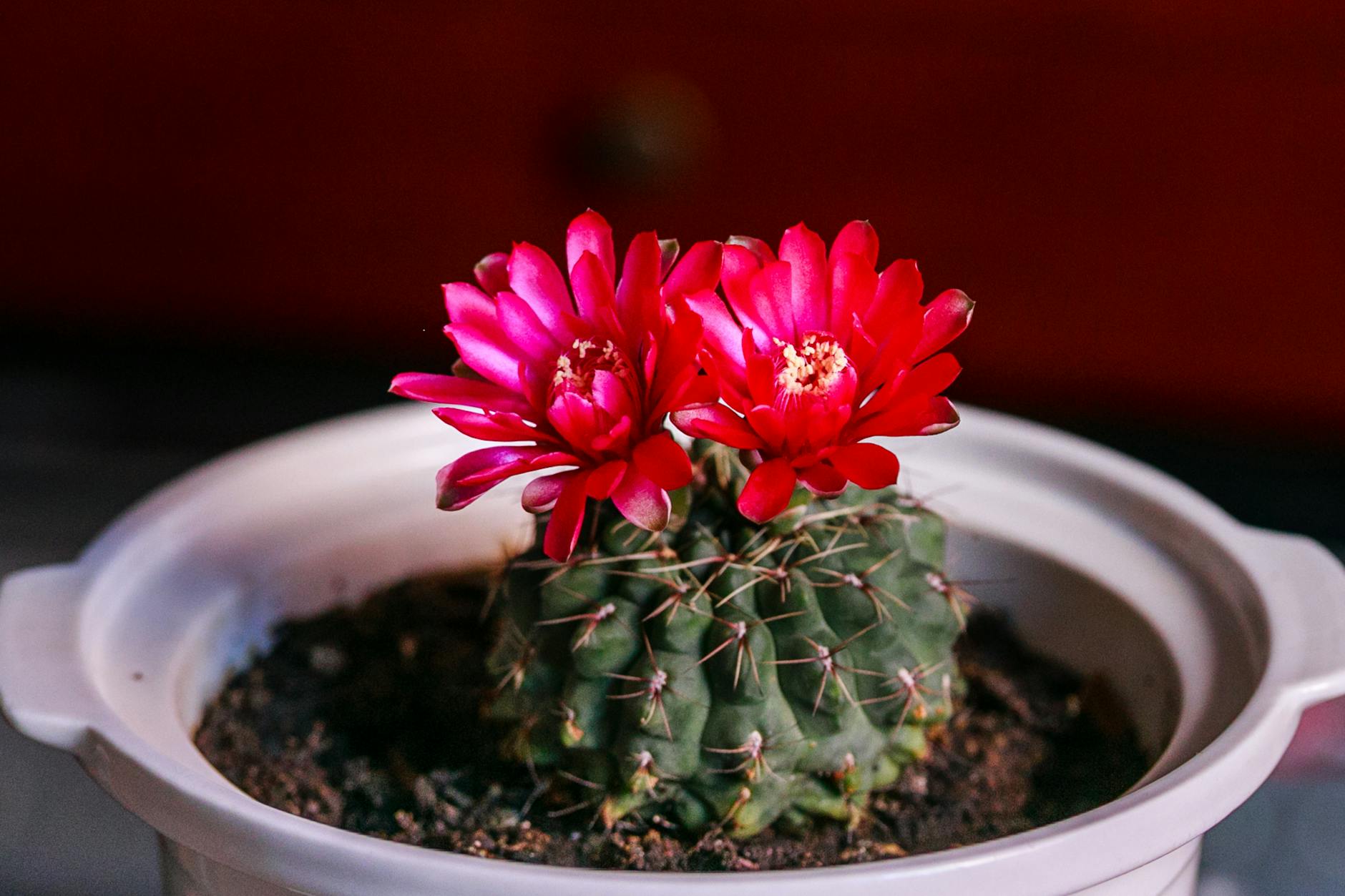
My cactus is in bloom, It feels so wrong, It feels so out-of-line – It’s job is just to loom, All decade long, With no intent. It always seemed so stoic Old as yore, With little outward sign – But was this shy heroic, Waiting for It’s chance to vent ?
My cactus is in bloom, What should I do ? It’s out-of-temper’ment – It just sits in my room, All decade through, In stalk and spine. It always seemed so zen, So green and squat – But this is decadent ! Was it just waiting, then, Until it got It’s chance to shine ?
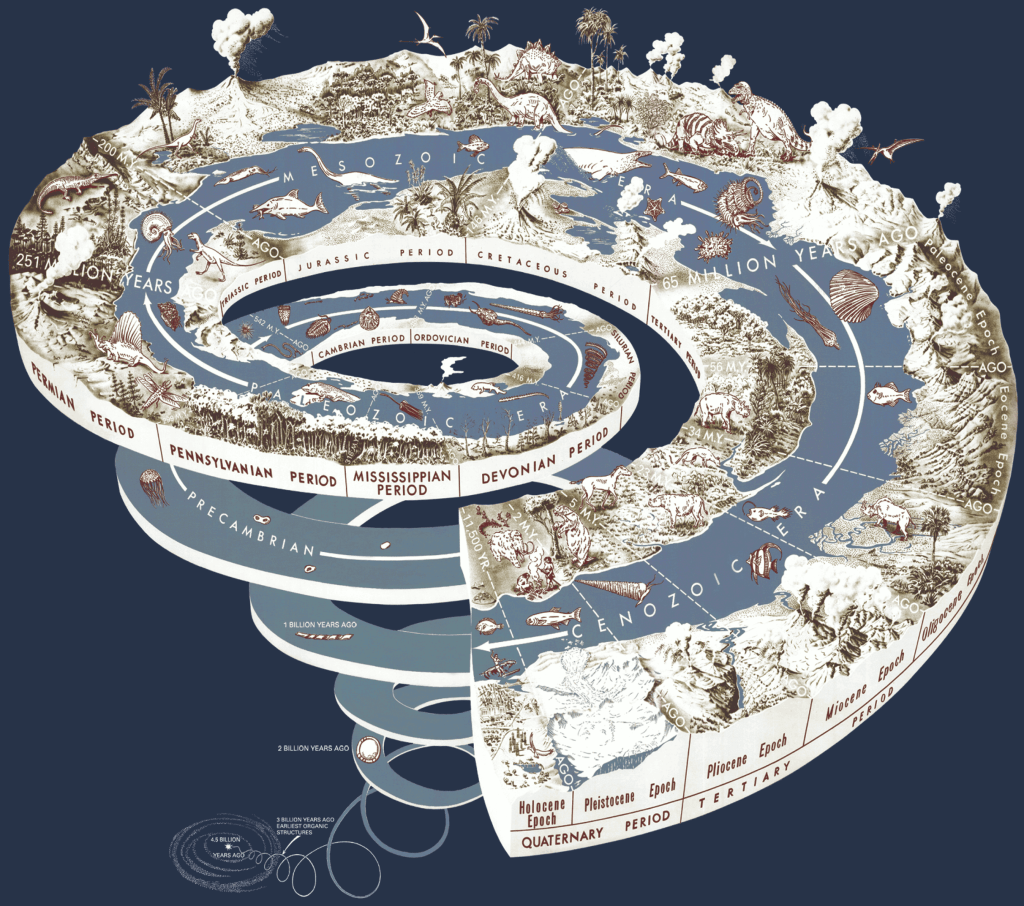
Geological Time Spiral by Joseph Graham, William Newman, & John Stacy
Counting Forwards
Imagine, if we like, To the Earth when it was younger – Let’s go back in our minds As Rodinia accretes and binds. Imagine all the life, With its breeding and its hunger – And contained within the ocean wide, While all the land is dead and dried. Go on back a billion years To when the Tonian began, And the first alga brave appears In the inter-tidal span. And let’s call this Year Thousand in our plan.
Now imagine, if you like, A thousand million later – To Britain, as it will become, Through evolution’s endless sum. Let’s use the past to take a hike, To be our ad-hoc dater – With ev’ry year that we explore That’s adding-on a million more. Ready ? Well then, come with me ! To Year One Thousand, long before, When Vinland Vikings rule the sea And early green specs dot the shore – And let’s see history expand once more.
1000-1280 The Tonian is a long old stretch, From Ethelred to Longshanks. We’re not sure when things happened quite, So none of these are strong ranks, But sponges would appear to appear Around the Fourth Crusade, Just as we leave the Dark Age, As the Boring Billion fade.
1280-1365 The Cryogenian grows cold, As the mediaeval warmth recedes – The plague upsets the status quo, As animals succeed. The monks and fossils leave their records, (Fewer than we’d wish), As peasants rise-up, and the jellies – Both the combs and fish.
1365-1460 The Ediacaran, through the Hundred Years War, Is a pregnant time. The Agincourt slaughter sees new forms of life Are on the climb. We’ve so little idea what, Though likely all the phyla we know Are going their separate ways back then, As the trade and prosperity grow.
1460-1515 Bang ! The War of the Cambrian Roses And Henry Tudor the Trilobite. Bosworth Field is awash with early fish, As eyes first see the light. Predators prey, so the shell evolves, And the codpiece proves the way to dress – And we know so much of those olden times Because of the Burgess printing press.
1515-1555 The Ordovician sweeps the monks away And ends in the great divorce – The Little Ice Age causes mass extinction, Though with a patchy force. Most of the phyla shrug it off, As do the merchants of the day, While plants colonise a whole new world of land, Down Mexico way.
1555-1580 The Elizabethan Silurian Sees vascular plants grow bodice and ruff, While armoured fish develop jaws As Catholics have it tough. The millipedes creep onto shore While Mary Queen of Scots must flee, And Francis Drake sails round the world, While scorpions swarm the sea.
1580-1640 Awaiting the tetrapod armada in Plymouth, Comes the Devonian span – Sharks and ammonites emerge In the Tempest of Caliban. King James writes his Bible On the wood of the early trees, Till the Civil War extinction Brings the shallows to their knees.
1640-1700 With the Carboniferous Restoration, Amphibeans arrive. There’s giant dragonflies in the endless forests, Where spiders thrive. They lay-down future coal, of course, As London is aflame – Till the Glorious Revolution, When the reptiles change the game.
1700-1750 The Permian now joins Pangaea With the Hannoverian line – Dimetrodon and future-mammals Have their chance to shine. But from the North, a Great Dying Sweeps them from their heights – The lava traps of Siberia, And the pikes of the Jacobites.
1750-1800 The Triassic sees a trident of firsts – Pterasaurs, crocomorphs, dinosaurs. The sea’s full of plessies and ichthies and turtles, An empire stretching to distant shores. But American lizards break away From rule they call draconian, And a great extinction’s coming-in That’s all thanks to Napoleon.
1800-1855 The Regency brings us the Jurassic, Victoria sees placentas get birthed, While the Chartists challenge the old big beasts, As the sauropods shake the earth. The allosaurs fight stegosaurs, While archaeopteryx soar above Of the Valley of Death as India splits, On their way to becoming a dove.
1855-1935 The Cretaceous next, but where to start ? Pangea well-and-truly splits, While flowers bloom for Victoria’s weeds, And spinosaurs are Edwardian hits. Veloceraptors perish in the Depression, But T-Rex jazzes the town With Triceratops to the very end, When the asteroid comes crashing down.
1935-2000+ Into the Cenozoic we go, As the atom bomb sees things get hot. Mammals and birds diversify, As hippy grasses grab their shot. Hominids climb down from the trees As Tony Blair brings-down the freeze – Then Christmas Day in ’99 Sees farmers plant communities.
Imagine, if we like, Where our journey goes from here – What might the next long thousand bring To life that’s ever-quickening ? And when extinctions strike, Then new forms suddenly appear. History shows progress all the while, Though fashions change the style. But here, for now, our trek is done, We’ve counted up the years we hold, From an Anglo-Saxon simple son To multi-cultured forms so bold. They tell the greatest story ever told.
Happy birthday ! Yes, it’s true, Rhyming Couplets is turning six, so here’s a special treat for anyone who’s still out there.
Similar to my championing of the Holocene Calendar, I hate counting backwards, and can’t wrap my head around the numbers. Therefore I propose the Paleontology Calendar, which can either begin at 0 (equal to 2,000 MYA) when the Great Oxydation Event was coming to an end, or at 1,000 MYA when the first algae was colonising the land. The latter is more useful, as it results in three-digit numbers rather than four, as we don’t have much evidence for what happened prior to the Ediacaran fauna emerging (they’re not called the Boring Billion for nothing…) However, I’ve adopted the former here so that the dates can line up with European history to make conceptualiseing the events easier, at least for me. By happy coincidence, 1000 MYA is also when Bicellum first appears, which might just be the earliest evidence we have of animals evolving away from algae…
Note that all dates prior to the Cambrian are tentative and likely to change in the future. Just when the animal phylums diverged is unclear as there are very few fossils, and rely on DNA analysis and molecular clocks. Furthermore, the current estimated dates may be a few years different from their historical counterparts for the sake of convenience (for example, some think that algae first poked its head out of the water as early as 1200 MYA). Come on, this is a poem, not a textbook !
The cottage down the lane had a big end-wall, Beneath the gable, Always covered in ivy, growing so tall, As tall as was able, Growing upto the eaves, to merge with the thatch, Such a weight of leaves to the crown – I’d wondered, how does it all attach ?, How did it not pull the old wall down ?
Drilling-in through ev’ry crack it can pry, And drinking the mortar dry, Whatever it takes to reach the sky – At least it sheltered from the wind. But at what cost ? This cottage was built With overbakes and wattled silt – So which would be the first to wilt, When neither was well underpinned ?
I waited years, but never did find out The power in the growth – For one hot night in the Summer drought, A fire killed them both. There’s a new-build cottage now, with a big end-wall Whitewashed in lime, With a single ivy runner – starting small, But on the climb…
Turmeric and ginger, Cumin, mustard, mace, Red-hot chilli peppers, With cardamom to taste, Cinnamon, paprika, And nutmeg makes it sweet, White pepper, black pepper, Turning up the heat.
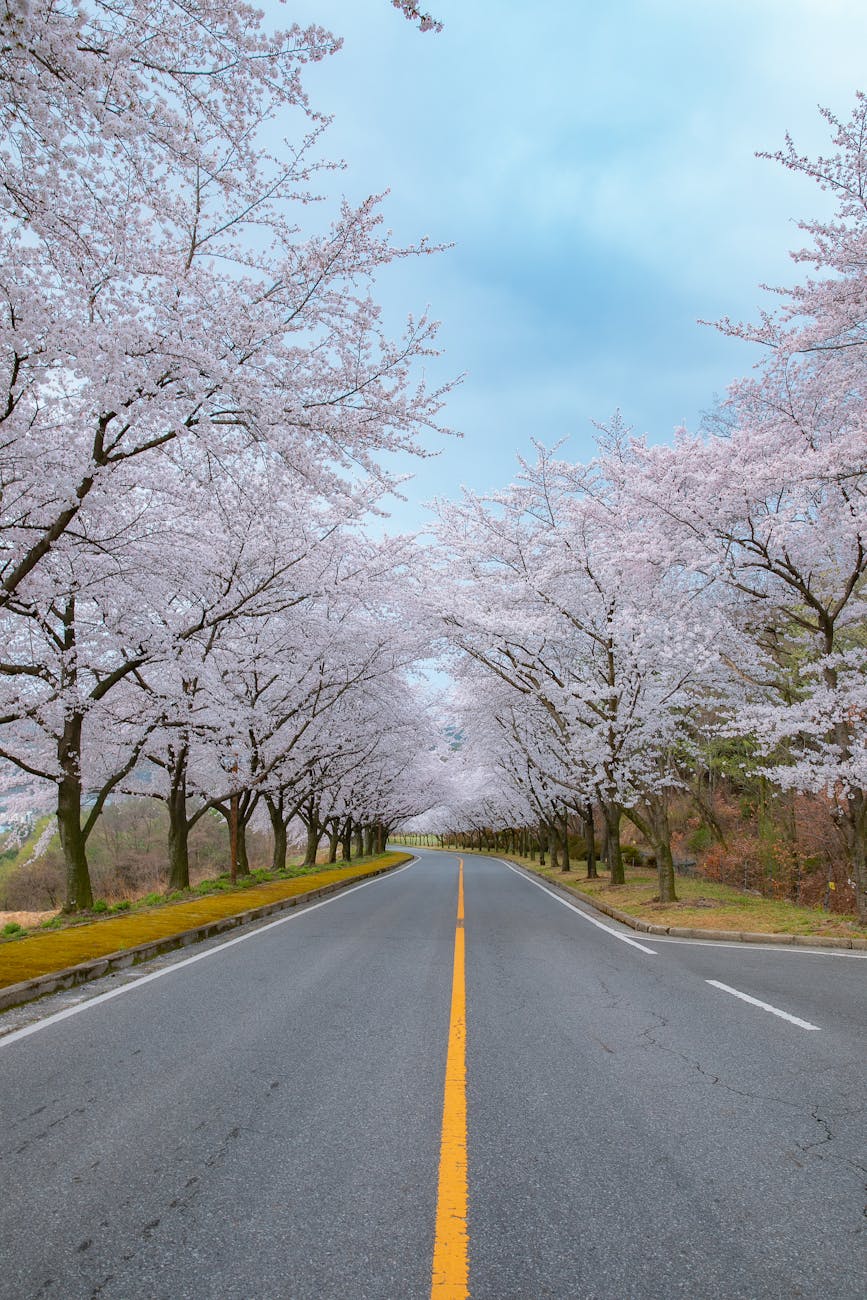
Sweet cherry, bird cherry, British since the glacier – White of flower, red of berry, Showing Spring is on the merry With their blossoms looking very Much the lacier.
And yet our folklore shrugs and mocks Our modern-day delight. Did Stonehenge mark the equinox As cherry petals blew in flocks ? Did Boudicca manoeuvre and out-fox From woods of white ?
Did Patrick banish Irish snakes From out of trees so halcyon ? Did Alfred burn the cherry cakes, Or Sherwood sport such dancing flakes, Or Shakespeare pine on ruddy aches, Throughout old Albion ?
The Japanese have celebrated long The bloom before the leaf, But Europe only saw a throng Of messy trees not worth a song. Was Easter’s shadow just too strong, Or blossoming too brief ?
There is some talk of a local tradition in the Chilterns of using cherry blossom braches to decorate churches at Easter, though I can’t find any Pre-Victorian sources to indicate how old this is.
So the only legitimate references I can find to cherry blossom (as opposed to the fruit) in British culture is in Geoffrey Chaucer’s The Miller’s Tale: “As whit as is the blosme vpon the rys.” ‘Rys’ is a Middle-English word for ‘branch’, so no individual tree is specified – and neither is a particular season in the Tale, not that it would really matter for the metaphor anyway. But the very first line of the General Prologue mentions April, so the Miller and his audience would have been on their pilgrimage at the perfect time to appreciate any roadside displays. And what other native British tree has flowers worth a poet’s attention beside the cherry and it’s close relatives like blackthorn or apple ?
Judas hanged himself, we’re told, But from which tree in the potter’s field ? Some say Elder, pagan and bold, And some say Cercis bore his yield. The Elder is likely the tale that’s old, Though the Bible has the facts concealed.
Cercis may be a later rod, So did logistics bring its birth ? For the Elder presence is rather odd, As a shrub which lacks both height and girth – So the one who kissed the face of god Must sway just inches from the earth.
The Romans built their crosses Out if any local wood – Roughly sawn and bluntly joined, They needn’t be too good. Growing full of nail-holes And bloodstained, as a rule, When used and used again, until they rotted, Then hacked-up for fuel.
If Jesus ever lived, if Jesus died Upon those wooden piers, Those planks would carry-on their work, Outlasting him by years. Some say cedar, some say cypress, Relics for a coronation. All are wrong – the Cross was built From our imagination.