Guising

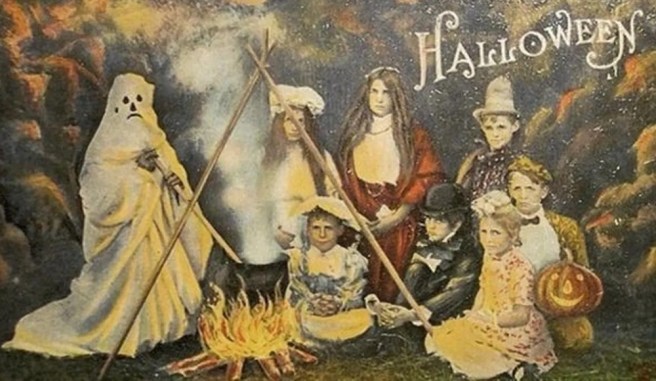
Alas, I have been unable to find out any more information about this postcard

Guising

Did people ever really think that spirits roam in late October ?
So the safest thing to do was simply blend-in where they tread ?
Or that their feeble efforts would fool anyone who’s half-way sober,
With no more than sheets and make-believe to raise the dead ?

Was it to fool the spirits ?, or the humans ?, or themselves ?
Or a warning to the Church that it was not so at-the-head ?
Perhaps the latent superstitions conjured up such elves
As an outlet in the face of poverty and mortal dread ?

I think we always knew it was a chance to have some fun,
And to dress-up and be mischievous, and stay-up late-of-bed.
Even those who still believed in spirits, saw through ev’ryone –
But let the children have their fun, and spare a crust of bread.

The word ‘mischievous’ needs to be stressed in its first syllable – MISS-chiv-ous. Some people pronounce it is miss-CHEEV-ee-ous, and there is absolutely nothing wrong with this – except in this case, as then the line won’t scan.

Brass-Cornered Boxes

Brass-Cornered Boxes

Wooden and leather bound, fit for a steamer,
A portable treasure chest, waiting for gold…
The trunk of a journeyman, noble, or dreamer
A personal world in a box in the hold.
What wonders are lurking, restrained by its lock ?,
To be served-up on life’s hungry trencher.
Not wanted on voyage – but oh, when we dock,
Then its contents shall spill-forth and venture.

Hoops & Smits

Emblem of Power by Victoria Shul

Hoops & Smits

We’ve ringed the noses of our bulls
Since the days of ancient Sumer,
And blinged their ears with tagging tools
Since the reign of George the Third.
And sheep we’ve daubed with bright and dark
Since Beau Peep was in bloomers,
And likewise branding’s left its mark
Since pharaohs watched the herd.

And long before the Roman Legion,
Pigeons wore a metal tumour
Round their ankles, through the season,
As they carried vital word.
And falcons showed their noble’s farms –
And scientists confirmed the rumour
Of migration, through the charms
They fitted to each bird.

Willow Pattern

Photo by Esra Nur Kalay on Pexels.com

Willow Pattern

Two dancing birds,
Beaks apart, as if in song –
As they circle through the cloudy, milky sky.
One windsocked weeping willow,
Slanted, yet still strong,
And three folks on a hump-backed bridge nearby.
Could it be they’re fishing ?
Or waiting for the boat ?
Though it hasn’t got a sail – perhaps a punt ?
Upon the other bank
Is a house that looks afloat,
Sporting plenty of blue shrubbery infront.
And over here, behind a zig-zag fence,
A squat pagoda,
That’s sheltered by a spreading ping-pong tree.
And round the edge are squares and scales,
And flowers for a coda,
A busyness of cobalt for our tea.
I stared and stared at China
On those Sunday afternoons,
Round at Grandma’s, in her cottage with the gate.
The disappearing cake
Revealed the timeless blue lagoons –
So very Eastern, yet so English, on a plate.

It is uncertain when the first examples of Willow Pattern appeared, although Wikipedia suggests they could have been produced by Spode in 1790.  They are, of course, a classic example of cultural appropriation – and thank goodness they were !  Genuine Chinese porcelain at this time was very expensive, and modern pecksniffs would have seen to it that it remianed so, and that the hard-working families of Britain should be denied the beauty and broadened horizons that came with their roast beef and Yorkshires.

Sacré Rouge

Photo by cottonbro studio on Pexels.com

Sacré Rouge

The bathtub killer – time for a pardon ?
Ah, now there’s a thorny one…
She’s a murderess, and a proud one,
And a test for the historian:
We may hate the very notion
Of the capital penalty –
But when a despot’s above the law,
Then is there another remedy ?
We’d much prefer to see him tried
For all the bloodshed he’d provoked –
And yet, she also was a part of that mob
That he had stoked.
Though actually, her action
Didn’t stop the Terror in its tracks,
And made a martyr from a monster,
As they ramped-up their attacks.
The fact that the ancient regime
Was such a horror is no excuse,
Nor that the new lot were the same –
It’s all a cycle of abuse.
Of course, we were not there, in the thick,
So would we be so wise ?
But today, at least, we can stand by the law, and by life –
And not eyes-for-eyes.

Wassail to the Puritan

This anonymous drawing may be showing (though it’s not definite) the postumous hanging of the psychpoth Cromwell in 1660. Personally, I wish he had been banged up for life in the same cell as the psychopath Stewart.

Wassail to the Puritan

Merry Christmas, Olly Cromwell,
Of the English Taliban –
You humourless and hypocritic man.
A busybody straight from Hell,
A spiter of all jollity –
A hero, then a hater of equality.
Here’s a Christmas toast
To the man who gave us back our kings –
You failed, you worthless sod – I hope that stings.
What England needed most right then
Was tolerance and peace
And years of sharing many Christmas geese.

The Jists & The Jets

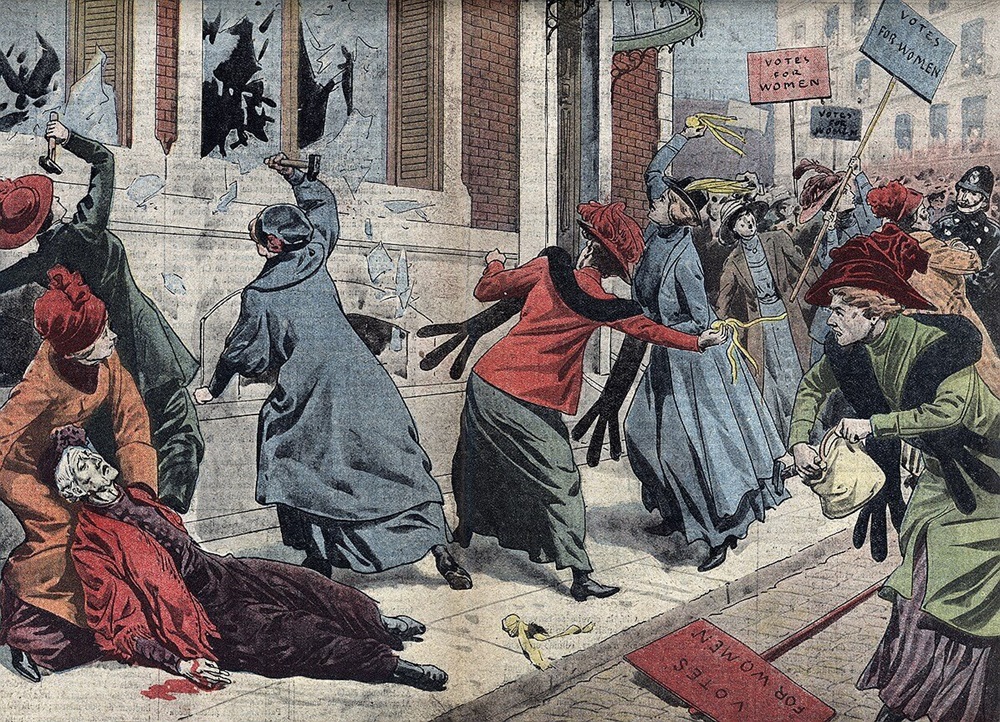
Après avoir brisé toutes les devantures des magasins by Eugène Damblans

The Jists & The Jets

We celebrate the Suffragettes –
Those terrorists made good,
Forgetting all the Suffragists
As a passive sisterhood.
Yet the former wanted only wealthy women
To get the vote,
While the latter wanted not just Chelsea women
To make the quote.
We also forget the unsung million
Of women manning the factories,
Who did far more to shift opinion
That a violent few reaction’ries.
Yet Emmaline the Tory succeeded
Over Millicent’s thwarted pen –
It seems what women most needed
Was to vote for the same old men.

Haunted Houses

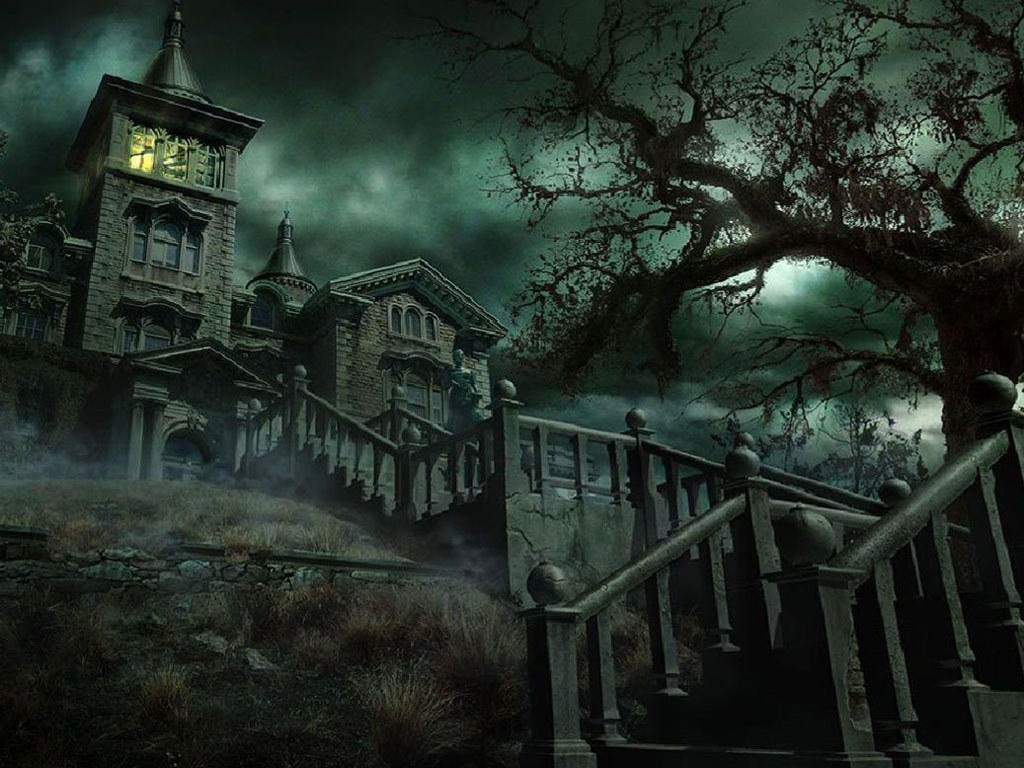
Haunted Castle by nihileswari (though surely AI…?)

Haunted Houses

Whenever I watched those creepy old movies,
I’d always ignore the psychos and ghouls,
And focus in on the architecture –
So wonderf’ly Gothic, so atmospheric !
Why were the characters in these old movies
Such philistines and such fools ?
Ignoring all of this architecture
And long to return to safely generic ?

I never found them creepy –
The shadows and arches were part of their charm –
Those Second Empire carpenter’s mansards,
That echo the castles of Prussia or Serbia.
And always the films were so sneaky,
Suggesting flamboyance is doing us harm –
For florid is evil – don’t stray from the standard
By daring to question the rules of suburbia.

For all that Conservatives moan about Horror,
It’s always been an ally of theirs –
Punishing drinking and sex in full
While the Final Girl is a goody-two-virgin.
And concrete has a Protestant aura,
A purity in its workaday airs –
Don’t be too flashy, too individual,
And squash down any expression emerging.

But all that Brutalism delivered
Was paranoia in ev’rything else –
Satanic panics were preached from the pulpits
Of low-ceiling’ed prefabs and walls of glass.
The decadent styles of the past sent shivers
That must be exorcised from our house –
And always rebellious goths were the culprits
Within the fantasies of their class.

Yet Horror wasn’t so saintly or pure –
With teenager heroes against their parents,
Yet parrotting cultural norms unwittingly,
Not quite thinking them through –
Which brings us back to the architecture
Mirroring this clash in appearance –
Dormers and towers are outcrops that fittingly
Symbolise warts on the face of the New.

But the poor jocks and nerds were always too busy
With running and screaming, to ever behold –
But I did.  And I wept if they set one alight,
To pay the ultimate cost.
Capitalism has left them so dizzy –
To buy all this new stuff, and knock down the old.
You think they’re haunted ?  They’re haunted alright,
By all of the beauty we’ve lost.

I must spotlight a recent video essay by Kendra Gaylord.  I cannot concur with her admirtation of Edward Hopper, but I certainly can agree in her love for the Mansard Roof.  And although the groteque capitalism of both the French Second Empire and the American Gilded Age are most-assuredly horror-worthy, I have always found the inhuman sterility of Brutalism far more suited for existential dread.

Journeyman Artist

Journeyman Artist

I’ve had to cut my prices,
As my canvases decrease –
No more ultramarine for Mary,
No more golden fleece.
My landscapes are a full foot shorter,
My Christ Childs have eight toes,
And the sitters for my portraits
Must do so in simpler clothes.
Another painter has come to town,
And she’s splashing her vibrant hues around –
A lady artist ?  Such novelty !
She’s practic’ly selling the things for free !

The trouble is, she’s also good –
But who could have trained her so ?
I’ve spent the last ten years with a master,
Just to learn what I know.
How is her flesh so creamy pink,
And how are her eyes so white ?
How does her satin fold in waves,
And her corsets clasp so tight ?
Another painter has set up shop,
And patronised by the very top.
Such soft, quick hands – so how will I cope ?,
As she grinds her pigments and crushes my hope.

What must I do to watch her work ?,
As she blushes her client’s cheek ?
And how can I stay professional,
As her brush-strokes leave me weak ?
But I must – she’s an artist like I’m an artist,
We’re brothers of the palette, are we…
But alas, she paints her angels and muses
Just as pretty as she !
Another painter is plying her trade,
And I know I should cheer the progress she’s made,
So I daren’t compliment the curves of her dress,
Or the delicate breasts of her shepherdess.

Soffits versus Crockets

Clare College Old Court, Kings College Chapel, and King’s College Gibbs Building in Cambridge.

Soffits versus Crockets

A war was waged in brick and lime,
Throughout Victorian abodes –
A battle fought in seminars
Of finials and glazing-bars.
It seemed so vital at the time –
For who defined the building codes
Controlled the future, wrote the book,
On how our homes and cities look.

The round opposed the pointed arch,
The column pushed against the pier,
As Classical and Gothic taste
Were drafted, pressed, and laid to waste.
With footslog critics on the march
To make their case and boo or cheer –
With so much breath and ink well-spent,
As up and up the buildings went.

But in the end, the Romans won –
The Gothic stalled, and fell from grace
Despite its use in school and hall,
It still felt churchy, overall.
Beneath Edwardians, its run
Was looking tired and losing pace –
Which was a shame, because its fuss
Was far more fun than serious.

As the following century
Dragged on, it ditched the Grecian-born –
As Classical found it was too
Of little use for shiny-new.
So buildings lost all sensory adornments,
All their locks were shorn –
And so the Battle of the Styles
Saw losses shared across the aisles.