The trouble with the past Is that the past is pre-determined – So we know just how it goes Because it’s all already been. Now at the time they must have felt so free, Yet they’re confirming That the past is fixed forever, With no wiggle-room between.
Little did those little people know There’s just one way for things to go, And ev’ry time we play it back, The same old things are still on track. There’s just no way to keep hold of dinosaurs When dead is dead – There’s no way to replay the wars, Or Anne Boleyn to keep her head.
But wait – if there’s a script to act, We write it out together From a million potential drafts That could go either way. For just like us, they got to choose But once they chose, they chose forever. The past is post-determined – Once it’s set, it has to stay.
It’s Time to Build a Stronger America by James Flagg
America, We Need to Talk
Look, we get it, you’re still young and brash With passion and guile of a sort we remember From out of our youth, from cutting a dash, When the world was in Spring and our credit in cash, And watching you now, we still feel an ember From deep in our hearts that we thought were but ash.
For we are the empires who strutted before you, Who drank the same honeydew now on your lips – With vassals and tributes to praise and adore you, And patience and prudence to hassle and bore you, So manifest destiny festers and grips – And no wonder it finds you when none can ignore you.
We’ve all been there – we British and Roman, We Persian and Aztec, we Mongol and French – We each were as mighty, who answered to no man, From horseback and gunboat, with longsword and bowman, And bloodlust and mistrust we never could quench, And the cripple’ing burden of being the showman.
It never quite goes away, of course, As our never-set suns stop their beaming – The memories built up in temples and wars Which we cherish in secret, still keeping the scores. The dreams we’re still dreaming at twilight’s last gleaming, So some day shall all this be yours.
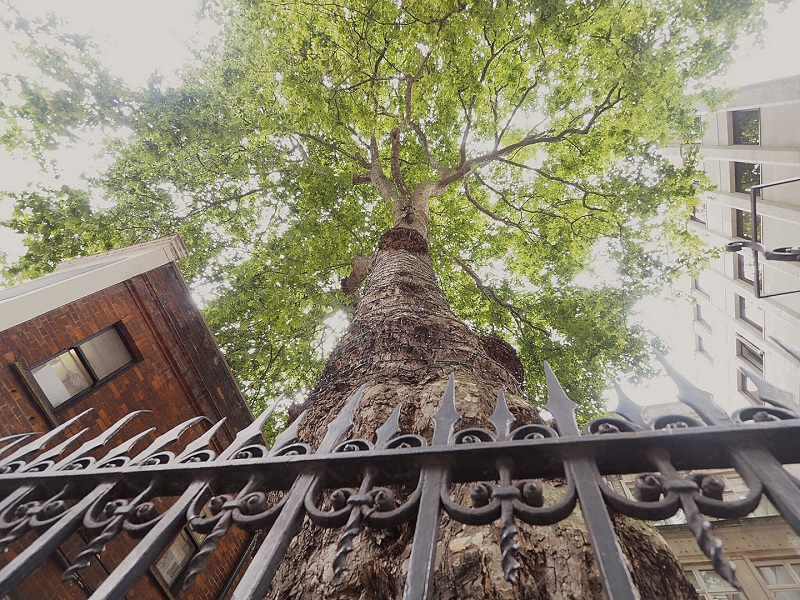
Photo of the London plane tree in Wood Street in the Square Mile (taken by Katie Wignall ?)
The Root of All Evil
“Since it was first hybridised in the 1660s, the London Plane has slowly taken over the world.”
– The Manchester Gardener
Hybrid sap, mosaic bark, Twisted bloom and swollen seed, Bright amid the sooty dark, This gnarlèd gothic breed. He sprouts so slyly, this plant in the greenery – One of the forest and part of the scenery – No felling him, this mimic of maple, primordial cousin: Hack off a limb, and this pollarding hydra will shoot out a dozen.
Spawned in the blooms of his immigrant parents, A cuckoo inherent, a mongrel ill-born. Wrought in the heart of Enlightenment steam, From a fever-soaked dream on a dew-sodden morn. With roots in the clay and his head in Orion, A vigorous scion, a devil-blest spawn, A chance aberration, a found’ry mutation, With lacewood of iron and baubles of thorn.
Invading our cities while shedding his skin, This cryptic chimera has crept his way in. And none of his caste have succumbed to senescence, as yet… Elixir of ever-youth pumps his capillary, Sweeter than gin from an alley distillery, Alchemised out of pea-soupers and coal-dust and sweat. As if he were built out of ratchets and springs, His ethic for work will be written in rings – He’s still in his galvanised prime, through the dry-times and wet.
What hath we wrought ?, and what hath we mined ?, That ought to lie buried or trampled behind – But workshops of soil are shooting out hordes of his kind. And what if we find that he just keeps on growing ?, And fruiting and sowing, till all is entwined ? Hammered and forged in the mill and pipette – Who knows how engorged this goliath may get ?
It is uncertain if the first accidental hybrid occured in Spain or in Vauxhall Gardens in London (well, technically in Surrey, but close enough). Interestingly, for all the streets lined with them, I don’t think there are any woods with them growing wild.Infact, it would be fascinating to deliberately plant a patch of wasteland with nothing but London Planes and see how well they self-seed. Yes, I realise that they’re not strictly British natives, but then they’re really native to nowhere.
Mischief Night, and the Devil is abroad – He could be here. For on this night, be you tenant or lord, There’s something near. Be it a ghost, or the ghost of a thought, The underworld or the over-wrought, It may be all, or it may be naught – It’s getting dark, my dear.
Mischief Night, and the Devil is amock – He could be nigh. For on this night, as our worries flock, His jinks run high. A will-o’-the-wisp, or a whisp’ring breeze, A chill in the air, or a banshee’s sneeze ? A frost tonight or a deathly freeze ? It’s getting cold – oh my…
Mischief Night, and the Devil is alive – He could be me. For on this night, the shenanigans thrive, And fools run free. Is that a ghoul, or a turnip’s head ? A friendly fright, or the living dead ? And the Devil just smiles and goes to bed – It’s getting late, you see.
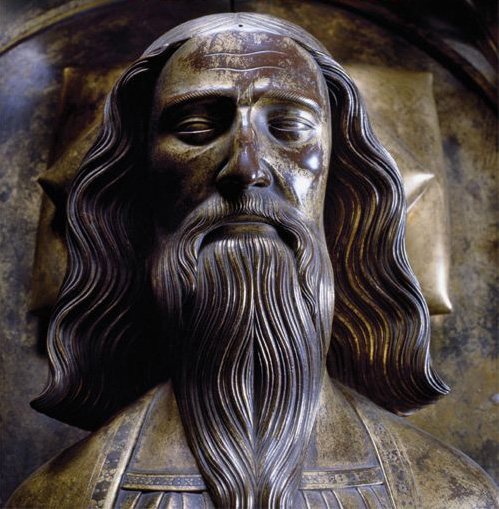
Bronze effigy of Edward the 3rd in Westminster Abbey
To the Future
My world was taught in your history class, In half a chapter your teacher rushed through. Somewhen between a turning point And some other event which we never knew. My world just probably made you bored, Learning the dates of a notable few – But not of my name – I never was found In the textbooks on which you scribbled and drew.
Maybe then I was nobody special, Somebody whom you can safely ignore. Never improved a million lives – Never brought hatred, hunger, and war. Maybe then I was nobody special, Maybe achieved next to nothing at all. But still I meant to a couple of dozen, And for those the closest, an awful lot more.
You may then think that I was unknown, Unrecorded in sadness and mirth. Save for the parish’s register-book Where my name’s still getting its three-entries’ worth. Maybe you gotten my census or tax, My causes of death and my weighing at birth. But never be thinking that this is my lot, All that I left from my time on this Earth.
Never get thinking that I didn’t count, Or thinking I’m someone you never need. For all that you laugh at my primitive ways, Just never forget that we nobodies breed. Even the famous had parents of unknowns, As did all the riff-raff who helped them succeed. So there must be hundreds, or thousands by your time, In whose chain-genetics I mean much indeed.
It is claimed that anyone living in Britain today and whose family have been living here for several generations will lmost certainly be a direct descendent of King Edward the Third, who died in 1377. Of course, if I’m, say, 24 generations down the line, that means I have over 830,000 great*21 grandparents, though quite a few of those will be dupliates. Not that the poems about him, of course.
Ah, those aristos, who never worked a day, Just sit back and wait for Papa to pass away. While armies of servants and hard-working-clarsses Would feed their fat faces and wipe their fat arses, And loans would be brokered to fund wars of nations, While riches would pour in from ex-slave plantations.
Ah, those aristos, who feasted on our sweat, Those patrons of the arts, that lavish social set – With artists and craftsmen and tailors and tours, And houses and horses and operas and balls. They almost were worth it, their style could defend it – They didn’t deserve it, but knew how to spend it.
Usually I resist any attempt to rhyme ‘class’ with ‘arse’, but this poem was written in with a definite accent in ear. ‘Papa’ of course should be pronounced with its stress on the second syllable. This is an early poem, but I’ve started to preach a little less and let a little satire slip in. The title incidentally comes from a line in Alan Bennett’s The Madness of George the Third.
We rack them out between bridges and nuts, And crank till they must reply. And those low, low throbs that we feel in our guts – Well, the sheep feel them too, by-and-by. But it’s never their bleats or their baas that are scored, It’s never their voices that sing from each chord, And it’s never their own requiem we applaud. In life and in death, so their tension will always be high.
How many hundreds of thousands of sheep Have our symphonies dispatched ? Every cello has reason to weep, And scream as its sinews are scratched. How many flocks must we cull to the muse ? How many sacrificed lambkins and ewes ? On the altar of Bach shall their entrails ooze. They live for this music, but always do strings come attached.
Playing Marbles and Rag & Bone Man by Steven Scholes
Mongers
We used to be just simple merchants – Iron, fish, and cheese, And jack-of-produce costermen – The traders in the bare necessities. But now we’re only spoken off As rumour, scare, and war – We’re jack-the-lads of shadowmen, Now hawking abstract concepts door-to-door.
Gems of The Crystal Palace, Sydenham by George Baxter, showing off the designs of Joseph Paxton
The Engineers’ Plot
Crystal Palace – it’s a suburb, Station, park, and football team, And a memory to a time When this nation still could dream. Once a product of Empire, A palace to capture its roar – Now just a flat-topped hill In the Republic of Elsinore. Straddling boroughs, pumping fountains, Soaring towers, glass for miles. Till flames across eight counties Shattered her dreamy crystal aisles.
She no more beguiles – but that sounds Victorian – Half vers libre, half Tudor sonnet. Flirting with jazz and television, Yet still bedecked in her bustle and bonnet. She was no Bauhaus, no mere function – Cast iron crockets encrusted her shell – For all her prefab industry, She always wore her baubles well. Ah, she’s gone now – like her dinosaurs, She’s of her time and place. Though her place of course is the one she named – You cannot say she leaves no trace.
Flatland always had all three, All three dimensions on it – Anyone with sense can see The Flatoids are upon it ! It’s true, they barely used the zed, But still the zed was there – But as for other strings that thread, These cannot cube the square.