Just Another Joe

Photo by Jan van der Wolf on Pexels.com

Just Another Joe

Poor little child, for now comes the naming,
The blanding and saming,
The cautious conforming,
The def’nitely not standing out from the norming.
But, loving parents, just look to your child,
For whatever’s chosen is hereafter filed –
For eighteen years onwards they cannot correct,
So only with courage and passion select.

For do we so need yet another Amanda ?
Or Johnny or Sandra ?
Or Alan or Gary ?
And are we deficient in Tom, Dick or Harry ?
So please do not foist them with Julie or Sam,
Nor Timmy, nor Mary, nor Philip, nor Pam.
For Cathy and Bill are as common as Claire
While Helens and Davids are found everywhere.

Now these names aren’t bad, they are just overused,
Their power diffused.
While others, no fairer,
Must serve in a purpose beyond their poor barer –
To label a kid with your own precious name
Is vanity foremost, to make them the same,
To moniker sprogs just to honour the dead
Is dubious burden to thrust in their head.

Yet some names stand out from the Susan and Ron –
Like Homer or Marlon,
Like Kingsley or Rudyard,
Like Heathcliff, or Linford, or else Isambard.
So Brooke and Keanu and Kelsey and Storm
Can ease off some pressure from Amy and Norm.
Give each of us fewer with whom we need share –
A little less common, a little more rare.

One of my first attempts to document my fascination with names, and also an early foray into my habit of versifyig a checklist.  I note that all of the examples in the final stanza call to mind a particular individual, which I’m sure I intended, but which I now think would be just as unfortunate on the poor kids as calling them Alfie or Sophie.
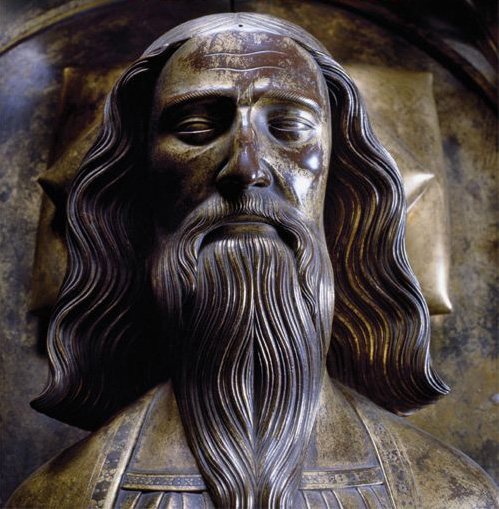
To the Future

grandad to us all
Bronze effigy of Edward the 3rd in Westminster Abbey

To the Future

My world was taught in your history class,
In half a chapter your teacher rushed through.
Somewhen between a turning point
And some other event which we never knew.
My world just probably made you bored,
Learning the dates of a notable few –
But not of my name – I never was found
In the textbooks on which you scribbled and drew.

Maybe then I was nobody special,
Somebody whom you can safely ignore.
Never improved a million lives –
Never brought hatred, hunger and war.
Maybe then I was nobody special,
Maybe achieved next to nothing at all.
But still I meant to a couple of dozen,
And for those the closest, an awful lot more.

You may then think that I was unknown,
Unrecorded in sadness and mirth.
Save for the parish’s register-book
Where my name’s still getting its three-entries’ worth.
Maybe you gotten my census or tax,
My causes of death and my weighting at birth.
But never be thinking that this is my lot,
All that I left from my time on this earth.

Never you think then that I didn’t count
Just cos you think I could never succeed.
Just cos you laugh at my primitive ways,
Never forget that we nobodies breed.
And if then I played in no big starring part,
But still my existence you so many need –
For there are yet hundreds, or thousand by now
In whose chain-genetics I mean much indeed.

It is claimed that anyone living in Britain today and whose family have been living here for several generations will lmost certainly be a direct descendent of King Edward the Third, who died in 1377.   Of course, if I’m, say, 24 generations down the line, that means I have over 830,000 great*21 grandparents, though quite a few of those will be dupliates.  Not that the poems about him, of course.

The Rigours of Indolence

there's a storm brewing
The Ball on Shipboard by James Tissot

The Rigours of Indolence

Ah, those aristos, who never worked a day,
Just sit back and wait for Papa to pass away.
While armies of servants and hard-working-clarsses
Would feed their fat faces and wipe their fat arses,
And loans would be brokered to fund wars of nations,
While riches would pour in from ex-slave plantations.

Ah, those aristos, who feasted on our sweat,
Those patrons of the arts, that lavish social set –
With artists and craftsmen and tailors and tours,
And houses and horses and operas and balls.
They almost were worth it, their style could defend it –
They didn’t deserve it, but knew how to spend it.

Usually I resist any attempt to rhyme ‘class’ with ‘arse’, but this poem was written in with a definite accent in ear.  ‘Papa’ of course should be pronounced with its stress on the second syllable.  This is an early poem, but I’ve started to preach a little less and let a little satire slip in.  The title incidentally comes from a line in Alan Bennett’s The Madness of George the Third.

World Peace

woman lying on bathtub
Photo by Andrea Piacquadio on Pexels.com

World Peace

I could lie here for hours.

I could lie here for hours,
Lie in tranquillity,
Keep all your showers and saunas from me.
There’s only one way for seeping out grime,
I just need a tub and a loofah – and time.
Secluded, alone, with my own private lake,
I soak in the warmth as I soak out the ache,
I massage my fingers through lathering cream,
And I breathe in the salts with the tickle’ing steam.
And eyes closed, transposed, I lie,
And nothing will matter until I’m dry.
I let wash away all the pressure and bile.
So go on without me, at least for a while.

I always imagine a bath is the perfect place to mine inspiration, but I think the brevity of this poem shows how little I find.  I’m more likely to turn up forty winks – and nothing wrong with that.

Collaterals

Photo by Pixabay on Pexels.com

Collaterals

They are the graves and the stats and the mothers
And citizens living where forces are tasked –
Who, we are told, so willingly suffer,
And cheer on our conflict (though never get asked).
Yet those who are calling for vengeance and blood –
Beseeching the need for the selflessly lying
Of lives-on-the-line so to hold back the flood –
They’re never the ones who always end dying.

They are the facts and the doubts and worries,
The objective news and the cooler-held heads –
It feels like they’re all swept away in the hurry,
To rumour and jingo and front-page spreads.
Yet those who are calling for boots on the ground –
They’re des’prate for war, just to send the bombs flying –
But we can ignore them, and talk ourselves down,
And all be the ones who never end dying.

I think it was written at the time of the Iraq war, and has aged as badly as the decision to fight.  This now sounds very preachy – it’s still a trap I fall into when I’m angry and it rarely works.  At least yhe second verse attempts to give it a bit of optomism.

Calling All Stations

train with smoke
Photo by Gabriela Palai on Pexels.com

Calling All Stations

Enjambment – it’s a nasty little habit
That’s likely to derail the locomotion of your meter –
For lines that run-away are sure to rabbit,
So prose may ride expresses, but the slow train sounds the sweeter.

Yet another poem about poetry, but at least it’s short.  I’ve always been puzzled by where modern poets choose to break their lines, particularly as when they read it out, there’s often no pause whatsoever between the lines.  The verb ‘to rabbit’ is used here in its cockney sense meaning to chatter – nothing to do with running, except the mouth.

Five Loaves & Two Red Fishes

those fish do not look cooked

Five Loaves & Two Red Fishes

Reverend, Reverend, writer of the tales:
Murder, guilt and passionlust, herringful and slick.
Popular and idolised, blessèd are your sales,
Though the critics pan you off as “slight” and “formulaic”.

Reverend, Reverend, writes another tale:
Murder, guilt and passionlust, once more with a twist –
The victim here is Jesus Christ, crucified, impaled.
Yet we know the killer has to be the one who kissed.

That’s okay, the Reverend is not asking whodunnit,
He tells it straight and poignant – for kudos, not for wealth.
Yet at the Ascension, so a final twist is sprung:
It turns out in Heaven waits old Lucifer himself.

“Just how can a Christian priest write of such a blasphemy ?”
Ask his readers and his bishop, still not comprehending.
“All because I do believe the Lord will yet forgive me,
(And I’d surely sell my soul for fiendish-good twist ending.)”

I feel the joke in this one is rather laboured, as are some of the rhymes.  Incidentally, the Bible contains one of the first locked-room mysteries in literature in the Book of Daniel (or at least in the versions that allow house-room for the apocryphal additions such as Bel & The Dragon).  And if you’re interested, the most common fish in the Sea of Galilee was the tilapia.

Juvenilia Week 2 – any improvement ?

Following on from the recently underwhelming week of early tat, and because I want to reach my third birthday next May before the barrel is dry and the cupboard is scraped, I’m once again fishing around in the week-old bag of lettuce leaves for the ones that not quite too-far gone – believe me, there are others in there which are nothing but liquid sludge.

These ones are just about presentable, especially after a few nips and tucks with the blue pencil.

The role of almost-shame consists of:

Five Loaves & Two Red Fishes

Calling All Stations

Collaterals

World Peace

The Rigours of Indolence

To the Future

Just Another Joe

Ecce Humanitas

The Curse of the Couplets

The Son of Man by Rene Magritte

The Curse of the Couplets

A minister’s office.  There is a knock and the Professor enters.

Minister
Ah, professor, good afternoon.
It’s really very good of you to see me quite so soon.

Professor
Oh, no trouble, Minister, no trouble at all.
I came the very minute that I first received your call.

Minister
Then let me bring you up to speed the problem facing here:
Something has been happening, and something very queer.
Something has affected quite the very way we speak,
It’s spread across the nation within only half a week,
It’s very hard to spot, of course, which makes it all the worse –
But each and ev’ry citizen has started talking verse.

Professor
But surely you don’t mean…

Minister
Alas, I rather mean I do.

Professor
But what then made you realise ?

Minister
(on intercom)
Ah, Bridget, tea for two.
(to Professor)
Oh, little things, just nagging doubts.

Professor
You thought you had some pests ?

Minister
We wanted to be certain, so we ran a batch of tests.
We’ve got our finest boffins out there looking for the source.

Professor
But why then did you turn to me ?

Minister
It’s time to alter course.
We need to find an antidote, we really can’t delay.
And that is why I called you in…

Bridget
(entering)
We’re out of Earl Grey.

Minister
Well never mind, well never mind, I’m sure this shall suffice.

Bridget exits.

Professor
I really can’t imagine I could give you sound advice.

Minister
But you’re our finest scholar, you must surely have some clue ?

Professor
Nothing at the moment, I’m afraid.

Minister
One lump, or two ?

Professor
But are you really certain that we’re talking all in rhymes ?
There hasn’t been a mention in the Telegraph or Times.

Minister
We’ve had to keep it hush-hush so as not to cause a panic.
Would you like a ginger-nut ?  Don’t worry, they’re organic.
Of course, it isn’t fatal – no, the country’s not entombed –
It’s just so very curious…

Professor
We’re doomed, by God, we’re doomed !

Minister
Now not to be alarmist, or to overstate things grossly,
You’d never even know it’s there unless you listen closely
To the steady pitter-patter in the rhythm of each sentence…

Professor
We’re doomed, I say !  We must all pray, and beg the Lord’s repentance.

Minister
Professor !  Pull yourself together !  I need you now to think –
There must be something, anything, to save us from the brink ?

Professor
Wait !  There may be something…the problem is systemic.

Minister
The problem is we’ve staring at a bloody epidemic !

Professor
The problem is within the brain and its linguistic centre
Now, usually it’s very good at recognising…

Door knock

Minister
Enter.

Bridget enters and clears the tea things.

Professor
…the diff’rences in how we speak, but something has confused it.

Bridget
Shall I clear the paper, too ?

Minister
I haven’t yet perused it.

Professor
We need to shake it up again, with something quite sublime:
By ending ev’ry sentence with a word that doesn’t rhyme !
Now ev’ryone’s aware that there is nothing rhymes with orange…

Bridget
I’ve contacted the builders to come and fix the door hinge.

Professor
Another word that comes to mind – there’s none to find with chimney.

Bridget
That Watkins tries to feel my legs – he said I had a trim knee.

Professor
There must be more, there must be more – I’m sure we’re safe with plinth.

Bridget
That gift I need to buy your son – was it guitar or synth ?
I’ve called the milliners – your wife has found her trilby small.
Will there be something else ?

Minister
No thanks, I think that will be all.

Bridget exits.

Professor
There’s must be more examples, such as anxious, purple, month…

Minister
No rhyme, say you ?  That can’t be true !  Why, surely there is…
There is…
Hah !  You’ve done it !  I’ve stopped rhyming.  How can I ever thank you professor ?  Your suggestion will save the country.  Finally, we can stop the rhyme.

Professor
That’s alright, Minister.  Any time.

Follow Your Nosings

Photo by Pixabay on Pexels.com

Follow Your Nosings

Ev’ry staircase runs in two directions,
Even MC Escher’s –
Join midway – on a landing, say,
And we all must make selections –
Oh, the pressure !
Do we climb for the sky through the oculus eye ?
Or sink in the bowel of the gravity well ?
Perhaps it’s an endless trip round a Mobius strip,
To spiral-step forever.
Jacob’s dreams have gone to town,
As the stairs go up, but the stairs go down –
Descend today, and tomorrow we rise,
Or labour now for a future of ease.
Yet up is always hard on our thighs,
And down is hard on our knees.