
Larviform Females
Larviforms are ladies who remain forever young –
As they climb-up through the instars but won’t reach the highest rung.
So they stay as grubs or maggots or as caterpillar bags,
Where these slow and wingless-women are such lazy lallygags.
Most will still pupate, but then emerge as they went in –
Or at least upon the outside, though their innards had a spin.
So they still have genes for adult-forms they’ll never get to wear,
But they do tend to be larger than the chaps, so plusses there.
I guess it works for them, as long as blokes can come and find them,
And they get on with the job that evolution has assigned them.
So they’ll never get to fly, but still their shells are looking smart –
Maybe larviforms are ladies who are just big kids at heart.
Larviforms are a kind of neoteny, which I’ve discussed before. But it’s interesting to imagine how this might have evolved. I can see the following occurring:
1) The genitals develop early, in the final instar before pupation. But this won’t help much if they can’t attract a mate…
2) The adult pheromones subsequently develop one stage early as well. These two steps could be reversed, and might actually be hormonally linked, meaning a change to one will also change the other. However, they are both needed before the final instar can lay any eggs, unless…
Alternate 2) The insect is/becomes parthenogenic – popping out clone eggs of herself without need of a male.
3) The instar still undergoes pupation, because this is pre-programmed.
4) The imago emerges as a regular adult and carries on reproducing.
5) A subsequent mutation causes problems with the pupation, but since the larvas have already laid some eggs, it isn’t catastrophic (at least on a species level, though not much fun for the girls involved…) But I don’t think that there has been any extensive research into the failure rates of pupas due to developmental issues, as opposed to predation.
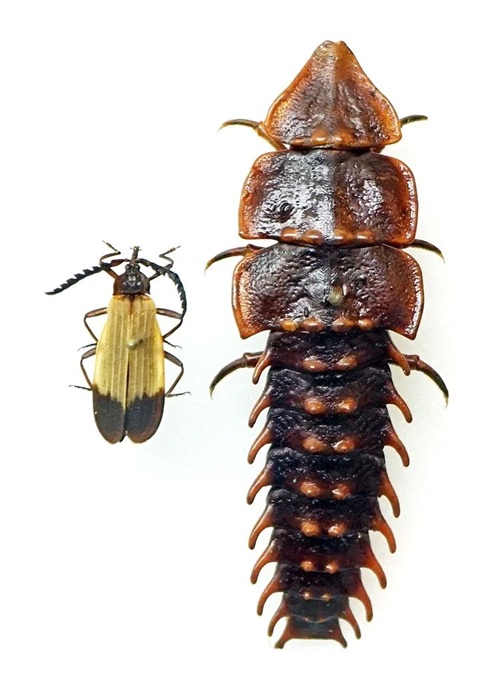
6) For insects like the trilobite beetle, which still undergo a pupation, but then emerge as a larger version of their old self, things are more complicated. It seems they undergo ‘pre-pupation’, where they curl up motionless for several days, still in the exoskeleton of their previous stage, and then shed that to become an adult. They have even managed to perform metamorphosis…on their mouthparts, but nowhere else (and not caused by the old ones being liquified and then rebuilt out of the soup as in the males). Well, they do now have working genitals, though I have no idea how far along their development was in the previous stage. But the crucual thing is that they never undergo a final moult, so their adult form is essentially a highly-active pupa that can feed and lay eggs and from which they never emerge. Presumably treating them with the right hormones could maybe reactivate this final moult, though I imagine it would be fatal.


