Walking along the canal, I see the duckweed is in bloom – Bank-to-bank, a carpet For the mallards’ living room. The moorhens leave a wake of clear That slowly zips together, The swans have clumps upon their prows, And flecks on ev’ry feather.
Rivers are no good, of course, They hurry up their flow – But out on the canal, It teaches how to take it slow. The coots are scooping mouthfuls, And the geese are busy working – But beneath the green and stillness, I can sense there’s something lurking…
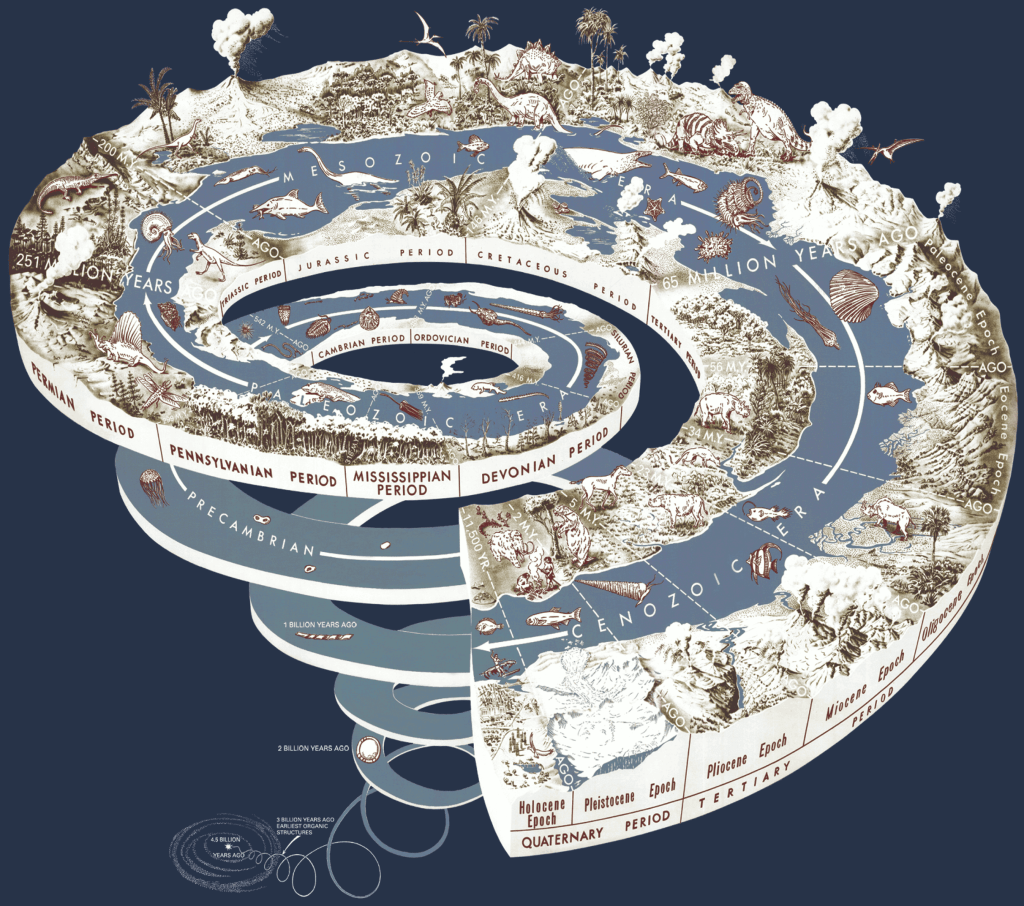
Geological Time Spiral by Joseph Graham, William Newman, & John Stacy
Counting Forwards
Imagine, if we like, To the Earth when it was younger – Let’s go back in our minds As Rodinia accretes and binds. Imagine all the life, With its breeding and its hunger, Is all within the ocean wide, While all the land is dead and dried. Go on back a billion years To when the Tonian began, And the first alga brave appears In the inter-tidal span. And let’s call this Year Thousand in our plan.
Now imagine, if you like, A thousand million later – To Britain, as it will become, Through evolution’s endless sum. Let’s use the past to take a hike, To be our ad-hoc dater – With ev’ry year that we explore That’s adding-on a million more. Ready ? Well then, come with me ! To Year One Thousand, long before, When Vinland Vikings rule the sea And early green specs dot the shore – And let’s see history expand once more.
1000-1280 The Tonian is a long old stretch, From Ethelred to Longshanks. We’re not sure when things happened quite, So none of these are strong ranks, But sponges would appear to appear Around the Fourth Crusade, Just as we leave the Dark Age, As the Boring Billion fade.
1280-1365 The Cryogenian grows cold, As the mediaeval warmth recedes – The plague upsets the status quo, As animals succeed. The monks and fossils leave their records, (Fewer than we’d wish), As peasants rise-up, and the jellies – Both the combs and fish.
1365-1460 The Ediacaran, through the Hundred Years War, Is a pregnant time. The Agincourt slaughter sees new forms of life Are on the climb. We’ve so little idea what, Though likely all the phyla we know Are going their separate ways back then, As the trade and prosperity grow.
1460-1515 Bang ! The War of the Cambrian Roses And Henry Tudor the Trilobite. Bosworth Field is awash with early fish, As eyes first see the light. Predators prey, so the shell evolves, And the codpiece probes the way to dress – And we know so much of those olden times Because of the Burgess printing press.
1515-1555 The Ordovician sweeps the monks away And ends in the great divorce – The Little Ice Age causes mass extinction, Though with a patchy force. Most of the phyla shrug it off, As do the merchants of the day, While plants colonise a whole new world of land, Down Mexico way.
1555-1580 The Elizabethan Silurian Sees vascular plants grow bodice and ruff, While armoured fish develop jaws As Catholics have it tough. The millipedes creep onto shore While Mary Queen of Scots must flee, And Francis Drake sails round the world, While scorpions swarm the sea.
1580-1640 Awaiting the tetrapod armada in Plymouth, Comes the Devonian span – Sharks and ammonites emerge In the Tempest of Caliban. King James writes his Bible On the wood of the early trees, Till the Civil War extinction Brings the shallows to their knees.
1640-1700 With the Carboniferous Restoration, Amphibeans arrive. There’s giant dragonflies in the endless forests, Where spiders thrive. They lay-down future coal, of course, As London is aflame – Till the Glorious Revolution, When the reptiles change the game.
1700-1750 The Permian now joins Pangaea With the Hannoverian line – Dimetrodon and future-mammals Have their chance to shine. But from the North, a Great Dying Sweeps them from their heights – The lava traps of Siberia, And the pikes of the Jacobites.
1750-1800 The Triassic sees a trident of firsts – Pterasaurs, crocomorphs, dinosaurs. The sea’s full of plessies and ichthies and turtles, An empire stretching to distant shores. But American lizards break away From rule they call draconian, And a great extinction’s coming-in That’s all thanks to Napoleon.
1800-1855 The Regency brings us the Jurassic, Victoria sees placentas get birthed, While the Chartists challenge the old big beasts, As the sauropods shake the earth. The allosaurs fight stegosaurs, While archaeopteryx soar above Of the Valley of Death as India splits, On their way to becoming a dove.
1855-1935 The Cretaceous next, but where to start ? Pangea well-and-truly splits, While flowers bloom for Victoria’s weeds, And spinosaurs are Edwardian hits. Veloceraptors perish in the Depression, But T-Rex jazzes the town With Triceratops to the very end, When the asteroid comes crashing down.
1935-2000+ Into the Cenozoic we go, As the atom bomb sees things get hot. Mammals and birds diversify, As hippy grasses grab their shot. Hominids climb down from the trees As Tony Blair brings-down the freeze – Then Christmas Day in ’99 Sees farmers plant communities.
Imagine, if we like, Where our journey goes from here – What might the next long thousand bring To life that’s ever-quickening ? And when extinctions strike, Then new forms suddenly appear. History shows progress all the while, Though fashions change the style. But here, for now, our trek is done, We’ve counted up the years we hold, From an Anglo-Saxon simple son To multi-cultured forms so bold. They tell the greatest story ever told.
Happy birthday ! Yes, it’s true, Rhyming Couplets is turning six, so here’s a special treat for anyone who’s still out there.
Similar to my championing of the Holocene Calendar, I hate counting backwards, and can’t wrap my head around the numbers. Therefore I propose the Paleontology Calendar, which can either begin at 0 (equal to 2,000 MYA) when the Great Oxydation Event was coming to an end, or at 1,000 MYA when the first algae was colonising the land. The latter is more useful, as it results in three-digit numbers rather than four, as we don’t have much evidence for what happened prior to the Ediacaran fauna emerging (they’re not called the Boring Billion for nothing…) However, I’ve adopted the former here so that the dates can line up with European history to make conceptualiseing the events easier, at least for me. By happy coincidence, 1000 MYA is also when Bicellum first appears, which might just be the earliest evidence we have of animals evolving away from algae…
Note that all dates prior to the Cambrian are tentative and likely to change in the future. Just when the animal phylums diverged is unclear as there are very few fossils, and rely on DNA analysis and molecular clocks. Furthermore, the current estimated dates may be a few years different from their historical counterparts for the sake convenience (for example, some think that algae first poked its head out of the water as early as 1200 MYA). Come on, this is a poem, not a textbook !
Beavers are thievers, By stealing the gravity Out of the water – Such utter depravity ! Beavers are stemming our streams With their half-inched beams, And leaving them pooling around. And now I hear beavers Are back in this manor, Those peevers and planners Are channelling London Town. I see their toothmarks Graffiti the tree barks Up to their old larks, Of gumming the plumbing – Their home is a slum Full of mildew and scum, And whenever they come They leave the bath running.
Beavers are weavers, When heaving their timbers, When lugging their tinder for cleaving together. You just won’t believe All the leaves they retrieve For their bodge for a lodge And their damnable dam. These immigrant skeevers Are tree-rustling reavers – Who knocked-up a hodgepodge Wherever they swam. We end up with either The swamp in a fever, Or banks in a stodge And the brook in a jam. But now that they’re Cockneys, And vegan beefeaters – These beavers won’t shock me a smidge. So change-up the meter, and take to the bridge –
They’re teeming in the borough, good and thorough, Down the Central Line, Grinning with their teeth on Hampstead Heath, And in the Serpentine. It won’t be very long And they’ll be seven thousand strong, With their ev’ry one a carrier Of oak and London plain. They’ll get their sapling shredding done From Wapping up to Teddington, By blocking Woolwich Barrier And flooding Pudding Lane.
Beavers are thievers, And duckers and divers, And cunning deceivers, And wetback survivors – They’re just like the rest of us, London domesticus, Hard-working strivers, And over-achievers. And soon they’ll fit right in, I’m sure, In the melting pot of the pond next door.
The real question, of course, is how do beavers colonise new rivers well away from the old ones? Some say they can travel over land for many miles, but we all know the truth – they’re carried there by red kites !
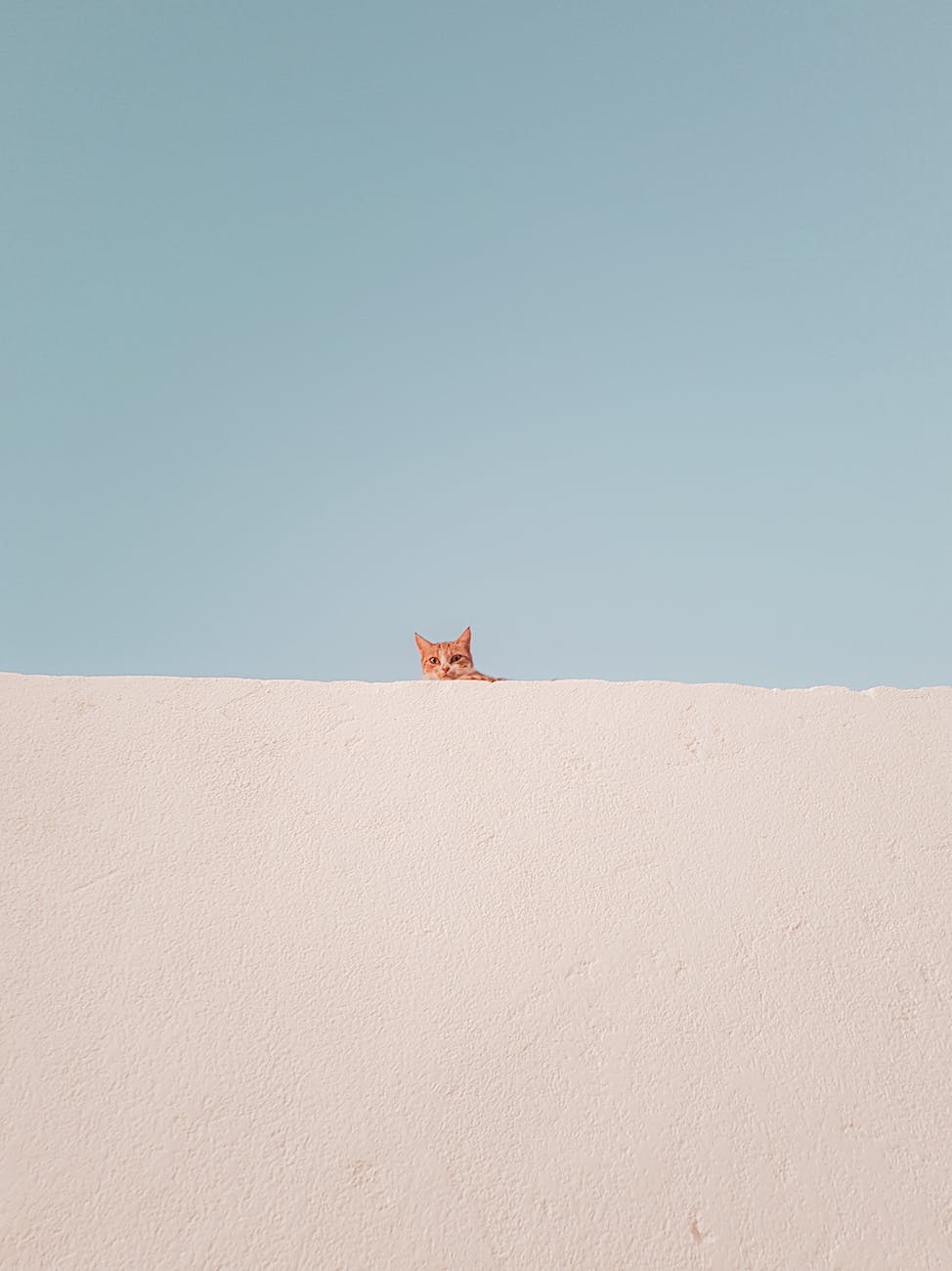
Not all cats are playfully aloof, Or queens of household staff – There’s some will never steal the show In fairytale or video. And likewise, on the busy midnight roof, They’re just some riff-a-raff – While toms compete and loudly brawl, Some kits can barely catawaul.
Not all cats are masters of their strut, Or lords of backyard realms – For some are timid, peeking out From under sofas, wracked with doubt. They know they’ll never truly make the cut, Their poses underwhelm – And so they snuggle-up indoors Where we protect them from the wars.
The first lone mayfly of the year, And Spring is on the go – Looks like the merry month is here As evenings make a show. The bulbs give way to tardy blooms While cuckoos boast their song, And mayfly brides greet urgent grooms – For Spring won’t stay for long.
The Catholics do it ev’ry Friday, Or so they often claim, The Protestants, only during lent, Attempt to do the same. While unbelieving heathens such as I May join-in, if we wish, But just as an excuse, in the event, To share some tasty fish. We only seem to think of it in my day, Just as Easter comes. But still, the start of the weekend is well spent In batter or golden crumbs.
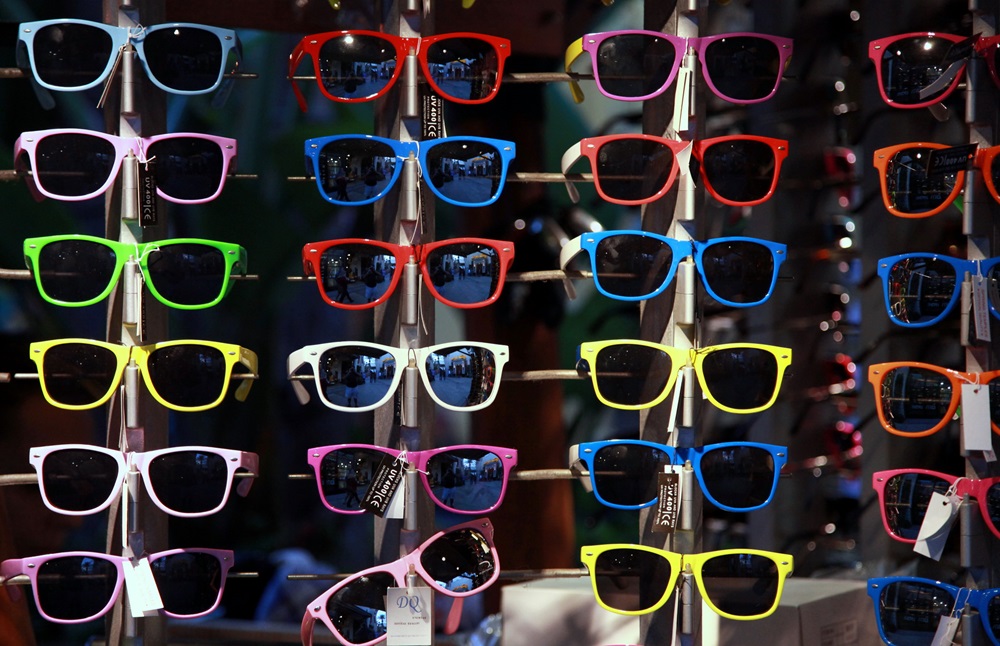
English sheepdogs, Highlands cattle, Marbled corneas in snakes, Stalk-eyed snails with pop-up headlights, Caterpillar eyespot fakes. Staring cameras tend to rattle, Black-walled, with a glossy sheen – So mask them, yet still feed them light, With eyes that see yet can’t be seen. So wear a pair of shades ? Sure, that’ll Make all nature look so cool… If only ancient life had bred right, We’d now be inscrutable ! Vision is a constant battle, How to let the photons in ? Yet we all see the infrared light Not through eyes, but through our skin.
Quetzelcoatlus, how did you fly ? By gliding on thermals ? Rarely flapping ? How did you launch your bulk to the sky ? And your massive head not handicapping ? Could you be becalmed ? Or even be-galed ? If the breeze were too strong, could it blow you over ? For every take-off, how many failed ? Were you more a hopper than cloud-top rover ?
Quetzelcoatlus, how did you fly ? When the zephyrs tugged you, how did you cruise them ? No point to ask evolution why – For you only grow wings if you need to use them. Could you be grounded ? Or just never land ? Soaring the oceans, wind in your hair ? Did you make runways along the strand ? The answers, alas, are up in the air…
By ‘wind in your hair’, I’m referring to their proposed feathers.
And since there are five of them shown above, should the painting be called Quatzelcoatli ? No. No it shouldn’t, as I’ve discussed here.
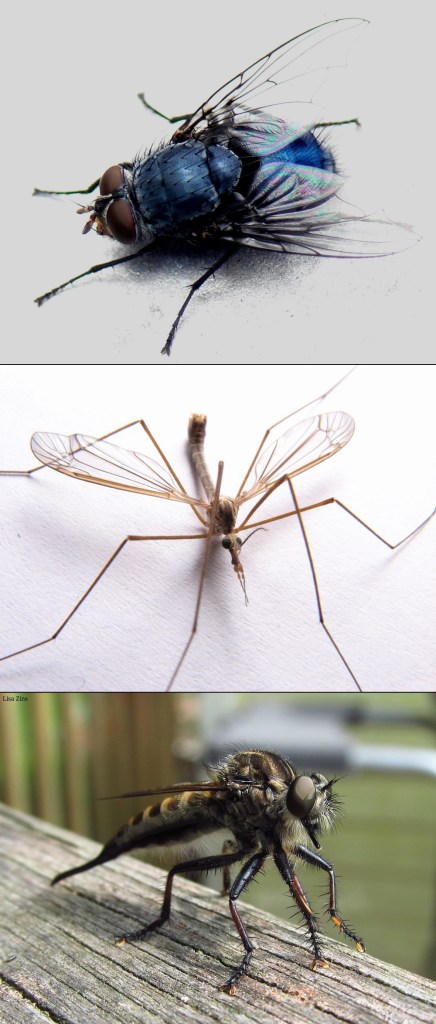
Compared to a tiny tiny fruitfly That we barely see, A bluebottle blowfly is a shiny guy, At half-a-bee. He must be big, because He is born to make a buzz – To-and-fro, darting, wheeling, Watch him go. Small enough to hang-out on the ceiling, Yet large enough to bounce against the window. My my, What a fly ! What a glow !
Compared to a tiny wee mosquito That we only hear, A cranefly is as silent as it’s slow, And nowt to fear ! Their leatherjackets may Be skeeter-eaters in their day, But there’s no meat on the menu Once they grow. And how they grow !, these slender-friends, These stilted-striders, palm-wide gliders, Gone in just a mo. My my, What a fly ! Magico !
Compared to a tiny tiny dancing gnat Within a cloud, A robberfly is big and fat, And ludicrously loud ! Aerial assaulters, Whose cheerleader-halters – Beat like a motorbike Or dynamo. With mouth-pike and bug-eye – Each giant part in all its art is big enough to spy – And what a show ! My my, What a fly ! Now you know.
There are plenty of people that will tell you that crane flies are not mosquitos and they do not eat mosquitos. They are wrong on both counts (for a given value of mosquito – they are certainly more closely related to each other than either is to a housefly, but they still went their separate ways way back in the Jurassic.) Most adult crane flies have no mouthparts at all, and their larvas are mostly vegetarian. However, with over 15 thousand species, there are always a few edge cases where the leatherjackets do sometimes eat those fidgety question marks that are mosquitettes.







 Rhyming Couplets