How the Curlew got its Curl

Long-Billed Curlew by Mike’s Birds

How the Curlew got its Curl

All the Summer, she shelters in her studio,
Under the North-sent light,
As she’s painting a curlew, a bird of the Winter,
That, like her, flees when the Sun gets bright.
She starts in April, starts from the tail-quills,
Nothing but browns and creams –
Slowly works forwards as evenings grow later,
Until she can hear its call in her dreams.

At five-times life-size, her bird is a monster,
A beautiful giant of the fens –
With every barb of every feather,
More real than in any photographer’s lens.
So unlike the shy things they are, them and her,
Avoiding the seaside crowds –
They to their moorland, her to her studio,
Waiting for the safety of the huddle’ing clouds.

By the late of May, she’s mottling the wing,
By June, she’s glinting the eye
By the height of July, she starts on the beak,
As the burning Sun is stoking-up the sky.
Inch-by-centimetre, longer and still longer,
Polished to perfection as she goes,
Longer than a godwit, longer than an avocet –
This beak is magnificent, and still its black arc grows !

All through August, she’s stretching it out
With the windows wide-open from dawn,
Bringing-in the songs of the blackbird and the goldfinch –
But the curlew cannot sing until its bill is fully-drawn.
Till finally, finally, it tapers to infinity,
Just as the September cools the air.
She locks up her studio and heads out to the marshes,
As the North-sent breezes blow the cobwebs from her hair.

This poem was inspired (but is not directly about) this painting by a friend, Anna Clare Lees-Buckley. She specialises in birds, but unlike the subject she doesn’t master in reclusivity.

Dino-Golf

Dino-Golf

A T-Rex guarded the first hole,
As we played a round by the beach –
Over the hump and round the bend
With a club and a scorecard each.
Fibreglass limestone hemmed the links
With fossil ammonites –
While bubbling streams built future cliffs
As they laid down chalky whites.
Triceratops was present, of course,
And cute troodontids too –
We admired their feathers as we let
Another pair play-on through.
The rough was an abandoned nest –
The eggs gave a tricky lie.
A pterosaur looked-on unimpressed,
As my ball refused to fly.
The sauropod was a juvenile,
The size of a family car,
And anchylosaurus raised her club
As I came in over par.
But the twelfth showed the first sign of trouble,
With a draught through the plastic swamp
To shake the early magnolias,
As I teed-off with a whomp.
The fifteenth had a river of lava
Splitting the fairway in half –
A pachycephy furrowed his dome,
As I took a photograph.
The seventeenth was watched by several shrews,
To no concern.
They looked-on patiently as we played,
Content to wait their turn.
And then, crowning the final hole,
Was a crater upon the green –
Only a metre across, but still,
Here comes the Paleogene…
As we finished our round at the end of the world,
It felt like the nick of time –
Then back to the seagulls along the Prom,
And an ice-age ninety-nine.

All Chalk, No Cheese

All Chalk, No Cheese

Cowes, atop the Isle of Wight –
East and West, though much the same –
Victorian and seaside-y,
With boats and seagulls running free.
And not a single cow in sight –
No running of the bulls – for shame !
No fording droves between the piers,
No cowboys showing off their steers.
And don’t come here in Cowes Week, right !
It doesn’t live up to its fame !
It’s not the time when bullocks battle,
Not a trace of rutting cattle.
Why then whet our appetite,
To wastes its strange and lively name ?
There are no bovine sacrifices,
Just cream teas at tourist prices.

I know, I know, despite a spine of rolling chalk downs through the Island, Cowes itself sits atop clay…

An Estate of Builder-Birds

House Martin Nests by Mike Prince

An Estate of Builder-Birds

Late-on in the Spring,
We’ll see the house-martins come again –
In stylish black-and-white,
And darting back-and-forth about the lane.
They’re patching up their daub-and-wattle nests,
The ones they left behind –
The Winter muck is jettisoned,
The inside cleaned and freshly lined.
Are these the very birds we saw last year,
The self-same mums and dads ?
Or are these now the chicks they hatched at home,
Inheriting their pads ?
Though ev’ry year, I swear,
They build another house beneath the eaves,
And often touching in a terrace,
Neighbours watching out for thieves –
And those would be the sparrows,
Feckless squatters in these high-rise flats –
A better prospect than the hedges,
Safe from cuckoos, frost, and cats.
Hoping to be laid-and-fledged
By hanging-out in hanging-domes,
Before the grockles fly in for the season
To their second homes.

Who is the Martin whose house these swallowets build ?  The OED postulates that it is a contraction of Martinet, but that that in turn is a diminutive of Martin.  Or it may be from a Latin term for a kingfisher.  Or a bit of both – never underestimate the power of conflation.

Look to your Lesser Linen

Red Kite, photographed by Tim Flach for a 2019 Royal Mail collection

Look to your Lesser Linen

Red kites are as red
As golden eagles are golden,
And seen against the sky, they’re just as black.
But there’s no mistaking that forking tail
And fingered wings on which they sail,
As slowly they embolden,
Advertising how they’re back.

Just when Milton Keynes was thriving,
So they were released upon
Our unsuspecting hills and country towns –
From Chiltern ghosts to national fame,
So barely-flapping, barely-tame,
From Leighton Buzzard to Ducklington,
From Salisbury Plain to the Sussex Downs.

They breached the M25, of course,
And rode the tarmac thermals on,
Lazily and low above the brownfields and the parks –
Ev’ry year they’re getting closer
To the busker, judge, and grocer,
Hamstead Heath and Kensington,
Beneath their ever-wider arcs.

These eagles of the suburbs
Are circling over school-run traffic,
Just above the High Street rooftops, watching us all day.
The City has its peregrines,
But those are rare and tiny things,
But these commuters are so graphic,
Newly neighbours here to stay.

Picking up the roadkill,
Perching on the weathervane,
Weaving litter into nests, and drinking from the overflows,
Stealing produce from the barrows,
Scattering the cockney sparrows –
Maybe London once again
Shall be a town of kites and crows.

Thunder Thrush

Blackbird & Nest by Harrison Weir

Thunder Thrush

“Cuckoo eggs are able to mimic dozens of other songbird eggs, but each female can only lay one kind.”
                                                                              – The Titchfield Twitcher

The first cuckoo of Spring,
And the war is about to begin agen
For the dunnock and robin, the pipit and wren –
But the blackbird nests at leisure
Knowing her treasured eggs are secure –
She’s fought and won this battle before.
For cuckoo hens must lay their eggs,
Their undercover powder kegs, to match
The very nest from which they hatched.
So daughters follow mothers and grans
In their taste of prey that spans way back –
A family tradition in attack.

But not the birds in black.
They know an egg that’s out of whack, alright –
Imposters tossed on sight.
As for the parents, lurking still,
They’re pecked and mobbed until they quit –
A tougher host by far than finch or tit.
Thus all the cuckoos with the genes
To burglarise the forest queens have gone,
Wiped out, were rumbled in their con.
So when these gothic thrushes hear
That goading call – no fear, no doubt –
They just sing louder yet to drown it out.

Estuary

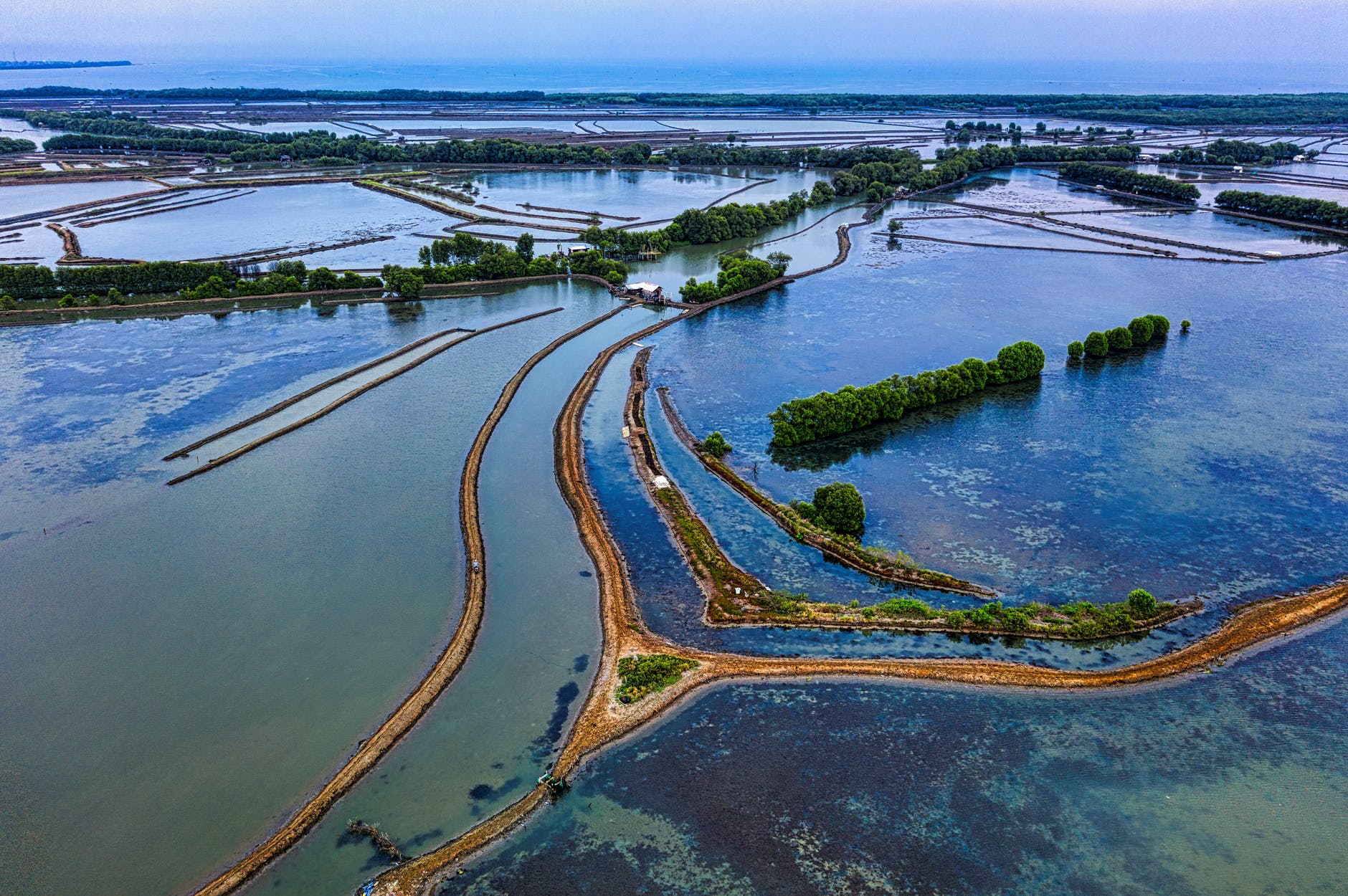
Photo by Tom Fisk on Pexels.com

Estuary

Downriver, below the final bridge,
The last of the swans patrol –
To meet the early terns, who reach
Only this far from their native shoal.
Passing strangers, side-by-side,
Sharing the brackish tide.

Up-ocean, above the muddy flats,
The first of the mussels are found
To meet the sticklebacks and sprats,
On the down-stream, up-bore bound.
Passing currents, slow and wide,
Sharing the brackish tide.

Cornucopia

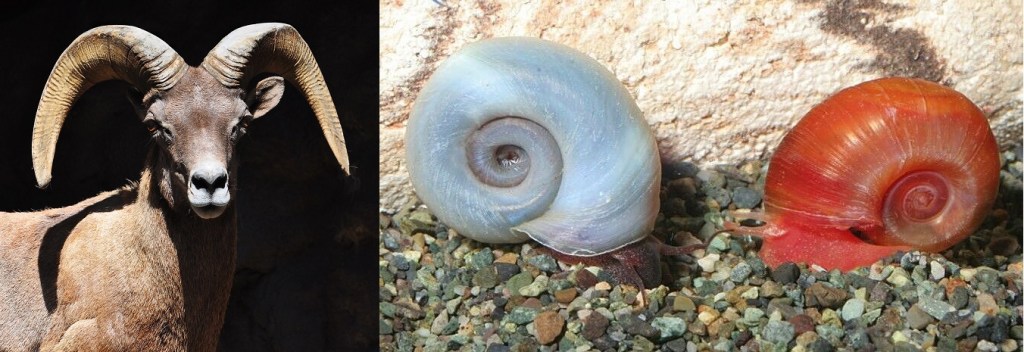
Desert Bighorn Sheep by Bill Gracey and Two Ramshorn Snails by Destroysoil

Cornucopia

Ramshorn snails with ammonite shells,
A spiral without a hint of a helix,
They’re more like a wheel than a pyramid, I feel,
All adding variety into the mix.
Some look drunken with sideways shells,
Half flat-on-their-backs and half falling-off
Like a coil of rope – but they seem to cope,
And it’s still a home, and we shouldn’t scoff.

And honestly, they’re shaped much more like a ramshorn
Than any ram’s horn, which is more like a corkscrew –
Though any shepherd could tell you with scorn
That some horns’ spirals leave gaps you could walk through.
Unlike the snails, those geometric purists –
And yet they’re just tourists in the twist of fate –
They barely take a turn and let the helter-skelter churn,
Yet rams’ horns grow ev’ry which-way but straight.

But I know what you’re thinking: what about the hermit crabs ?
What of it will spring-loaded scavengers make ?
Will they recycle these torus-shaped slabs,
Or are they afraid that their body-skew will break ?
Is such shelly symmetry unnecessary gimmickry ?
Or circular efficiency for streamlining’s sake ?
Much better suited than the filigreed or fluted,
Or the messy-convoluted coilings of a snake.

Ramshorn snails with ammonite shells,
So ambidextrous in their twisting –
Easy gliders or top-heavy sliders ?
Some are upright, and others are listing.
If snails have ramshorns then rams have crownhorns,
The biggest ones worn by the king of the dales –
And even when shorn, it becomes a shepherd’s cornet
To warn us of the wolves or the thieves or the snails.

A Halcyon Vision

A Halcyon Vision

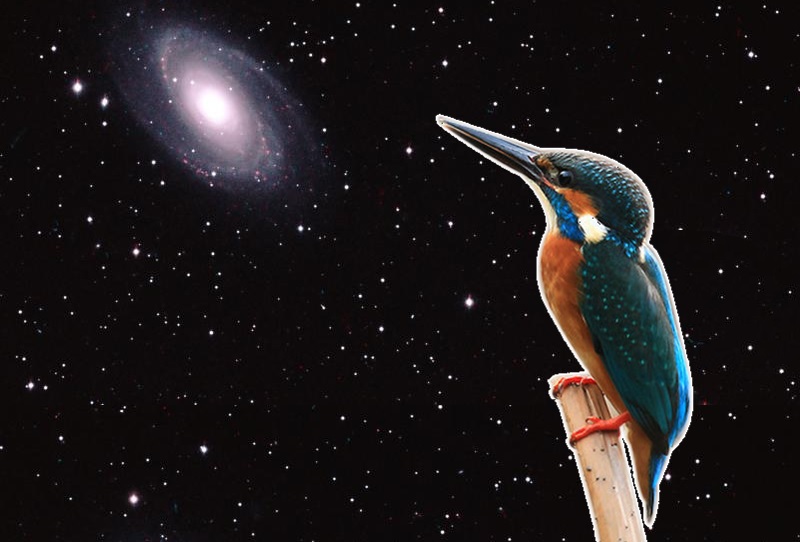
A kingfisher glints like a galaxy,
We only see where he used to be –
A flash of white, a swirl of red,
But when we look again, he’s fled.
When searching with a lens, or two,
He’s there, he’s gone, a cloud of blue –
We scan the verge where the sparkles play,
As he dances in and out of the Milky Way.

Mockingbirds

Mockingbirds

OO is for Hoopoo,
U is for Duv,
O is for Swon and for Folcon, my luv.
H is for Wooper,
F is for Chuff,
Z is for Fezzant, and pritty enuff.
N is for Natcatcher,
K is for Kwail,
J is for Pijjon, who’s bringing the mail.
I is for Ider,
R is for Ren,
T is for Tarmigan – ta-ta, my hen.