A sunfish may look like a sun, And a starfish like a star – But both are fake, for the only one that’s real – The starriest fish by far – Is not some Milky Way-long eel, But Cetus – the stellar monster gar – He’s bigger than Cancer, older than Pisces, Swimming the span of the sky high seas.
We’ve ringed the noses of our bulls Since the days of ancient Sumer, And blinged their ears with tagging tools Since the reign of George the Third. And sheep we’ve daubed with bright and dark Since Beau Peep was in bloomers, And likewise branding’s left its mark Since pharaohs watched the herd.
And long before the Roman Legion, Pigeons wore a metal tumour Round their ankles, through the season, As they carried vital word. And falcons showed their noble’s farms – And scientists confirmed the rumour Of migration, through the charms They fitted to each bird.
One deer, two deers, That’s how or should be – Mixing with the fishes and the sheeps. Red deers, roe deers, Two-by-two, or sometimes three, If fallows really are at home for keeps. Muntjacs and sikas, Followed fallows over here, And water deers are plurals now, it’s true. For us native speakers, We won’t raise a pedant’s tear If all of them get ess – and mooses too !
She has the memory of a goldfish, In that she remembers pretty well. She is a frog in a warming dish That knows it is no place to dwell. And she’s a giraffe who loves shut-eye, An ostrich with her head held high, A colourblind bull when the red rags fly, And an old wife with new tales to tell.
There ! A steak of white ! Let’s see…that’s one. Now was it large, or small, or green-veined ? Oh, what fun ! And there ! A brown of some sort – Could be meadow, heath, or speckled wood – But it’s clearly brown, I’d say, If that’s much good… A flash of red ! An admiral ? A tortoiseshell ? What’s going on ? Let’s take a closer look, But no, it’s gone… Wait, was that one the same That I tallied over there, As it circles round the garden ? That’s not fair !
Spiders have eight, and box-jellies twenty-four, Scallops have hundreds, and dragonflies thousands, And digital cameras even more ! But vertebrates make do with two, Plus the odd ocelli peeping-through – But only a couple of retinas – A pair of light-bucket dishes – Well, except for a few strange fishes ! And I don’t mean the four-eyed anableps, Who see through both the water and air, And focus the light through diff’rent steps But onto the same old patch of cells, That parallels the ones we chordates share. No, I mean the brownsnout spookfish – They may not look as swish as barreleyes, Until we realise that here may be The ancestor of a whole new tree Of multi-looking vertebrates to arise – That one day may just populate The future Earth with their future eyes.
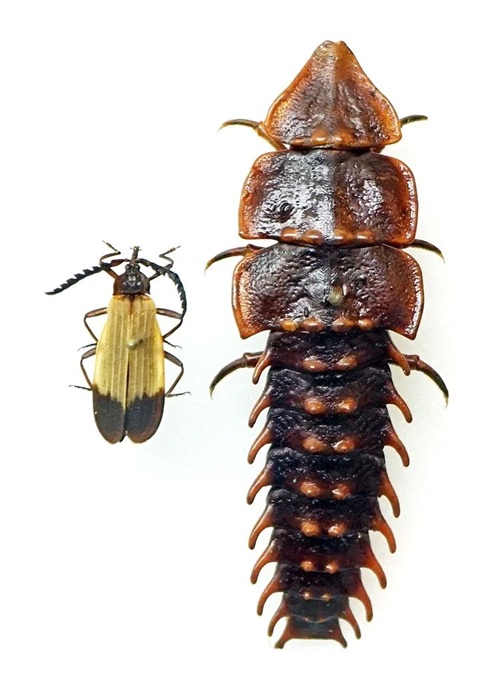
Trilobite beetles, showing the adult male (l) and adult female (r)
Larviform Females
Larviforms are ladies who remain forever young – As they climb-up through the instars but won’t reach the highest rung. So they stay as grubs or maggots or as caterpillar bags, Where these slow and wingless-women are such lazy lallygags. Most will still pupate, but then emerge as they went in – Or at least upon the outside, though their innards had a spin. So they still have genes for adult-forms they’ll never get to wear, But they do tend to be larger than the chaps, so plusses there. I guess it works for them, as long as blokes can come and find them, And they get on with the job that evolution has assigned them. So they’ll never get to fly, but still their shells are looking smart – Maybe larviforms are ladies who are just big kids at heart.
Larviforms are a kind of neoteny, which I’ve discussed before. But it’s interesting to imagine how this might have evolved. I can see the following occurring:
1) The genitals develop early, in the final instar before pupation. But this won’t help much if they can’t attract a mate… 2) The adult pheromones subsequently develop one stage early as well. These two steps could be reversed, and might actually be hormonally linked, meaning a change to one will also change the other. However, they are both needed before the final instar can lay any eggs, unless… Alternate 2) The insect is/becomes parthenogenic – popping out clone eggs of herself without need of a male. 3) The instar still undergoes pupation, because this is pre-programmed. 4) The imago emerges as a regular adult and carries on reproducing.
5) A subsequent mutation causes problems with the pupation, but since the larvas have already laid some eggs, it isn’t catastrophic (at least on a species level, though not much fun for the girls involved…) But I don’t think that there has been any extensive research into the failure rates of pupas due to developmental issues, as opposed to predation. 6) For insects like the trilobite beetle, which still undergo a pupation, but then emerge as a larger version of their old self, things are more complicated. It seems they undergo ‘pre-pupation’, where they curl up motionless for several days, still in the exoskeleton of their previous stage, and then shed that to become an adult. They have even managed to perform metamorphosis…on their mouthparts, but nowhere else (and not caused by the old ones being liquified and then rebuilt out of the soup as in the males). Well, they do now have working genitals, though I have no idea how far along their development was in the previous stage. But the crucual thing is that they never undergo a final moult, so their adult form is essentially a highly-active pupa that can feed and lay eggs and from which they never emerge. Presumably treating them with the right hormones could maybe reactivate this final moult, though I imagine it would be fatal.
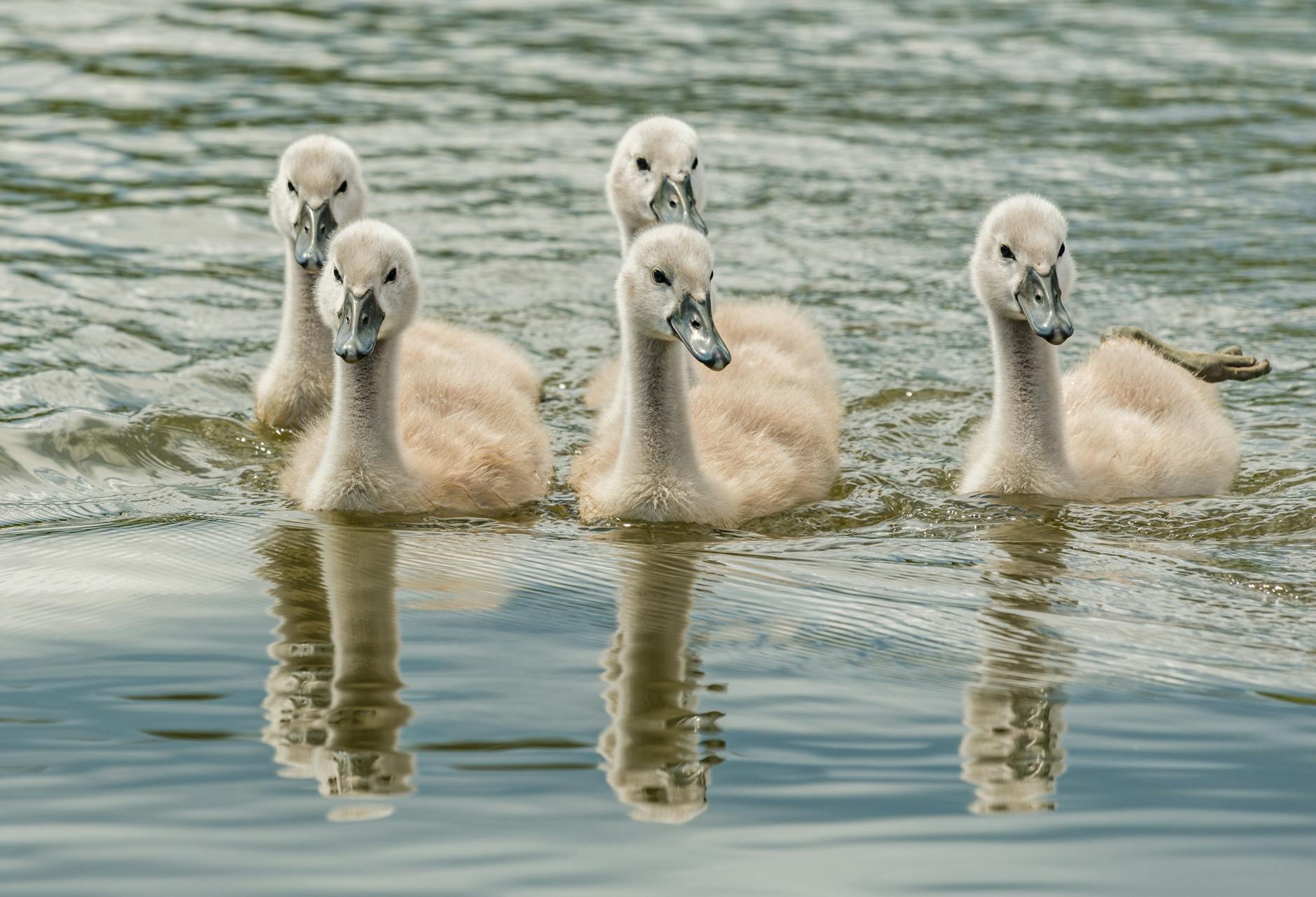
The pair of swans along this stretch this year Haul ten in tow. Ten grey balls of hatchlings in a row. Yet in a month or two, I fear That only five remain – As pikes and gulls and foxes thin the strain.
In the past, my ancestors would breed The same way too – Investing in the odds to see them through. Famine and TB could not succeed, For I am here today – Yet dread how many died along the way.
For months the swans will teach their young, But still their numbers drop – They surely notice what they cannot stop. Of all the ten that they’ve begun, Just one or two will fly – It’s no life for a parent, but they try.
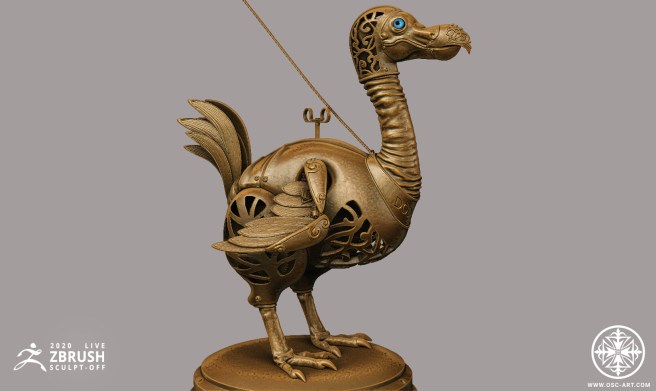
Dodos are dead, but are they as dead as a dodo ? They ain’t no doornail, sure – How can they be dead in toto ?, We’ve all seen the photo From some exhibition or tour. Cos even extinct, we’ve still got a load of them stuffed, Displaying their strange allure. So though their species is cuffed, They’d be pretty chuffed If they knew how they still endure. See, dodos have fostered a posthumous fame, They’ve entered our public lore – The Quasimodo of hubris and shame, They’ve stepped up their game To embody the perfect metaphor. So dodos are dead, but their digital DNA code Lives on in a lab, still pure. Maybe some day, we’ll get it to load And be bestowed By dodos who finally found the cure.
for completeness, here’s the original image in full.
The Teacher of my prim’ry school, Had a class terrarium – I used to think it far more cool Than an dull aquarium. What was in it ? It wasn’t ants, Or butterflies, or bees, Nor stick-insects on potted plants, Or circus-ready fleas. Woodlice would be far too small, But these were large as brooches – And the Head had ruled out, I recall, Tarantulas or roaches. I do remember chirping, But I don’t think they were crickets – Rather, they were something lurking, In their tank of wood-chip thickets. Very shiny black, they were, And safe for us to handle – The kind of pet the schools prefer, That wouldn’t cause a scandal. Ah yes, they were bess beetles ! And the best beetles around. They were so pretty, yet discreet, When burrowed in the ground. They lived their lives on rotting wood, With their not-so-many grubs, Which they cared for like a parent should – By giving belly rubs. And they’d recycle wood, as well And clean the forest floor – Whenever they were low, it fell to me To give them more. The Vicar, when he came to school, Just loved to point them out – He found they were a useful tool To help us be devout. Even the fathers got involved, As their kids reached adulthood – It seemed these insects somehow solved The trick to being good. These were godly creatures, he would say, Almost Confucian – He never mentioned how they came that way Through evolution. Or how they’d eat their excrement, their frass, To redigest. That wasn’t the sort of thing for class !, And wouldn’t be on the test… Me, I loved to handle them, They never bit or scampered. Even their young I couldn’t condemn – Those maggots plump and pampered. And they even sang to them, soft squeaks, And lived a year or two. In insect terms, these guys were freaks, Yet ev’ry bit as true. Bess beetles, betsy bugs, These patent-leather passalids – All wrapping up their larvas snug, To help pupate their kids. Industrious, yet safe and pure, In their tight-knit family – There’s a metaphor in there, I’m sure, But it was lost on me.