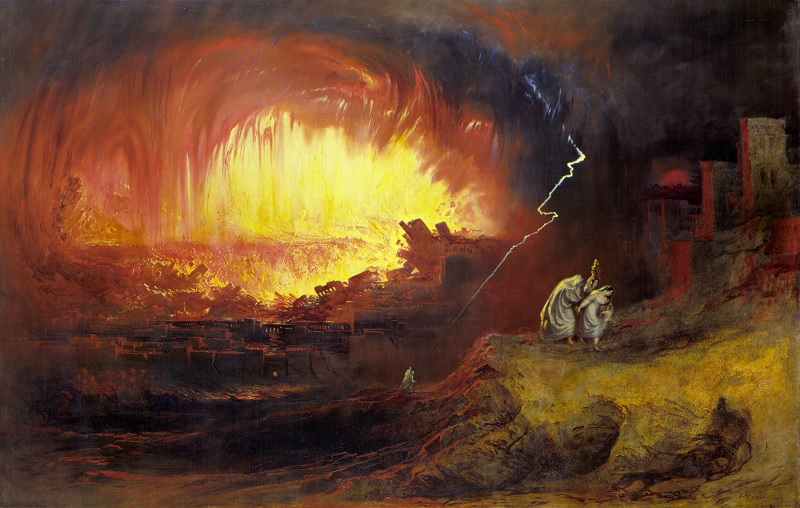
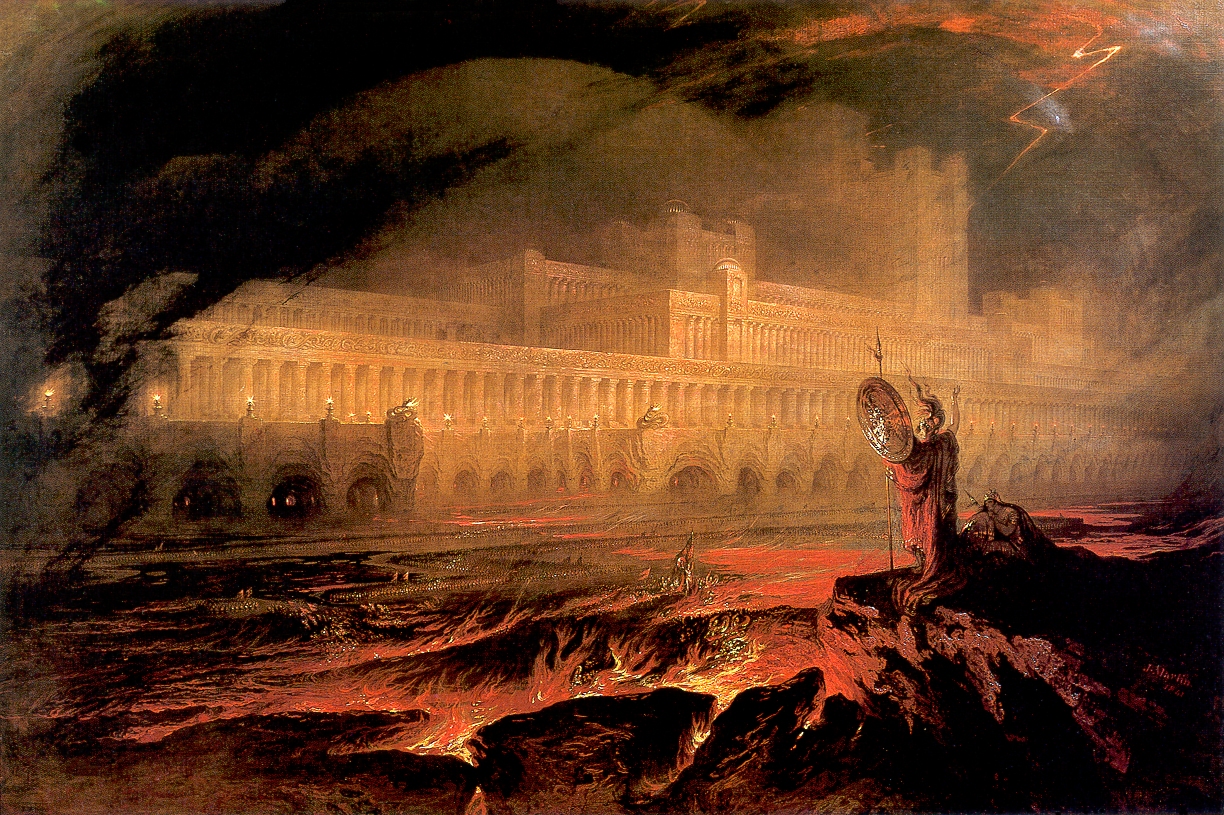
The Destruction of Sodom & Gomorrah by John Martin
A Walk Through the End of Days
I never thought Catastrophe Would be as beautiful as this, That Ragnarok at sunset Is a moment of such bliss. So peaceful is Apocalypse, So languid is the End of Time – The Armageddons come and go, But were they ever this sublime ?
So come, my dear, Come and let us stroll awhile, To seek the lesser-spotted troll That builds its nest beneath the stile, As angels circle with the hawks, And demons gad on Sunday walks, And banshees squawk and phantoms play And the Ending of the World’s a world away.
We’re told and told we’re living through The cataclysmic Final Days: Where wrath is wrought on wretched waifs Who sup with Jews and gays. Yet brimstone seems in short supply, And so too human sacrifice – Just people getting on with lives Amid the unseen Antichrist.
So come, my dear, Come and let us wend a path That takes us further round the bend To promised bloody aftermath. Let’s walk with blacks and greens and reds Before the sky falls on our heads, And, hand-in-hand, let’s thread our way Through the law-abiding wastes of Judgement Day.
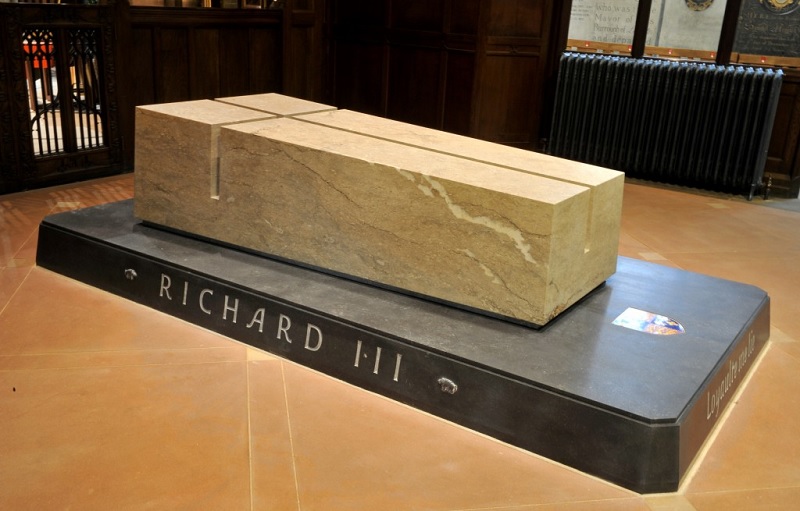
A long-dead king has gained a sponsor, As he gets re-buried in state A tyrant, if not quite the monster That the Tudors would create.
But wait – We’re missing the beauty here, Amid the pomp and lack of debate: It’s not in the marble, or toady veneer, In a minster of the second rate.
So a long-lost king was dug out of the ground – So what ? But how do we know whose bones we’ve found Despite long centuries years of rot ? That is the beauty we’re missing, I say – The beauty of DNA !
It shows us just who’s our forebear or grandson – And surely that’s all worth a king’s ransom ! And where were such secrets first teased from their source ? Why, right here in Leicester, of course !
Charlemagne, Charlemagne, where did you go ? Where is your kingdom and afterglow ? Where is the Bede now, or Alfred the Great ? Wherefore the burgeoning Byzantine state ? What of iconoclasts spoiling the feast ? What of the Slavs who are ruling the East ? What of the Vikings’ unstoppable force ? Just when will Lindisfarne fall to the Norse ?
Three hundred years, and none of it happened. Three hundred years, and all lived in one day. All of that history, artwork and trappings Are nothing but forgeries, fooling away. Nothing but myths and mistakes in the dating, With stories conflating, And years gone astray.
Charlemagne, Charlemagne, where is your reign ? Where are the Arabs all storming through Spain ? Where are the monks and the plainchants they sing ? When will they bury the Sutton Hoo king ? Where are the famines and smallpox and worse ? Where is your Beowulf writing his verse ? Where are they building their towers of bells ? Where are they gilding the Vellum of Kells ?
Three hundred years, and none are correct – Just three hundred years in the stroke of a pen. All of that history – tattered and wrecked – It’s either invented or happened elsewhen. Nothing but legends and lack of hard data, To make us all later, millennial men.
But three hundred years… How many lives in those three hundred years ? How many folks with their hopes and their fears ? How many lovers, and soldiers, and seers ? We shouldn’t ignore them, we shouldn’t mistreat them, Or else we’ll be doomed to forever repeat them.
The Phantom Time Hypothesis is a conspiracy theory that purports that the period of history in Europe between HE 10614–10911 did not actually exist.
Complete bollocks, of course. Take away those years and the positions of the planets and the dates of eclipses as recorded in antiquity, and calculated backwards from today, wouldn’t line up. Oh, and the ancient Chinese would have to be in on it as well.
The ancient Greeks were pretty clever, Worked out that the Earth was round From shadows cast by poles at noon And by the Earth upon the Moon, And how the sky was put together Just from watching from the ground, And some who guessed a central Sun About which all the planets run.
But then along came Aristotle, Then along came Ptolemy – And they alone would set the tone Till their mistakes were set in stone. The hand is dead, but still can throttle, Piously and solemnly, Of any thought that might get out – So hush the whisper, choke the doubt.
But still, but still, The more we looked, the more we saw – The though the heavens mostly draw Upon the Ptolemaic law, They sometimes would exert their will That rubbed enquiring watchers raw.
You see, the ancient Greeks well knew That crystal dome and ev’ry gem That all the night, without a rest, Would wheel above from East to West. And like the stars, the planets, too – Though slower, losing ground on them. Except…well, that’s where trouble lies, With yearly yet unruly skies.
Because they each would switch their motion, With the stars, and overtaking ! Week by week, the Greeks would trace The way the planets dance and race. So Ptolemy proposed a notion, Saved the universe from breaking – Sure it was all fudge and spin, But epicyles for the win !
But here’s the thing – For all its complex shells and reels, For all its windmills within wheels, It somehow kinda always deals With accurate positioning, As though the sums would guide their heels.
So if the Greeks were badly off, Well, spare that scoff – they did their best With nothing but a pair of eyes To theorise what they can’t test. But did they ever pinch their gaze And mutter at the tangled ways In which the heavens spend their days ? Did even Ptolemy have doubt And long to hack the deadwood out ?
The Romans, though they changed the names (From Krios, Aries, from Ares, Mars), They kept the skies just as before, For fourteen hundred years or more. And though the planets’ little games Were thought as written in the stars – A monk proposed a new appraiser, Slashing bunkum with his razor.
Simple answers, they’re what matter ! Less is more than meets the eye – If two proposals have to fight, The simplest one is often right. And all those epicycles clatter With a clean, efficient sky – Forget the Church and ancient stuff, Copernicus has had enough !
And yet, and yet, Despite his perfect circles round His central sun, we quickly found Like Ptolemy’s, they ran aground, Till Kepler and ellipses met – And suddenly, the maths was sound.
Truth be told, Copernicus Had little proof on which to base His unbound Earth and steadfast Sun – In faith alone, his planets spun. But still the world must turn, and thus, Young Galileo took his place – Perhaps with fewer facts than hope, But this time with a telescope.
And in the eyepiece, clear as night, The moons of Jupiter were seen – As though the planet gave them birth – And not in orbit round the Earth ! And better yet, the startling sight Of Venus phasing inbetween A smaller full and larger new – And then the revolution flew !
So here’s the thing – With claims of modern matter dark, And energy with unseen spark – Has it the proof of string and quark ? Or do they chase around a ring To make the model fit the mark ?
And like Copernicus, they could be right, Despite a lack of evidence. Or like old Ptolemy, they could be wrong, Yet strong in their defence – His theory held up, truth to tell, In matching observations well – But oh, it was a complex hell ! So scientists, and heaven-gazers, Never lose your sharpest razors !
Carved heads in the Great Hall at Hampton Court by Richard Rydge, photographed by little_miss_sunnydale
No Man’s Pie is Freed from his Ambitious Finger
The Tudors – always the bloody Tudors ! I’m sick of the Tudors, sick of their tricks – Bloody Marys and bloody Henrys, And bloody Bess and her politics, And wimpy Eddy, and snow-white Jane – Tudors bloody Tudors – since I was six. Papists in priestholes, Proddies in the Tower And the heroes end up dead and the villains stay in power.
Ev’ryone’s a bastard, Anyone who’s Tudor – Henry’s shagging ev’ryone, But Bess, no-one has screwed her. Both have shafted England, Made the whole place prude-er.
The Tudors: bloody Tyndale and Shakespeare, The bloody Armada and Raleigh and Drake, The bloody plots and the bloody spies, And witches burned at the bloody stake, And Irish, Jews and Gypsies shunned – Nasty bloody Tudors – more than I can take ! Monks changing habits and monarchs swapping spouses – A-ring-a-ring of roses and a plague on all their houses !
Ev’ryone’s a bastard, Ev’ryone’s a bluff: Ev’ryone in sackcloth, Or codpiece, hose and ruff. Who will spare our England, Who will cry “Enough !” ?
All aboard for the End of Days, When kingdoms drown and cities blaze. See stars burn out and worlds collide, As the dead shall walk and the damned shall ride ! I’ll see you all at the bitter end, When gods take arms and fates entwine. We’re six-six-six for nil, my friend, Let’s party like it’s ninety-nine ! The long goodbye, the last farewell – I’ll see you all on the Road to Hell !
Fires to the North and fighting to the South, The time has come, the Walrus said, and gently dabbed his mouth. Famine to the West, and plague upon the East – The Quick comingle with the Dead, the Angel with the Beast. Penitents shall weep and moan – Some prayers pleaded, others hurled. We’re all-for-one and all alone, So step right up for the End of the World !
Roll up ! Roll up for Ragnarok ! For hark ! There raps the Reaper’s knock. The hour is nigh, our time is come, I hear the trumpet and the drum. I’ll see you all on Judgement Day, When gods lay bets and futures mix. We’re thirty-coins-per-soul, they say – Keep tuppence back to cross the Styx. We’re three-score-ten before the tomb – I’ll see you all at the Gates to Doom !
Chaos to the left and jokers to the right, The wind of Thor is blowing cold, the Morningstar is bright. Shouting to the front and screaming to the rear – The Saved shall ally with the Sold, the Comrade with the Clear. Penitents shall beg and curse – Some prosaic, some sublime. It’s goodnight to the Universe, And set your clocks for the End of Time !
frontispiece from Novum Organum Scientiarum by Francis Bacon, art by anon
The Voyage of the Novum Organum
’Twas in the summer of ’20 When our galleon set sale. Now gather ye, and plenty, As I lay the fearless tale: We soon approached the pillars bold That Hercules himself, we’re told, Had planted, so’s to say “Behold ! Behold these sights, and quail ! Here lies the End of the Earth, my friends, And who knows what may lie beyond ? It’s time to find what you’re worth, my friends, If dareꞌst ye leave your pond. Will you view my gates as a warning ? Then head for home on the turning tide. Or will you view my gates as a dawning ? Then pass on through to the other side !”
Who knows if God shall forsake us ? Who knows where the currents take us ? Over the seas on our questing quest: With our fortunes pressed for the holy grail, As on and on we sail.
So wise old Captain Bacon Gave the word to pass on through. We prayed he weren’t mistaken And a-gambling with his crew. We sailed betwixt those ancient piers, And set a course for new frontiers. Once Argonauts, now pioneers ! ’Twas time to earn our due. “There lies the Start of the Earth, my friends, When we find out what lies ahead ! It’s time to give rebirth, my friends, It’s time to raise the dead !” We knew great riches would await us, All our maps were full of exes ! We dug up booty with apparatus, And unearthed keys to fresh complexes.
Follow the clues, be smart and plucky – Here be dragons, if we’re lucky ! Over the seas on our questing quest: The better we guessed, the more we unveiled, As on and on we sailed.
We plumbed that deep wide ocean So’s to chart her reefs and bars The first we found was motion – It was written in the stars ! Then spied we microscopic forms – A hidden world of tiny swarms. We shuddered, but we rode such storms, And better for the scars. There lies so much joy on this Earth, my friends – Let’s find out what we share her with ! There’s nowhere upon her in dearth, my friends – She’s always more to give ! We sailed upon her seas of numbers, Fathomed her amounts amounting: Formulas and patterns slumbered – Ev’rything, we learned, was counting.
And the point where the limit of our learning meets, There’s always a fair wind filling our sheets. Over the seas on our questing quest: The more we professed, the more we regaled, As on and on we sailed.
The further out our striving, So the better stocked our stores. And always we’re arriving Onto ever-stranger shores. And on those lands we took our drills And tapped the streams and dug the hills And set down bridges, rails and mills, And just and noble laws. We learned how the whole of the Earth, my friends, Is built from the same few blocks, not more ! We learned how the life round her girth, my friends, Is built from life before ! We sailed away to explore and learn, And still there is so much more to find ! We know we can never again return To that ancient world that we left behind.
We’ll never be bored and we’ll never be done – We’ll never arrive at the setting sun. Over the seas on our questing quest: The more we progress, the higher we scale, As on and on we sail.
Cornubia by John Miller. The fine detail is somewhat lost here, but every church (maybe just the mediaeval ones ?) has a shaft of light falling on it – you can just make out the larger shaft picking out Truro Cathedral (which also houses the painting). Yes, I know the cathedral is Victorian, but it reuses some of the fabric of Truro parish church.
The Land of the Saints
They’re pious in Cornwall, or proud, or just quaint, Sennan and Bryvyth, Morwetha and Cleer They name half their villages after a saint – Piran and Tudy, Winwillo, Gwinear Not many Marys or Peters or Pauls, Nevet and Probus, Mabena and Breock For ev’ry Saint Helen’s we find a Saint Mawes. Leven and Cuby, Wennapa and Feock Our corp‘or‘ate saints have been roundly withstood, Sithney and Breward, Lalluwy and Ruan For theirs are so local, old Cornish done good. Mylor and Sancreed, Illogan and Mewan
I’m sure I’m getting the emphasis wrong on some of these names, but that’s the beauty of English – anything goes, and my mispronunciation is just as valid as yours, especially when you definitely have never heard of these names before. And yes, they’re Cornish, not English, but consider them now Anglisised. And yes, I did just spell Anglisised with two esses – deal with it.
“…all other flying creeping things, which have four feet, shall be an abomination unto you.”
– Leviticus 11: 23
Chow down on the damselflies, Munch upon their crop – Bite into their compound eyes Until you feel them pop. Scoff on moths and feast on ’wigs, Or ’skaters, ’skeeters, whirligigs – And aphids served up by the dish With ladybirds and silverfish.
Count the legs to know the score. If six apiece, our bugs are pure.
Chomp upon the wasp when ripe And pluck each silky wing, Chew upon its barley-stripe And suck its juicy sting. Scarabs sate the palate well, Just don’t forget to crack the shell – While maggots taste so sweet and young, When slowly melting on the tongue.
Count each foot and thigh and shin – When legs are six, we never sin.
But locusts and crickets All look like they’ve rickets With bandy gert hindlegs for springing around. And mantids, you’re saying Have forelimbs for praying. But all use all six when they creep on the ground. And fleas, if you please, walk the hexa-gait too – (At least, in the circus they do.)
So count each leg, each gnat and bee – For six is fit anatomy !
*****
But feast not on the mutants, The foul four-leggèd mutants ! Such creeping fowls thou shalt not eat, With legs above their feet.
Beware the peacock butterfly ! With four leg-legs and foreleg combs. Beware the mantidfly, they cry ! And drive these devils from our homes.
Then feast not on the spine that’s rimmed by six, With shoulders double-limbed. So count the struts in which they’re clad – Six legs good, four legs bad.
And I heard of some bats in New Zealand Who go on all-fours on the floor Their wings get tucked up, and each free hand Is def’nit’ly walked on, for sure !
So shout it out to congregations – None shall taste abominations ! Heresies thou shalt not eat With legs above their feet.
So gather, gather for the feast Of insects, great and small. They’re pure and kosher, ev’ry beast – Six-leggèd, one and all !
I have seen footage of a mantidfly use it’s forelimbs to help pull itself up a wall, but on the flat at least they seem to keep them folded up. The unrelated praying mantis does similar, but I think may use it’s forelimbs for locomotion a bit more often. But the real champions are the brush-footed butterlies (peacocks, monarchs, tortoiseshells, red admirals) whose front ‘legs’ are far too short for standing on. Probably best not to eat them, just in case…
As for birds, they use their forelimbs for flying, or swimming (penguins), or display and balance (ostriches), but never for weight-bearing locomotion. The only partial exception are the hoatzin and the unrelated turacos whose chicks have claws on their wings which they use to climb (but not walk), and which are lost as they fledge. The pterosaors were a different matter, with azhdarchids in particular showing a preference to spend longer on the ground scampering around on all-fours, but of course they hadn’t survived Noah’s Ark…
Oh, and the narrator seems to have forgotten that bats are specifically forbidden in Leviticus 11:19, so avoiding New Zealand bats in favour of flying foxes is no help. Although…did ‘bat’ really mean bat ? I’ve pondered on that over here.