That subtle hint of rosemary, That teasing tang of thyme, Where parsley peps with a pleasing edge And fennel venerates our veg. The wisdom of the sage is free To sing the zing of lime, As basil dances on our tongues, And spearmint sweetens-up our lungs.
But herbs in all their subtlety Are pinched-off in their prime – Just swamped beneath the mono-taste With which are dished are debased As cooks commit with careless glee A culinary crime Of blanding soups and stews and rice With boring bucketfuls of spice.
Nature’s abundance Is only abundant Because of our breeding and care. We keep safe with fences From predators hellbent On forcing our people to share.
We took weedy grasses And made them triumphant By winnowing pearls from the tat. Through thousands of passes We bred out redundants, And kept only those who grew fat.
We took crabby apples And looked for those farthest From regular bitter and small. So don’t pray at chapels For bountiful harvests – It’s farmers who let us grow tall !
We beefed-up our cattle, And fluffed-up our sheep, And we hen-pecked our hens to lay more. We’ve long waged the battle ’Gainst ringworm and creep, And upping our yields by the score.
And yes, it’s true sometimes We’ve made matters worse In our efforts to keep us all fed. But we’ll undo such crimes As we learn from the curse, In our bid to be better well-bred.
But to reap all we sow Could yet come to a stop If we don’t keep our labours up still. The hard row to hoe For the cream of the crop Could succumb to the dew of the mill.
Nature’s abundance Is only abundant Because of our breeding and care. It takes great expense, But it’s very well spent, Till the earth is encouraged to share.
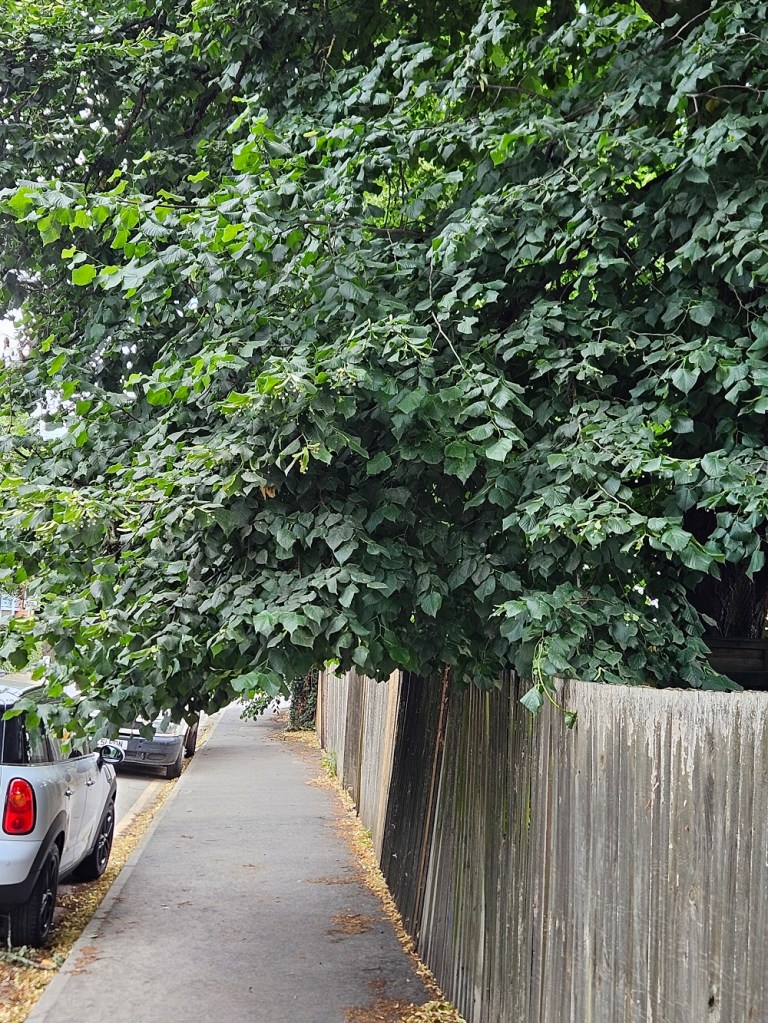
Low branches over pavements, Should I bob or step out in the road ? Who leaves wych-elms any which-how, Never pruned, and deeply downward-bowed ? Though less likely misbehaving, More likely negligence at fault. I ought to hack them off right now, But more than like I get done for assault.
Double-deckers punch right through, But my head has to duck beneath each stalk. It’s worse when it’s been raining, And I get a hairwash thrown into my walk. But appletrees, and conkers too, Are lack-of-headroom serial abusers – Lurking, swelling, for each braining – As the Autumn comes, so come the bruises.
Once, all this was fields, Before the semis and the lawns – But their ghost still haunts the verges Where the stinging nettle spawns, The brambles form a makeshift hedge, The foxes keep the rabbits clear, And the accidental barley waits For the fresh suburban beer.
Once, all this was pasture, Till the Guinea pigs replaced the sheep – Yet deer still nibble round the edge, And moles have penetrated deep. The thistles form a pop-up wood, The owls invade the lean-to shed, And the reawakened barley waits For the local deli’s bread.
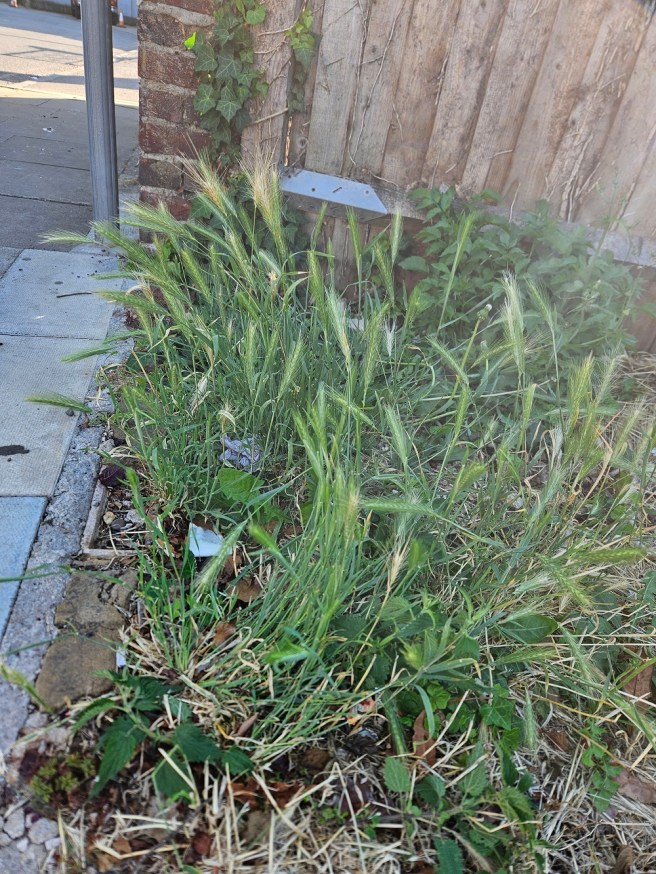
This straggly mess looks more like the cultivated variety’s disreputable cousin, Wall Barley. But even this is now being used as a food, and what can be more artisanal than that ?
Double roses are showy but barren, Turning stamens into yet more petals, Living the bachelor life. Even if they still make pollen, Bees can’t push through all those petals, Leaving them with no midwife. Yet these are the roses in bouquets, To symbolise our multilayered love Of loud and overdressed grooms. But dog roses are where bees graze – They’re wide-open with stamens full of love And hips full of future blooms.
Two-toned, long nosed, petals conjoined. Such pretty flowers, so rarely seen – So full of danger, so full of class, Yet snipped-off to plump-up the tubers, alas. Was that how these had been purloined ? Too toxic to keep in a garden that’s clean ? Yet someone had kept them, and set them in glass As they gingerly lowered them into a vase.
There’s something illicit in bolted blooms, In the flowers we’re not meant to see – The propellers of rocket, the lilac of chive, The pom-poms of garlic, the lettuce alive. Gardeners always link flowers with doom, Or as a time-waster, delaying the pea – But hold back the harvest, and unwheel the barrow For the scarlet of runners and saffron of marrow.
I don’t know why the alkanet Is only served by bumblebees, But ev’ry time I see a patch, Then bumbles are their only catch. Their flowers are so dainty, yet, The smaller sort don’t visit these – Perhaps their pollen is too heavy For the lighter bees to ferry ? The plants spring up in shady wet, Against the walls, beneath the trees – Perhaps this also says the best Where bumbles like to build their nest ? I hear such bugs are under threat But here they gather as they please – Where beefy bees are bumbling by, To drink the deep blue blossoms dry.
I saw the plant through the window of the meeting room A bedraggled thing – Clearly wilted, but not yet quite in the waterless tomb – Determined to cling. But every time I passed, the space was fulfilling its mission, Hosting a crowd – I hadn’t a hope of providing the patient a little nutrition, Or sparing the shroud. Not unless I fancied hearing of paradigm shifts And stakeholder rights, Or talking shop about new regulations and faulty lifts Between doughnut bites. Until, at last, while walking by on my way to the train, And a forlorn glance – The lights were out, but the hallway fluorescents leaked through the pane… I took my chance. I had just a drop in my water bottle, to break the drought With barely a stream – But I saw some dregs in the coffee cups that were strewn about And a pot of cream. And a leak in the corner of the room had collected on the window sill – And that was its lot. Then I never found that room so empty again, till a fire drill Gave me a shot. The rest of the time, I’d pass the window and flick my eyes, To check its state, But through endless workshops preaching the need to synergise, It didn’t look great. Yet when I finally proffered my notice, on my very last day, I was glad to see, That that poor and bedraggled little bit of green in amongst the grey Was outlasting me.
Street trees, lining suburban streets From Wandsworth to Walthamstow. Planes, of course, and sycamores, Wherever the middle-class grow. Full of rustles, full of tweets, From Hackney to Acton Town, To shade the cars and the corner stores Till the council trim them down.
Street trees, lining suburban streets From Kidbrooke to Cricklewood With tear-off strips and missing cats In a vertical neighbourhood. Full of squirrels and parakeets From Hampton to Harringay Then shed their leaves on the garden flats Till the council sweep them away.
The tallest, broadest sycamore in Dorset Is a stately tree – Beloved by Lords and Parliament, A pillar of society – He’s tended by The National Trust, As English as can be, In a village with a funny name, And a bloody history.
Yet sycamores are not a native, Bringing European fruits To challenge all the local trees With non-conforming shoots. These upstarts will not know their place, Their seeds are new recruits, And down into the bedrock They have planted creeping roots.
Yet, for all their canopy may shield, And union hold fast, They do not live so long, these trees, Their shelter cannot last. And though the status quo may praise, When safely in the past, They’ll gladly chop his children down And root him out at last.
‘Sycamore‘ is a restless word. It appears to have started life in Hebrew, before the Greeks noticed how much it coincidentally sounded like their words for fig-mulberry. From there it made its way via Latin and French to English, where it was applied to a newly-introduced species of European maple tree. Confusingly, the contemporeous authors of the King James Bible used it several times to refer to the original fig tree. And then the Americans took the word and slapped it on a type of plane tree quite unrelated to either (although in their partial defence, the leaves of the plane do look a very maple-like, as even Carl Linneus noted in his name Acer pseudoplatanus). The one thing the three trees seem to have in common is their shade-giving spread.
Meanwhile, it is also a surname – apparently deriving from the village of Siglemere near Bramford in Suffolk, from *sīcel ‘small stream’ + mere ‘pool’. So in seems that my eight-year old self was quite wrong to insist that they were called sycamores because their seed-cases were shaped like sickles…