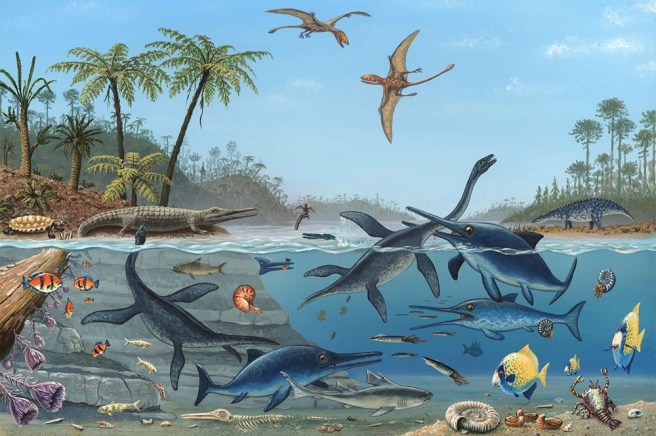
Duria Antiquior (Ancient Dorset) by Henry De la Beche, coloured and updated by Richard Bizley
Book-Nosed Lukas
Pterosaurs weren’t dinosaurs – And so says Lukas, keen to crow. You know what, Lukas ? We already know. And neither were the mosasaurs, And ichthy’saurs and ples’osaurs, Dimetridon or sarchosuchus – Come on, Lukas, don’t harp on so.
Sometimes, Lukas, we’ll play ball, Cos evolution’s cool and all – But we also need a name instead To call all things this scaly, big, and dead. We need a widely-reckoned file, A catch-all term, a handy pile – But one that leaves out bird and crocodile.
With chapter, verse, and nomenclature ? Don’t be such a whiny bore, By giving us a minus score In your self-waging, name-defining war – Lumbering and out-of-date, We’ve got your number, Lukas, mate – You’re such a dinosaur !
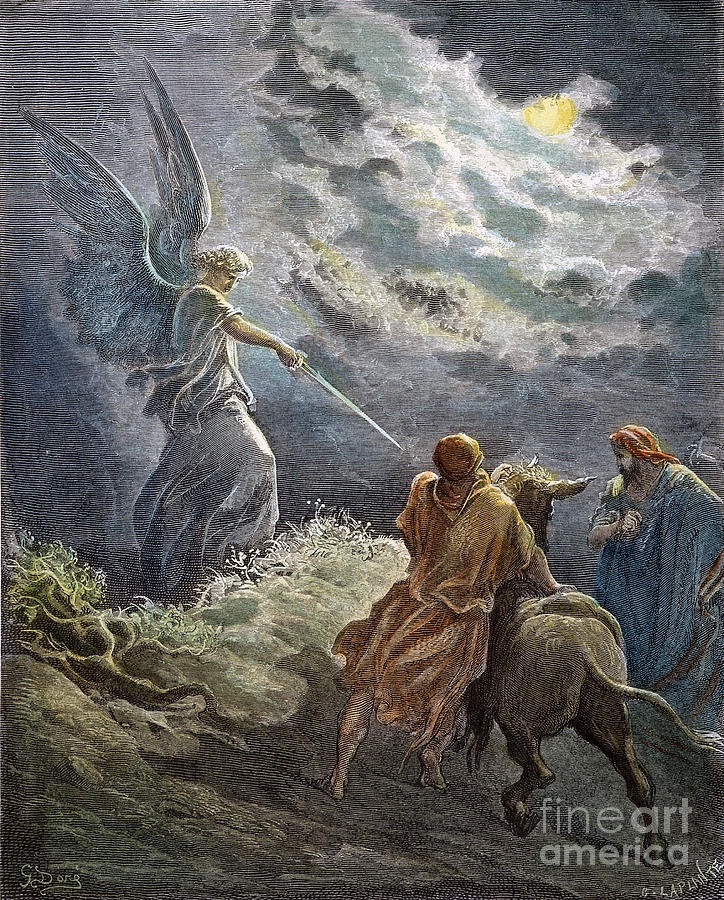
The Fundamentalists, they have it easy, Claiming ev’ry King James word is true. Of course the donkey spoke, if a little wheezy – When God’s at hand, then that’s what donkey’s do.
But here in the good old C of E, We never talk of the talking ass – Like Balaam, we simply do not see, And think the verse is lacking class.
Deep down, we know, you see – we know no donkey Has the necessary lips, nor tongue, nor throat – A quaint little fairytale, but quite the wrong key For Sunday mornings – so not something we quote.
Now we’ve no problems with Holy Week And the Resurrection – we’re all onboard – But we just cannot accept that an ass can speak, Not even for the Lord.
All the Summer, she shelters in her studio, Under the North-sent light, As she’s painting a curlew, a bird of the Winter, That, like her, flees when the Sun gets bright. She starts in April, starts from the tail-quills, Nothing but browns and creams – Slowly works forwards as evenings grow later, Until she can hear its call in her dreams.
At five-times life-size, her bird is a monster, A beautiful giant of the fens – With every barb of every feather, More real than in any photographer’s lens. So unlike the shy things they are, them and her, Avoiding the seaside crowds – They to their moorland, her to her studio, Waiting for the safety of the huddle’ing clouds.
By the late of May, she’s mottling the wing, By June, she’s glinting the eye By the height of July, she starts on the beak, As the burning Sun is stoking-up the sky. Inch-by-centimetre, longer and still longer, Polished to perfection as she goes, Longer than a godwit, longer than an avocet – This beak is magnificent, and still its black arc grows !
All through August, she’s stretching it out With the windows wide-open from dawn, Bringing-in the songs of the blackbird and the goldfinch – But the curlew cannot sing until its bill is fully-drawn. Till finally, finally, it tapers to infinity, Just as the September cools the air. She locks up her studio and heads out to the marshes, As the North-sent breezes blow the cobwebs from her hair.
This poem was inspired (but is not directly about) this painting by a friend, Anna Clare Lees-Buckley. She specialises in birds, but unlike the subject she doesn’t master in reclusivity.
These days, I let me wrists go naked, Unencumbered by the time – Shaking loose the shackles of knowing Of just how fast the seconds are going. I no more have to stress if I’ll make it, I no more have to hear it chime.
There are dozens of other clocks to choose On walls and screens and towers – So why must I also carry it round, And see that it’s hands are tightly wound ?, When we spend our lives in constant news, Surrounded by the hours.
The onions always made you cry, In ev’ry fry-up, soup, and pie – But that’s what onions do, I guess, They leave all chefs in such a mess. And so you had to drop them out From roasted duck and sauteed trout – You didn’t trust, as master cook, They way they always made you look.
Instead, you turned to garlic, And gazed beyond shallots and springs – Your eyes no longer marked by onion rings. You tossed the cloves in thick, Undaunted by my teasing quips – “Is this to stop me kissing other lips ?” Until, at once, you were gone – You said it was to breathe fresh air, To peel back the layers of life and see what’s there. And yet, you linger on – It’s been three days and a dozen beers, Yet still I taste your garlic in my tears.
A T-Rex guarded the first hole, As we played a round by the beach – Over the hump and round the bend With a club and a scorecard each. Fibreglass limestone hemmed the links With fossil ammonites – While bubbling streams built future cliffs As they laid down chalky whites. Triceratops was present, of course, And cute troodontids too – We admired their feathers as we let Another pair play-on through. The rough was an abandoned nest – The eggs gave a tricky lie. A pterosaur looked-on unimpressed, As my ball refused to fly. The sauropod was a juvenile, The size of a family car, And anchylosaurus raised her club As I came in over par. But the twelfth showed the first sign of trouble, With a draught through the plastic swamp To shake the early magnolias, As I teed-off with a whomp. The fifteenth had a river of lava Splitting the fairway in half – A pachycephy furrowed his dome, As I took a photograph. The seventeenth was watched by several shrews, To no concern. They looked-on patiently as we played, Content to wait their turn. And then, crowning the final hole, Was a crater upon the green – Only a metre across, but still, Here comes the Paleogene… As we finished our round at the end of the world, It felt like the nick of time – Then back to the seagulls along the Prom, And an ice-age ninety-nine.
Vasily and Stanislav, Though really their names don’t matter to us, And how many others we’ll never hear of – Remember their actions, but don’t make a fuss. No statues raised, and that’s how it should be, They aren’t special, they’re just good men Who held their nerve and held their breath Until it was safe to breathe agen. They did their jobs, and did them well, And gently reinserted the pin. They passed the test and lived to tell, And took their reprimands on the chin.
Cowes, atop the Isle of Wight – East and West, though much the same – Victorian and seaside-y, With boats and seagulls running free. And not a single cow in sight – No running of the bulls – for shame ! No fording droves between the piers, No cowboys showing off their steers. And don’t come here in Cowes Week, right ! It doesn’t live up to its fame ! It’s not the time when bullocks battle, Not a trace of rutting cattle. Why then whet our appetite, To wastes its strange and lively name ? There are no bovine sacrifices, Just cream teas at tourist prices.
I know, I know, despite a spine of rolling chalk downs through the Island, Cowes itself sits atop clay…
Jenny von Westphalen & Jenny Lind (both born Johanna). Presumably their J’s were soft.
Next-Jen
Women have answered to ‘Jenny’ far longer than ‘Jennifer’, Whether they’re maidens or maids – A pet form of Janet, Joanna, or even of wrens, She’s really a jack-of-all-trades. Old English had a few Jinifers, sure, But those weren’t Guiniveres, those were Junipers – Then, from nowhere, Jennifer came – From Cornwall, and from a parallel universe.
As the Twentieth Century progressed, The Jennies were pressed into service And switched their allegiance to Jennifer only, And rode her success to over-abundance – Then into the downward curve of redundancy, No longer heroines, neighbours, or queens – But surely we’ll always remember the Jennies, As donkeys, or greenteeth, or spinning machines.
I’ve discussed the unexpected rise of Jennifer over here.
The English tongue is a toolkit To unlock those very English sounds In a well-oiled perfect fit. The Scots and Welsh have tongues that sit At a slightly diff’rent angle each So’s not to mangle all those subtle bits of brogue That abound within their speech. Americans are yet more rogue, Dismissing our metric metre For their own iambic feet and inches – They prefer their rhotic burr to ring, With a tongue that sounds the sweeter And a throat that swells and pinches Fine enough to let it sing. But none of we Anglophones are great At sounding French, or Japanese – We haven’t the tools we need for these. And that’s okay – we still can try, And even if we’re second-rate, There’s no need to be shy. The thing is, no two individual tongues Are contoured quite the same They vary how they’re ribbed and strung, And where they set their aim. So if we were to slur your foreign name next time we call, It’s just because our tongues are curled the other way, that’s all.